


A Strategic Guide for Silicone Product Buyers
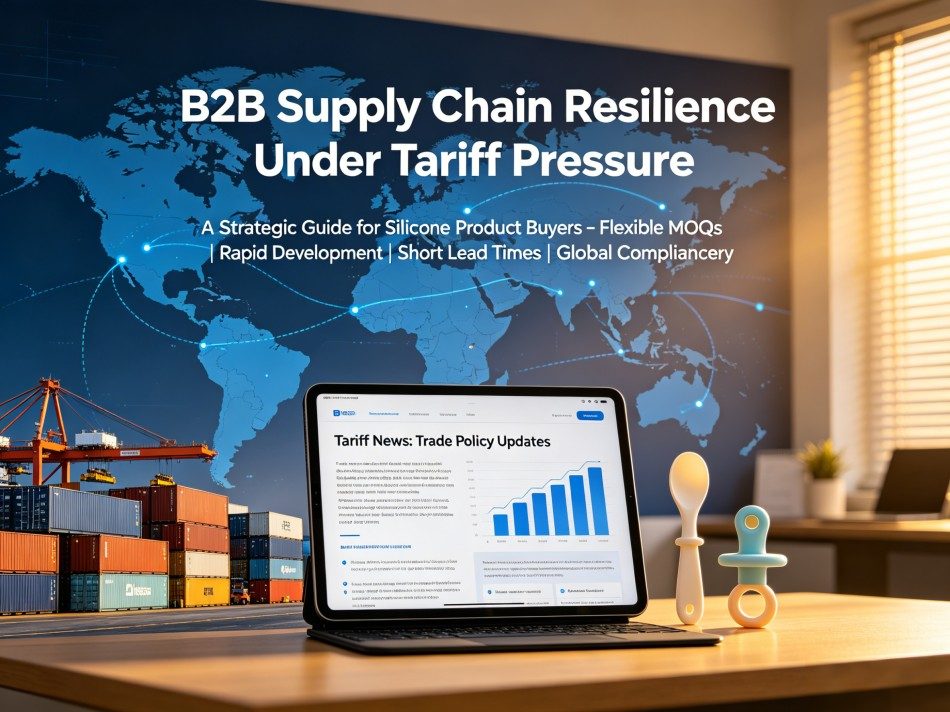
How flexible MOQs, rapid development, short lead times, global compliance, digital transformation, and green manufacturing are reshaping the industry — Updated with 2025-2026 trade policy developments.
Introduction: A New Era of Trade Uncertainty
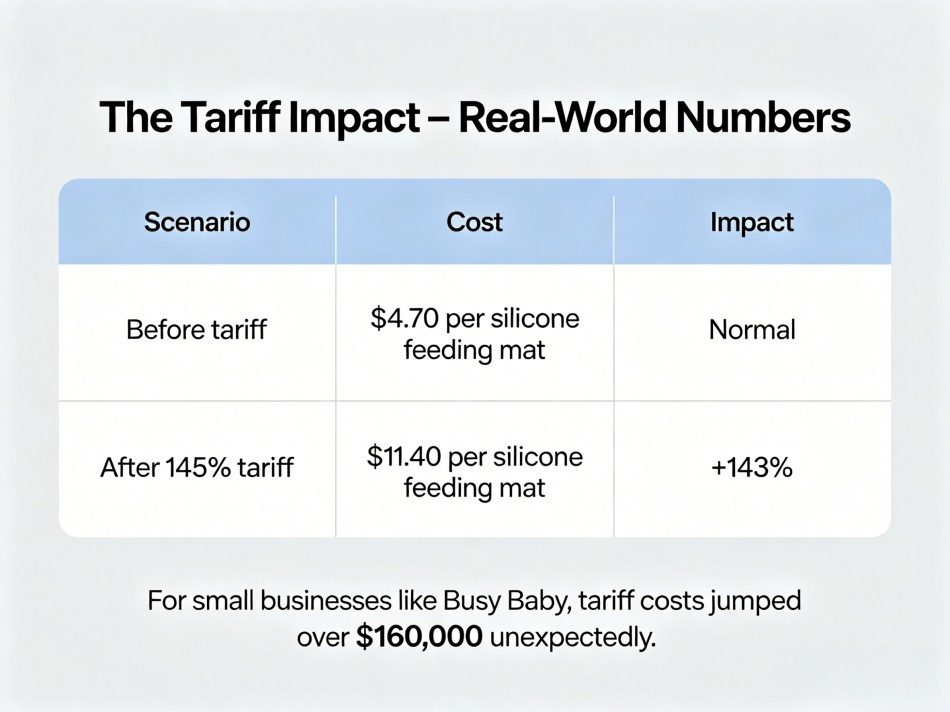
The global trade landscape has shifted dramatically. In 2025, the United States imposed tariffs as high as 145% on certain Chinese-origin goods, including many baby products. For the baby products sector, an estimated 90% of core baby care products and components are manufactured in Asia, with the vast majority coming from China.
The impact is already visible. Munchkin Inc., a major baby product brand, halted orders from China and instituted a hiring freeze, warning that some products would be sold out within three months. Busy Baby, a small business specializing in silicone feeding products, faced over $160,000 in unexpected tariff costs, with founder Beth Benike stating, “I have no idea how to come up with this money in such a short time”.
Yet within this disruption lies opportunity.
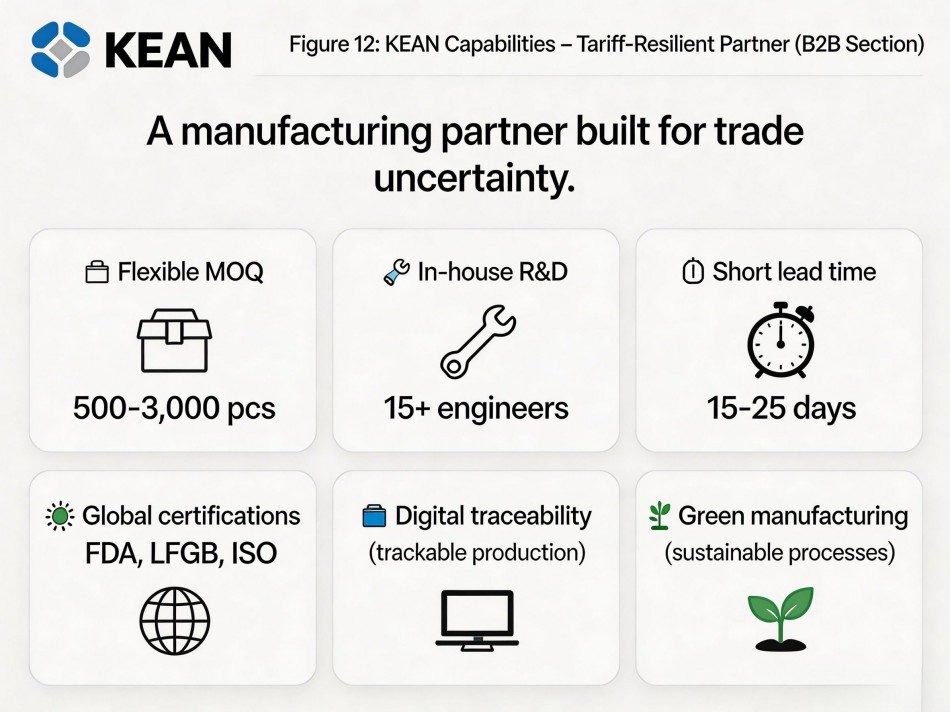
B2B buyers are shifting from traditional bulk-purchase models toward agile, responsive supply chain strategies. This guide explores six core capabilities that silicone product manufacturers must offer to help B2B clients thrive under tariff pressure — and how to evaluate potential partners against these criteria.
Latest Development (June 2025): A bipartisan group of U.S. lawmakers, led by Senator Kirsten Gillibrand and Congresswoman Ayanna Pressley, has formally requested the Treasury Department to exempt essential baby products (car seats, strollers, cribs, highchairs, and feeding products) from the 145% tariffs. The request cites that “the health and safety of infants should not be collateral damage in trade policy.” As of late June 2025, no formal exemptions have been announced, but the political momentum is growing.
Flexible MOQ – Small Batches, Mixed Colors, Lower Risk
Why Flexibility Matters Now
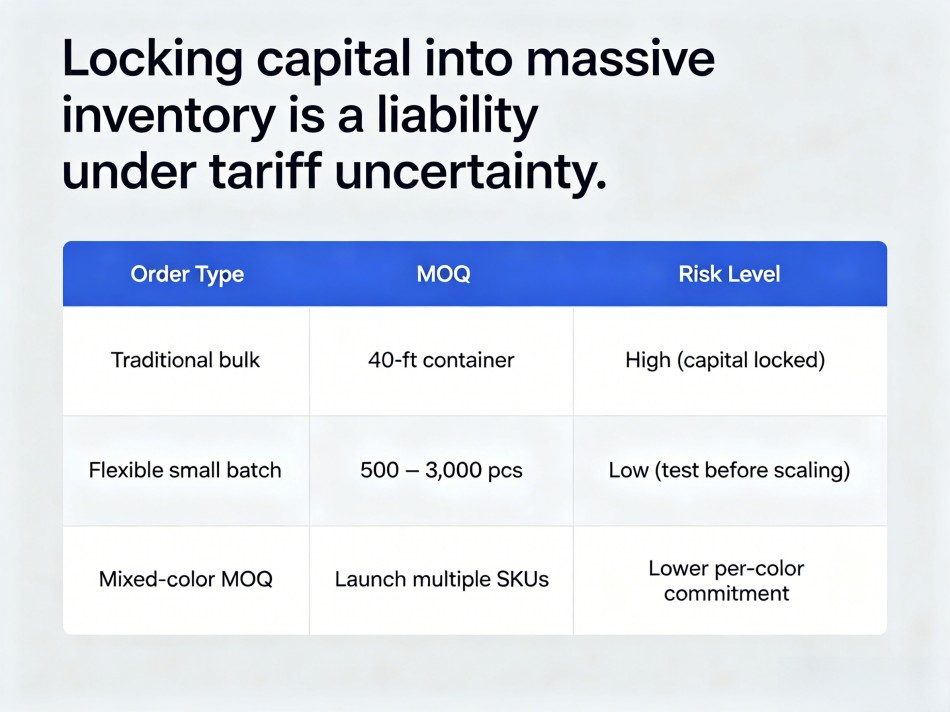
Traditional B2B sourcing meant filling a 40-foot container twice a year. That model worked when trade was predictable. Today, with tariffs that can shift overnight, locking capital into massive inventory is a liability.
According to DCL Corporation’s 2025 supply chain analysis, “brands are increasingly moving toward frequent, smaller shipments that align more closely with actual demand. This model reduces lead times, improves cash flow, minimizes tariff impacts, and enables them to react to market changes without being burdened by excess inventory”.
The same report notes that “the shift toward smaller, just-in-time shipments is one such strategy. Instead of importing entire container loads and risking high tariff bills on unsold inventory, companies are increasingly embracing tariff deferment models – where duties are only paid once a product is sold”.
What to Look for in a Manufacturer
Capability | Why It Matters Under Tariffs |
Low MOQ (e.g., 500–3,000 pcs) | Test new markets without risking large tariff payments on unsold inventory |
Mixed-color MOQ | Launch multiple SKUs simultaneously with lower per-color commitment |
Neutral packaging option | Start selling immediately while developing custom packaging |
Order combining | Mix different products in one shipment to spread fixed costs |
Real-World Impact
Beth Benike, owner of Busy Baby, saw her landed cost per silicone feeding mat rise from $4.70 to $11.40 after the 145% tariff was imposed. With a warehouse full of 23,000 finished units, she could not sell them because the retail price would “scare away 98% of consumers”. A flexible MOQ model — allowing smaller, test-market quantities — would have reduced her exposure.
Red Flag: A manufacturer that requires container-minimum orders and refuses small-batch trials is not equipped for the current trade environment.
Mature R&D & Design Capabilities – From Idea to Sample, Fast
The Speed Imperative
Zara disrupted fashion by reducing design-to-delivery time to as little as five weeks. Today, B2B buyers expect the same agility. When tariffs are volatile, speed becomes a hedge — the faster you move from concept to market, the less exposure you have to trade policy changes.
The US Manufacturing Reality
Despite political rhetoric about “reshoring,” domestic silicone manufacturing faces structural limitations. According to Munchink CEO Steven Dunn, “There’s not enough tool makers and manufacturing expertise and automation and skilled labor in the U.S. to make the thousands of products the juvenile industry needs”. An Ohio bicycle shop owner discovered that under current tariffs, the screw cost for a single children’s bike exceeds the 2019 import price of the entire bike.
What Mature R&D Looks Like
Capability | What It Enables |
In-house engineering team | No waiting for external mold makers; faster iterations |
3D printing for prototyping | Validate form, fit, and function before steel is cut |
DFM (Design for Manufacturing) review | Catch design flaws before tooling – not after |
Patent support | Protect your brand’s unique designs |
Red Flag: A manufacturer that outsources mold design or has no engineering staff cannot deliver rapid development.
Short Lead Times – One-Stop Service & Strong Production Capacity
Why Lead Times Matter More Than Ever
With ocean freight delays and Red Sea disruptions, air freight has become cost-competitive. But air freight only helps if the product is ready. A manufacturer that takes 60 days for mold making forces you into slow ocean freight. One that delivers samples in 7–10 days and production in 15–25 days enables faster, more flexible shipping.
Industry Benchmark
According to supply chain experts, “companies that have implemented optimized logistics strategies have seen reductions in transportation costs by up to 10-15%”. Manufacturers with in house production can achieve sample delivery in 5–7 days (stock) or 7–10 days (custom) and mass production lead times of 15–25 days.
One-Stop Service Defined
A true one-stop manufacturer handles: mold design, material sourcing, production, finishing, assembly, packaging, and quality control — all in-house.
Red Flag: A manufacturer that subcontracts molding, printing, or assembly cannot guarantee short lead times.
Global Certifications & Compliance – Selling Anywhere, Without Surprises
The Compliance Challenge
Each market has its own safety standards. A product that passes FDA (US) may fail LFGB (Germany). A teether meeting EN71 (EU) may not satisfy GB 4806.11 (China).
Critical Certifications by Market
Market | Key Certifications |
United States | FDA 21 CFR 177.2600, CPSIA, ASTM F963, Prop 65 |
European Union | LFGB (Germany), EU 10/2011, EN71, CE, REACH, RoHS |
China | GB 4806.11, GB 4806.7, 3C |
International | ISO 9001, BSCI, Sedex, GMP |
China’s 2025 Tariff Adjustments
Notably, China has moved in the opposite direction on certain goods. Effective January 1, 2025, China implemented import tariff exemptions on infant formula (rate reduced from 15% to 0%), diapers (0%), and certain medical nutrition products. This divergence in trade policy creates opportunities for B2B buyers sourcing from China for domestic sales.
Red Flag: A manufacturer that claims “FDA compliant” but cannot provide a test report from an accredited lab (SGS, TÜV, Intertek, BV) is not truly certified.
Digital Transformation – Visibility, Traceability, and Efficiency
The Digital Imperative
Traditional B2B fulfillment has lagged behind B2C in technology adoption — disjointed systems leading to fragmented supply chains. That is changing. “Modern B2B logistics is embracing automation and integration, closing the decade-long gap between B2B and B2C,” according to industry analysts.
What Digital Transformation Looks Like
Technology | Application in Silicone Manufacturing |
Real-time production tracking | You know where your order is at any moment |
Automated quality reporting | Digital records of in-process and final inspections |
IoT-enabled equipment monitoring | Predictive maintenance prevents delays |
Blockchain for traceability | Tamper-proof records from raw material to finished good |
The Customs Clearance Challenge
The US Customs’ “Country of Origin Digital Verification System,” introduced in 2024, requires importers to provide factory surveillance footage from upstream suppliers. This has extended customs clearance times from an average of 3 days to 17 days. Digital systems that maintain comprehensive production records can dramatically reduce these delays.
Red Flag: A manufacturer that cannot provide production photos, tracking updates, or digital quality reports.
Green & Energy-Efficient Production – Sustainability as Supply Chain Strategy
Why Green Manufacturing Matters
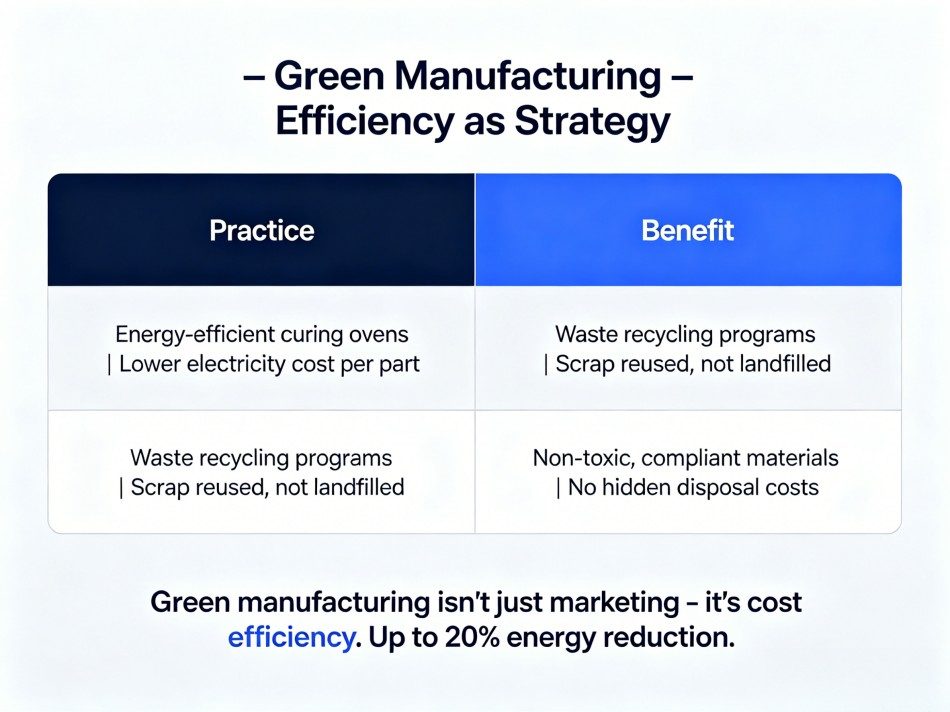
Sustainability is no longer just marketing — major retailers increasingly require environmental compliance. Under tariff pressure, green manufacturing serves another purpose: efficiency.
What Green Manufacturing Includes
Practice | Benefit |
Energy-efficient curing ovens | Lower electricity cost per part |
Waste recycling programs | Scrap silicone reused, not landfilled |
Non-toxic, compliant materials | No hidden costs for chemical disposal |
Industry Context
Research indicates that “by adopting eco friendly manufacturing practices… companies can significantly decrease their carbon footprint, with some leading manufacturers achieving up to a 20% reduction”.
For B2B buyers, partnering with a green manufacturer satisfies retailer sustainability audits and improves brand perception.
Red Flag: A manufacturer that cannot describe its environmental practices.
Logistics Support – Trade Terms, Shipping Options, and Platform Integration
The Logistics Landscape Under Tariffs
With tariffs increasing landed costs, optimizing logistics is essential.
Trade Terms: What You Need to Know
Term | Meaning | Best For |
EXW | Buyer picks up at factory | Experienced importers |
FOB | Seller delivers to port; buyer handles from there | Most common |
DAP | Seller delivers to named destination | Balance of responsibility |
DDP | Seller handles everything including duties | Most predictable landed cost |
Under tariff uncertainty, DDP is increasingly attractive because it provides a single, all-inclusive cost.
Logistics Network Requirements
Capability | Why It Matters |
Multiple carriers (DHL, FedEx, UPS) | Choose based on speed vs. cost |
Air freight (express and standard) | Speed for time-sensitive orders |
Ocean freight (FCL and LCL) | Cost-effective for larger orders |
Warehouse integration | Direct shipment to Amazon FBA |
Platform Warehouse Support
For Amazon sellers, direct shipping to Amazon FBA warehouses is critical. A manufacturer understanding FBA labeling, pallet requirements, and carrier compliance saves weeks of logistics coordination.
Red Flag: A manufacturer offering only one shipping method or unable to provide customs documentation.
After-Sales Support – Packaging, Warranty, and Dedicated Communication
Transport Packaging – More Important Than You Think
Requirement | Why It Matters |
Carton weight limits | Avoids extra handling fees |
Palletization standards | Required for LTL and FTL shipments |
Edge protection and strapping | Prevents carton collapse |
Labeling (shipping marks, country of origin) | Required for customs |
Warranty and Defect Handling
According to Ruiyang Silicone, “every silicone project has different use to meet, which is why we offer a variety of flexible warranty”.
Dedicated Communication
Ruiyang emphasizes “fast and personalized service” with “every request handled by a dedicated team, from quotation to delivery to door”. For B2B buyers, a single point of contact who knows your product, history, and requirements is invaluable.
Red Flag: No after-sales contact, no warranty policy, or a generic customer service email address.
The 2025 Baby Product Tariff Exemption Debate – What B2B Buyers Need to Know
Political Pressure for Exemptions
On May 7, 2025, Treasury Secretary Scott Bessent testified before the House Financial Services Committee that baby product tariff exemptions were “under consideration”. President Trump confirmed the same day that he would “take a look at it”.
Since then, multiple lawmakers have pushed for action:
Senator Kirsten Gillibrand (D-NY) wrote to USTR on May 8, 2025, noting that 98% of car seats and 97% of strollers are imported from China, and families cannot absorb this “baby tax”.
Congresswoman Ayanna Pressley led a June 25, 2025 letter with 21 other lawmakers urging the Treasury Secretary to “move swiftly to exempt essential infant and toddler products,” warning that baby product prices have increased by up to 30%.
State-Level Actions
Minnesota’s HF 18 bill, effective July 1, 2025, expands the state sales tax exemption for baby products to include car seats, strollers, cribs, highchairs, bottle sterilizers, and eating utensils.
What This Means for B2B Buyers
Scenario | Implication |
Exemptions granted | Immediate relief for baby feeding products; potential surge in demand |
No exemptions | Continued pressure to diversify sourcing and use agile supply chain strategies |
Partial exemptions | Need to track which product categories are covered |
Strategic Recommendation: Even if exemptions are granted, the underlying trend toward supply chain diversification is permanent. Maintain relationships with flexible manufacturers regardless of short-term policy changes.
Bringing It All Together – Evaluating Your Silicone Manufacturing Partner
Pre-Sourcing Checklist
Before contacting any manufacturer, clarify:
Target market(s) – determines required certifications
Estimated annual volume – influences MOQ negotiations
Product complexity – determines required R&D capability
Desired lead time – determines production capacity requirements
Shipping preference – determines logistics needs
Manufacturer Evaluation Scorecard (Tariff-Resilience Edition)
Criteria | Weight | What to Verify |
Flexible MOQ (under 1000 pcs) | 15% | Written MOQ policy; mixed-color options |
In-house R&D (no outsourcing) | 15% | Engineer headcount; patent portfolio |
Short lead time (under 30 days for production) | 15% | Past order timelines; capacity documentation |
Multi-market certifications | 15% | Current test reports, not just certificates |
Digital traceability | 10% | Real time tracking; digital QC reports |
Green manufacturing practices | 10% | Energy, waste, and compliance documentation |
DDP shipping capability | 10% | Experience with door-to-door delivery |
After-sales support structure | 10% | Dedicated contact; warranty terms |
Total | 100% |
Action: Below 70% – proceed with caution. Below 60% – look elsewhere.
Conclusion: Resilience Is Not Just Survival – It Is Competitive Advantage
Tariffs are not a temporary disruption. As Treasury Secretary Bessent’s May 2025 testimony and the ongoing congressional pressure demonstrate, the debate over baby product tariffs reflects a fundamental realignment of global trade. The six capabilities outlined — flexible MOQ, mature R&D, short lead times, global certification, digital transformation, and green manufacturing — are the baseline for a resilient supply chain.
For B2B buyers, the question is not “which manufacturer has the lowest price?” It is “which manufacturer can help me manage risk, adapt quickly, and protect my margins when trade conditions change?”
Choose a partner who invests in these capabilities.
Ready to add KEAN Silicone to your partner line?
Request a sample, download spec sheet, or contact our wholesale team today.
Contact Wholesale Team →


