


Silicone vs TPE for Baby Products: Which Material Is Better?
A B2B Guide to Material Selection, Performance, Processing, Cost, and Application Fit
When developing baby products, choosing between silicone and thermoplastic elastomers (TPE) is rarely a simple question of which material is “better.” Both materials can provide softness, flexibility, elasticity, and attractive tactile properties, but they behave differently during molding, under heat, in contact with chemicals, and throughout the product lifecycle.
For brands and sourcing teams, the more useful question is: Which material is better suited to the product's intended use, performance requirements, manufacturing process, regulatory market, and target price?
The right choice therefore depends less on the material's name and more on what the finished baby product needs to do.
Basic Properties of Silicone and TPE
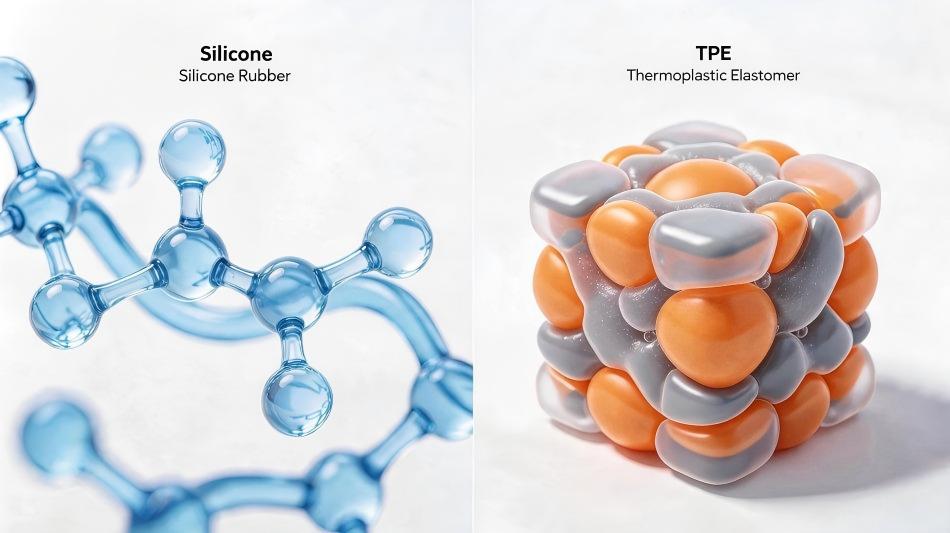
Silicone and TPE are both flexible elastomeric materials, but their molecular structures and manufacturing behavior are fundamentally different.
Silicone rubber is an elastomer based on a silicon-oxygen backbone. For baby-care applications, liquid silicone rubber (LSR) is particularly important because it can be precisely injection molded into soft, flexible components. LSR is a two-component material that cures into a crosslinked elastomer rather than behaving like a conventional thermoplastic after molding. Manufacturers can formulate silicone grades for different hardness levels, transparency, tear strength, and application requirements.
TPE, by contrast, combines rubber-like elasticity with thermoplastic processing characteristics. Its soft and hard phases provide elasticity while allowing the material to be processed using techniques such as injection molding and extrusion. Different TPE families—including TPS, TPO, TPC and other specialized formulations—can have substantially different performance characteristics.
This distinction is important for B2B buyers because “TPE” is not a single material specification. A TPE designed for a soft grip product may have very different heat resistance, chemical resistance, hardness, or food-contact suitability from another TPE formulation.
The same principle applies to silicone. A generic statement such as “silicone is food grade” is not sufficient for a commercial product specification. The selected grade, formulation, manufacturing process, finished article, intended food-contact conditions, and applicable market requirements all need to be considered.
For baby products, the material decision should therefore start with the finished-product requirements, not simply with a preference for silicone or TPE.
Transparency and Optical Performance
Transparency can be an important design factor for baby products, particularly for products where parents need to see the contents, internal structure, or cleanliness of the product.
TPE can also be produced in transparent or translucent grades, but optical performance depends strongly on the specific polymer family, formulation, additives, processing conditions, wall thickness, and surface finish.
For designers, the practical difference is that material transparency should be evaluated at the finished-part level, rather than assuming that every silicone or every TPE will have the same visual appearance.
For example:
Requirement | Silicone | TPE |
Transparent appearance | Excellent with suitable grades | Possible with suitable grades |
Translucent colors | Excellent | Excellent |
Soft-touch appearance | Excellent | Excellent |
Color customization | Excellent | Excellent |
Optical consistency | Highly dependent on formulation and molding | Highly dependent on grade and processing |
For baby products, transparency is usually not the deciding factor by itself. It becomes more important when combined with requirements such as softness, heat resistance, sterilization, chemical exposure, and long-term appearance.
Temperature Resistance
Temperature performance is one of the clearest areas where silicone often has an advantage over many general-purpose TPE grades.
Silicone elastomers can maintain useful mechanical performance across a relatively wide temperature range. For example, WACKER lists a temperature range of approximately -55°C to +210°C for selected ELASTOSIL LSR grades, although actual operating limits depend on the specific formulation and application.
TPE performance is much more grade-dependent. Some TPEs are optimized for low-temperature flexibility, while other specialty TPE families can offer substantially higher temperature resistance. For example, Celanese describes different TPE families ranging from low-temperature flexible grades to TPC grades with broader temperature capability.
This creates an important sourcing distinction:
Silicone generally provides a wider temperature-performance window for many baby-care applications, while TPE performance needs to be evaluated grade by grade.
This matters particularly for:
Baby bottle nipples
Feeding utensils
Bowls and plates
Teethers
Products exposed to hot water
Reusable products requiring repeated washing
Components exposed to steam sterilization
However, buyers should not simply specify a maximum temperature such as “200°C” and assume that the product is automatically suitable for that condition. The finished product, geometry, exposure time, cleaning method, and repeated-use cycle all need to be considered.
Chemical and Environmental Resistance
Baby products can encounter water, milk, formula, food oils, detergents, saliva, cleaning agents, and temperature fluctuations throughout their service life.
Therefore, it is inaccurate to say simply:
Silicone is chemically resistant, while TPE is not.
The more accurate B2B approach is:
Silicone generally provides strong environmental stability, while TPE chemical resistance must be evaluated against the specific formulation and exposure conditions.
For a baby product, the relevant question is not merely whether a material resists “chemicals.” Buyers should identify the actual exposure conditions:
Milk/formula → food oils → saliva → detergent → hot water → repeated washing → drying → UV exposure, if applicable.
The manufacturer should then verify the material and finished product against those conditions.
Processing and Design Flexibility
This is where TPE can become particularly attractive for manufacturers.
Because TPE behaves as a thermoplastic during processing, it can generally be processed using conventional thermoplastic manufacturing technologies such as injection molding, extrusion, thermoforming, and related processes.
This can make TPE attractive for:
High-volume injection molding
Complex multi-material structures
Overmolding
Fast production cycles
Color-rich designs
Components combining hard and soft plastics
Silicone, particularly LSR, follows a different molding process. LSR is typically metered, mixed, injected, and heat-cured inside the mold. Modern LSR systems can support highly automated, high-volume production and can also be formulated for adhesion to selected substrates.
Silicone's processing characteristics can be especially valuable when the product requires:
Very soft tactile performance
Flexible thin sections
High elasticity
Repeated compression
High temperature resistance
Soft components for direct contact with babies
From a design perspective, neither material automatically wins.
Instead:
Choose TPE when thermoplastic processing, rapid molding, hard-soft integration, or specific structural requirements are dominant.
Choose silicone when long-term flexibility, heat resistance, soft tactile performance, and repeated-use durability are more important.
Cost and Service Life
Material price alone does not determine which option is more economical.
TPE can offer attractive economics because it can be processed using conventional thermoplastic injection-molding equipment and, depending on the grade and application, can support efficient high-volume manufacturing. Some TPE systems can also be recycled or reprocessed within appropriate manufacturing constraints.
Silicone may involve higher material and tooling costs in some applications, but this should be evaluated against its expected service life and performance.
For example, a silicone baby product may justify its cost if it needs to withstand:
Repeated washing
High-temperature exposure
Frequent sterilization
Repeated compression
Long-term flexibility
Frequent consumer handling
The better purchasing metric is therefore not simply:
Cost per kilogram
but:
Total cost of ownership = material + tooling + processing + scrap + testing + packaging + expected service life + replacement frequency.
This is particularly important for B2B brands. A material that is initially cheaper but requires more frequent replacement may not actually provide the lowest cost at the product-lifecycle level.
How to Choose for Different Baby Product Applications
There is no universal winner. The application should determine the material.
Baby Product | Silicone | TPE | Typical Consideration |
Baby bottle nipple | Strong choice | Possible | Softness, elasticity, heat resistance, food-contact requirements |
Teether | Strong choice | Possible | Softness, tear resistance, tactile feel, repeated cleaning |
Baby spoon | Strong choice | Possible | Softness, temperature resistance, food contact |
Baby plate/bowl | Strong choice | Possible | Heat resistance, flexibility, cleaning |
Bib | Strong choice | Possible | Softness, flexibility, cleanability |
Soft-touch grip | Excellent | Excellent | TPE may offer processing advantages |
Hard-soft overmolded product | Excellent | Excellent | Depends on substrate compatibility and bonding process |
High-volume thermoplastic design | Possible | Strong choice | Processing efficiency |
Product requiring frequent high-temperature exposure | Strong choice | Grade dependent | Verify actual service conditions |
Highly flexible reusable product | Strong choice | Good | Silicone often offers strong long-term elasticity |
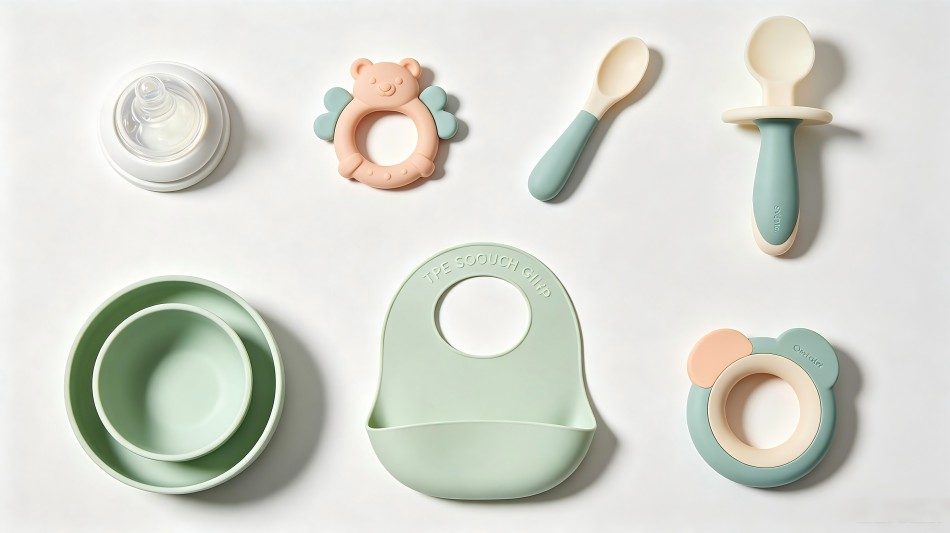
For feeding products, teethers, nipples, and reusable baby-care products, silicone is often a strong candidate because its combination of flexibility, heat resistance, durability, and available food-contact grades aligns well with these requirements. Dow, for example, specifically identifies silicone elastomers for infant-care applications such as sippy cups, teething rings, and bottle nipples.
TPE becomes particularly interesting when the product architecture benefits from thermoplastic processing, hard-soft integration, high-volume production, or specific mechanical characteristics.
The most important point for procurement teams is that the material should be selected at the grade level, not just the family level.
A sourcing request such as:
“Please quote this product in TPE.”
is incomplete.
A stronger RFQ would specify:
Target hardness
Required temperature range
Food-contact application
Cleaning/sterilization conditions
Required transparency
Color requirements
Tear and tensile requirements
Compression or flexing requirements
Applicable market regulations
Expected annual volume
Target service life
Substrate and bonding requirements, if overmolding is involved
This gives the manufacturer enough information to recommend an appropriate material rather than simply selecting the cheapest available grade.
Conclusion: Silicone or TPE — Which Is Better?
The answer is neither material is universally better.
Silicone is often the stronger choice when a baby product requires high temperature resistance, long-term flexibility, soft tactile performance, repeated washing or sterilization, and stable performance over repeated use. It is particularly relevant to feeding and oral-contact products where material qualification and finished-product compliance are critical.
TPE can be the better choice when the product requires thermoplastic processing, efficient high-volume injection molding, complex hard-soft structures, specific mechanical performance, or a particular cost target. Its broad material family also gives designers considerable flexibility, although the selected grade must be evaluated carefully.
For B2B buyers, the most reliable decision-making framework is therefore:
Application → Performance → Regulatory requirements → Manufacturing process → Volume → Total cost → Service life
Rather than asking:
“Is silicone safer than TPE?”
the better question is:
“Which qualified material grade provides the required performance and regulatory suitability for this specific finished baby product?”
For a baby-product brand, the best material is ultimately the one that delivers the right combination of safety, performance, manufacturability, consistency, compliance, and lifecycle economics.
📌Technical Reference
FDA — Food Contact Substances — Food types and conditions of use for food-contact substances.
FDA — Food Contact SubstancesFDA — Food Packaging & Other Substances that Come in Contact with Food — Consumer information on food-contact materials.
FDA — Food Packaging & Other SubstancesFDA — Food Contact Substances for Infant Formula and Human Milk — Guidance on food-contact substances for infant feeding applications.
FDA — Food Contact Substances for Infant Formula and Human MilkEuropean Commission — Food Contact Materials — EU regulatory framework for food-contact materials.
European Commission — Food Contact MaterialsDow — Silicone Rubber / LSR — Technical information on liquid silicone rubber for infant-care and consumer applications.
Dow — Silicone Rubber / LSRDow — Infant Care Silicone Solutions — Silicone applications for infant-care products.
Dow — Infant Care Silicone SolutionsCelanese — Thermoplastic Elastomers — Technical information on TPE families and processing characteristics.
Celanese — Thermoplastic ElastomersWACKER — ELASTOSIL LSR Technical Information — Technical data on liquid silicone rubber grades and temperature performance.
WACKER — ELASTOSIL LSR Technical Information


