


|
|
How Hollow Silicone Structures Can Create a New Teething Experience Without Adding More Components
A silicone teether can look deceptively simple.
There may be only one piece of silicone, a few rounded surfaces, and a shape designed to fit a baby's hand. Yet behind that simple appearance are several competing product-development requirements: the teether needs to be easy to hold, sufficiently flexible, comfortable to chew, durable under repeated deformation, easy to clean, and distinctive enough for a baby brand to sell in an increasingly crowded market.
For manufacturers and B2B buyers, this creates an important question:
If most silicone teethers are built around a solid silicone structure, can changing the internal structure create a meaningfully different product experience?
The answer is yes.
The development of air-chamber teethers introduces another design variable: instead of controlling the feel only through silicone hardness or surface texture, engineers can also use hollow internal geometry to control softness, compression and rebound.
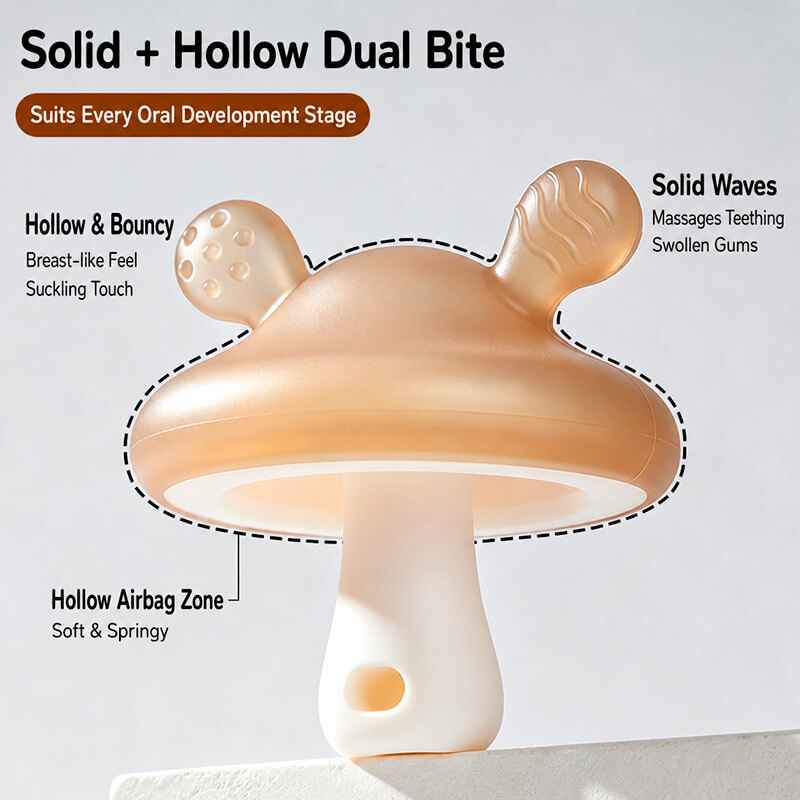
KEAN's TR109 Mushroom Rabbit Air Chamber Teether was developed around this principle. The product uses an approximately 80% air-chamber structure together with solid silicone areas, creating a combination of hollow, solid and resilient tactile zones within a lightweight one-piece design.
For brands looking for a more differentiated silicone teether, this structural approach may be more valuable than simply changing the shape.
|
|

The Problem With Making Every Teether Solid
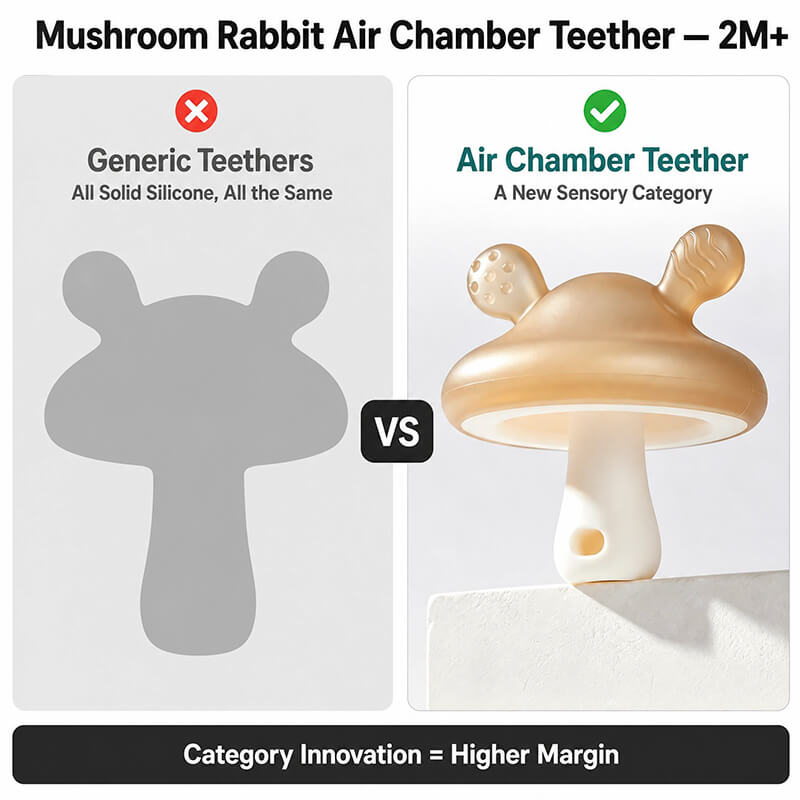
Many conventional silicone teethers are essentially solid molded forms.
The overall softness is then influenced mainly by factors such as silicone hardness, wall thickness, geometry and surface texture.
This approach is effective, but it also creates a limitation.
If the entire product is relatively solid, changing the tactile experience often requires changing the material formulation, hardness, thickness or external geometry.
That can make product differentiation increasingly dependent on appearance.
One brand creates an animal.
Another creates a fruit.
Another creates a ring.
Another creates a mushroom.
But underneath the visual differences, many products can still have a similar solid-silicone feel.
For a crowded baby-product category, this creates a product-development problem:
How can a brand create a genuinely different tactile experience without simply adding more parts or more decorative features?
An air-chamber structure offers one possible answer.
Air Chamber Design Changes the Structure, Not Just the Appearance
The key idea behind an air-chamber teether is simple:
The inside of the product becomes part of the user experience.
Instead of filling the entire molded body with solid silicone, selected areas are intentionally formed as hollow chambers.
When those areas are pressed, they can deform differently from solid sections.
The result is not simply “softer silicone.”
It is a different structural response.
A solid silicone section provides relatively direct resistance.
A hollow section can compress more readily and provide a softer, spring-like response.
When these two structures are combined in one product, the baby can encounter different levels of resistance while holding, pressing and chewing different areas.
That is the core design logic behind the TR109.
Its mushroom cap incorporates a hollow air-chamber structure, while other areas remain solid or textured. The product specification describes this as a combination of air chamber and solid silicone zones.
The Difference Is Structural
Solid silicone
Direct resistance → firmer tactile feedback
Hollow air chamber
Compressible structure → softer, springier response
Mixed structure
Different resistance zones → more varied tactile experience
This is why the term air-chamber teether is more meaningful than simply calling the product a “soft teether.”
The softness comes partly from geometry, not only from the material.
Why the Air-Chamber Ratio Matters
The most important design decision is not simply whether a product is hollow.
It is how much of the product should be hollow and where the hollow structure should be located.
According to the TR109 product-development information, approximately 80% of the product uses the air-cushion structure.
That creates a fundamentally different product architecture from a conventional solid teether.
But the remaining solid areas are equally important.
If everything were hollow, the product could lose the contrast that makes the design interesting.
The combination of hollow and solid regions creates the differentiated tactile experience.
This means the engineering objective is not:
“Make the product as soft as possible.”
Instead, it is:
“Create the right distribution of softness, compression and structural support.”
This is a much more useful way to approach teether development.
Three Tactile Zones Instead of One
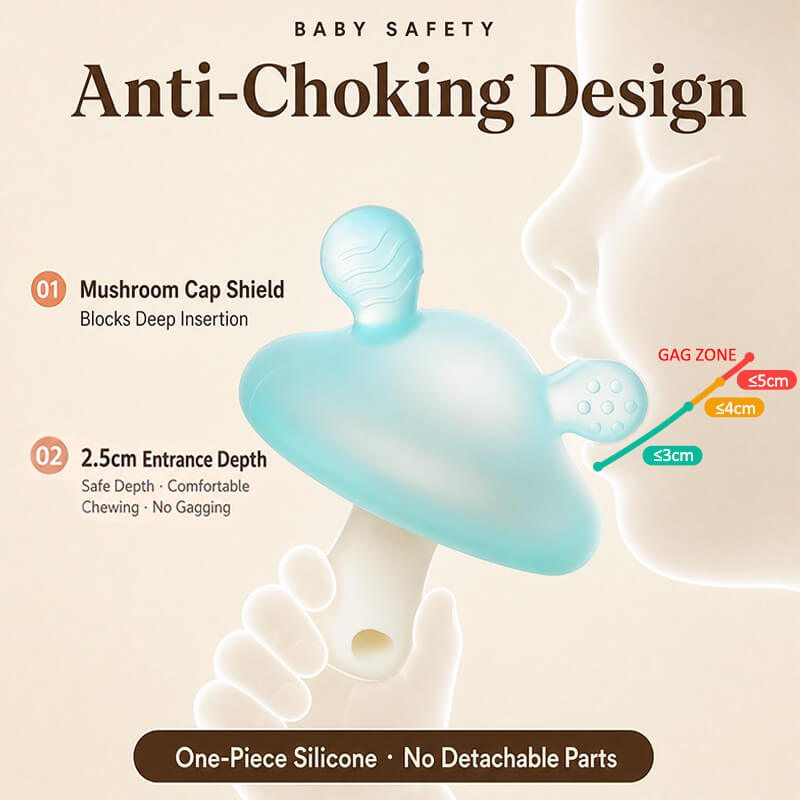
The TR109 takes the concept one step further by combining approximately three different structural sensations:
Air-Cushion Zone
The hollow section provides a soft, compressible and resilient feel.
Solid Silicone Zone
The solid section provides greater structural resistance.
Rabbit-Ear Zone
The two rabbit ears use different structural forms, including solid and hollow areas, creating another tactile contrast.
The product specification describes the design as providing solid, hollow and air-cushion tactile experiences.
For baby-product brands, this is an important distinction.
The product is not simply offering “more textures.”
It is offering different structural responses.
That creates a stronger product story because the differentiation is built into the physical architecture.
Air-Chamber Design Can Also Reduce Product Weight
Another benefit of hollow geometry is material efficiency.
A solid object naturally contains more material than a comparable hollow structure.
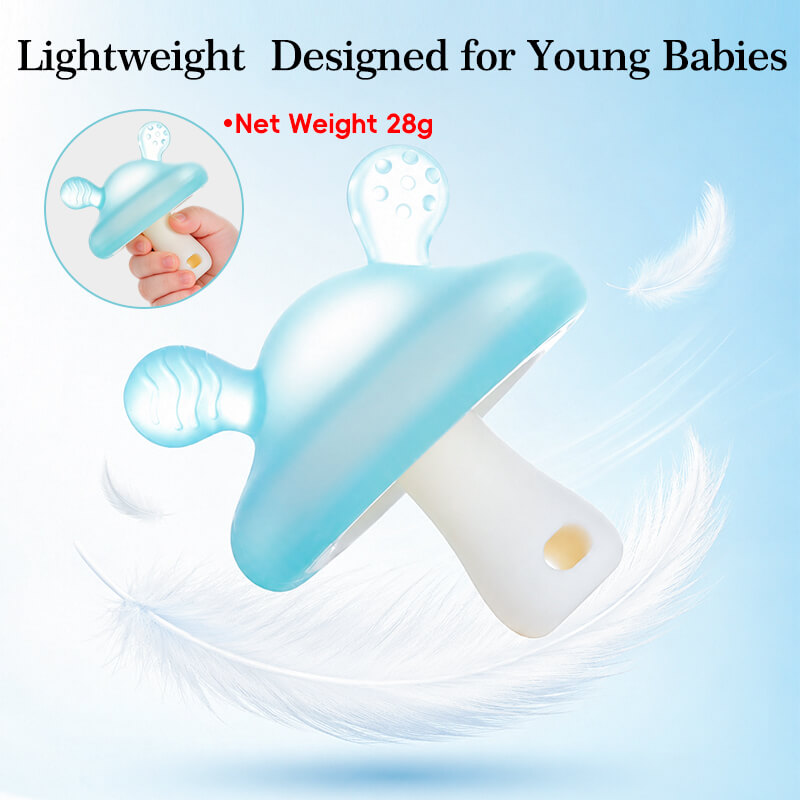
The TR109 weighs approximately 28 grams, with a compact size of around 60 × 64 mm.
The lightweight construction is particularly relevant for products intended for younger babies, because the product needs to be manageable for small hands.
This creates an interesting relationship between structure and ergonomics:
Less internal material → lower overall weight → easier handling
But the goal is not simply to remove material.
The hollow structure has to be positioned so that the product remains sufficiently stable and maintains its intended shape.
That is where air-chamber design becomes an engineering problem rather than a simple styling decision.
The Manufacturing Challenge: A Hollow Structure Must Still Be a One-Piece Product
Creating a hollow silicone teether is more complicated than creating a simple solid shape.
The mold needs to reproduce the external surface while also defining the internal cavity.
At the same time, the silicone needs to form a continuous product structure around the chamber.
This is where LSR one-piece molding becomes particularly important for this type of product.
The TR109 is specified as a food-grade silicone product manufactured using one-piece silicone molding, while KEAN's product-development materials identify liquid silicone rubber one-piece construction as a core manufacturing feature.
The objective is to achieve:
External geometry + internal cavity + continuous silicone structure
in a single integrated product.
That eliminates the need to manufacture a separate air pouch and attach it to the outside of the teether.
It also means the air chamber becomes part of the molded geometry itself.
Mold Engineering Is Where the Air-Chamber Concept Becomes Real
For a conventional solid teether, mold development already needs to consider parting lines, texture, wall thickness, grip areas, rounded edges, demolding and surface quality.
An internal hollow structure adds another layer of engineering.
The mold must define:
The outer product geometry
The internal air-chamber geometry
The transition between hollow and solid areas
The thickness of the silicone walls
The position of textured zones
The grip opening
The parting-line location
Venting and material-flow considerations
Demolding requirements
These elements cannot be designed independently.
For example, changing the wall thickness of the air chamber can affect how easily the area compresses.
Changing the shape of the chamber can alter the rebound response.
Moving the chamber closer to a textured surface can change how that surface behaves when pressed.
Therefore, air-chamber design should begin at the 3D engineering stage, not after the mold has already been opened.
General silicone-teether manufacturing guidance also emphasizes that mold design needs to consider wall thickness, undercuts, grip areas, texture, parting lines, venting and sample trials before mass production.
LSR Processing Helps Translate the Geometry Into a Repeatable Product
Liquid silicone rubber is particularly relevant to precision silicone products because the molding process can reproduce complex geometry while maintaining a consistent silicone structure.
For an air-chamber teether, consistency becomes particularly important.
The product is not just a surface shape.
Its performance depends partly on the relationship between:
Silicone material + wall thickness + internal cavity + external geometry.
If these dimensions vary too much between production batches, the tactile response may also vary.
That is why a successful air-chamber product needs more than a good-looking mold.
It needs controlled production.
The development process should therefore move through:
3D structure → mold evaluation → prototype → tactile evaluation → dimensional adjustment → sample approval → mass production → QC
rather than treating mold opening as the final engineering step.
Why One-Piece Construction Matters
The air-chamber concept could theoretically be created using multiple components.
But for a baby teether, that would introduce unnecessary interfaces.
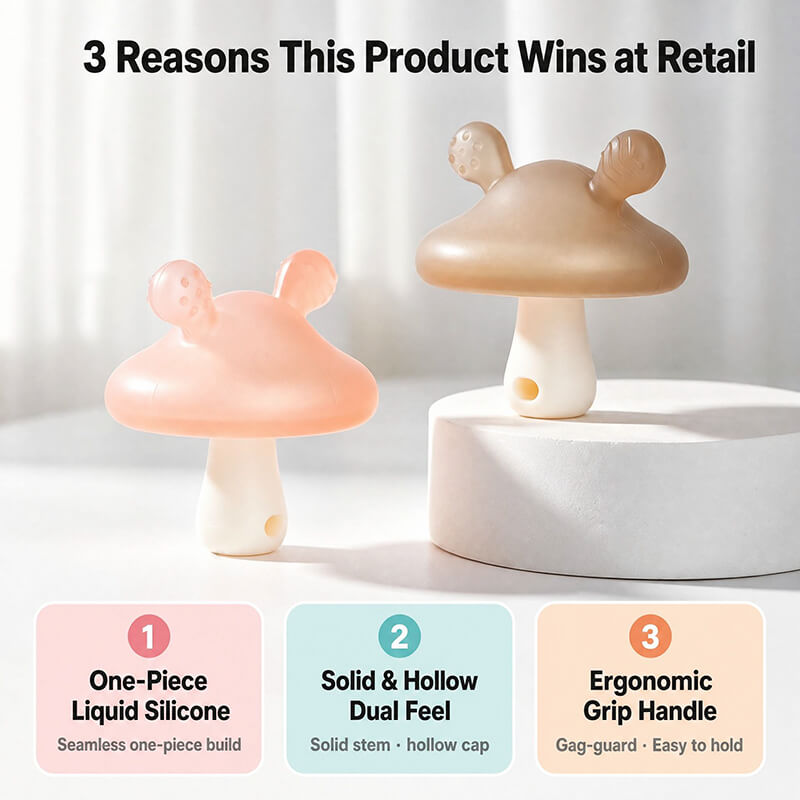
TR109 instead uses a one-piece silicone construction.
This creates an integrated product form without separate structural pieces. The current KEAN product page specifically identifies one-piece construction and the absence of detachable structural components as design features.
From a manufacturing perspective, this can simplify assembly.
From a product-design perspective, it also creates a cleaner surface and reduces the number of structural joints that need to be managed.
For baby products, one-piece construction is therefore not simply an aesthetic choice. It can be part of a broader structural and quality-control strategy.
KEAN's broader discussion of one-piece molded teethers similarly emphasizes the importance of eliminating unnecessary separate components and controlling material consistency, geometry and production quality.
The Rabbit Ear Design Adds Another Layer of Differentiation
The air chamber is the main engineering story.
But the rabbit ears make the concept easier to understand visually.
Rather than using identical solid surfaces throughout the product, the ears incorporate different structural sensations.
One area can feel more substantial.
Another can deform more readily.
This turns the recognizable character element into a functional component of the teether rather than simply decorative styling.
That is an important opportunity for baby brands.
A character should not only make the product look different.
It can also become part of the product's tactile architecture.
This is where character design and engineering design overlap.
Lightweight Design and Small-Hand Ergonomics
The TR109 also addresses another recurring problem with infant teethers: products that are difficult for younger babies to hold comfortably.
At approximately 28 grams, the product is designed around a lightweight construction. Its handle extends inward to create a defined gripping area for small hands.
The design therefore combines three decisions:
Air chamber → reduced material and soft compression
Lightweight body → easier handling
Inner-grip structure → clearer holding area
These decisions reinforce one another.
This is more meaningful than simply stating that the product is “lightweight.”
The weight is connected to the internal structure and the gripping geometry.
Why This Matters to B2B Buyers
For a brand owner, the most valuable part of an air-chamber teether may not be the mushroom or rabbit appearance.
It is the fact that the product has a clear engineering story.
In a crowded teether market, “cute silicone teether” is difficult to differentiate.
“Lightweight silicone teether” is better.
But:
“One-piece silicone teether with an engineered air-chamber structure that combines hollow, solid and resilient tactile zones”
creates a much stronger product-development narrative.
It gives the brand something concrete to communicate.
It also gives the product a potential platform for customization.
The same structural concept could potentially be developed with:
Different outer silhouettes
Different character shapes
Different tactile patterns
Different air-chamber distributions
Different silicone colors
Different logo locations
Different packaging concepts
The visual identity can change without abandoning the underlying structural innovation.
What Brands Should Ask Before Developing an Air-Chamber Teether
For buyers considering this type of product, several questions should be discussed before tooling begins.
1. Where should the air chamber be located?
The chamber should serve a functional purpose rather than simply reducing material.
2. How large should the hollow area be?
The hollow-to-solid ratio influences the structural response and overall feel.
3. How should the chamber connect with the external geometry?
The transition between soft and solid areas needs to be engineered carefully.
4. How will the mold reproduce the internal structure?
The tooling strategy should be reviewed before production tooling is finalized.
5. How will the finished product be inspected?
Dimensions, appearance, structural integrity and consistency should all be considered.
6. What happens if the product is repeatedly compressed?
The final product should be evaluated under the intended use conditions and applicable finished-product testing requirements.
These questions turn an attractive concept into a manufacturable product.
From “Soft Silicone” to “Engineered Softness”
This is perhaps the most important lesson from the TR109 design.
Softness does not have to come only from selecting a softer silicone material.
It can also come from engineering the geometry of the product.
A solid silicone product has one structural response.
A hollow silicone product has another.
A product combining both can provide multiple responses in different zones.
This opens up a broader design vocabulary for silicone baby products:
Hardness controls material response.
Wall thickness controls flexibility.
Texture controls surface sensation.
Air chambers control compressibility.
Overall geometry controls grip and handling.
Together, these variables allow manufacturers and product developers to design a much more intentional sensory experience.
A New Direction for Silicone Teether Development
The teether category does not necessarily need more complicated products.
It needs smarter structures.
The TR109 Mushroom Rabbit Air Chamber Teether demonstrates one way to approach that problem: use an integrated silicone structure, replace part of the solid mass with an engineered hollow chamber, preserve selected solid areas for contrast, and combine the result with lightweight ergonomics and recognizable character design.
The result is not simply another mushroom-shaped teether.
The air chamber is the product idea.
The mushroom and rabbit form provide the visual identity.
The LSR one-piece molding provides the manufacturing foundation.
And the combination of hollow, solid and resilient zones provides the tactile differentiation.
For baby-product brands, this is the type of product development approach that can turn a familiar category into a more distinctive SKU.
Conclusion: The Next Teether Innovation May Be Inside the Product
For decades, silicone teethers have been differentiated mainly through shape, color, texture and material softness.
Air-chamber construction introduces another possibility:
designing the inside of the product to change the experience on the outside.
That shift may sound small, but it changes how a teether can be engineered.
Instead of asking only:
Which silicone hardness should we use?
product developers can also ask:
Where should the product be solid? Where should it compress? Where should it rebound? And how can those zones be molded into one continuous structure?
That is the real value of the air-chamber approach.
For KEAN's TR109, approximately 80% of the structure is designed around the air-cushion concept, combined with solid and textured areas, a 28g lightweight body, an inward-extending grip and one-piece silicone molding.
For brands developing their next silicone teether, infant teether or custom baby teething toy, the opportunity is not simply to create another shape.
It is to create a different structural experience.
Air Chamber + Solid Silicone + One-Piece LSR Molding + Lightweight Ergonomics
That combination gives a familiar category a new engineering story—and gives B2B brands a stronger foundation for product differentiation, OEM/ODM customization and new teether collections.
Sources & Technical References
KEAN Silicone — Mushroom Silicone Teething Toy / TR109: product structure, air-chamber design, one-piece molding, 28g weight, product dimensions, customization and compliance information.
KEAN Silicone — KEAN Silicone Unveils Its 2026 Autumn New Product Collection: TR109 development concept, approximately 80% air-cushion structure, solid/air-cushion tactile experience and LSR one-piece molding.
KEAN Silicone — Why One-Piece Molded Teethers Are Safer: discussion of one-piece construction, LSR molding, structural design and QC considerations.
KEAN Silicone — Baby Teething Toys: current silicone teether product-category context.


