|  |
From Material Selection to Multi-Stage Design: What Baby Product Brands Should Consider When Developing the Next Generation of Sippy Cups
For baby and toddler product brands, developing another drinking cup may seem straightforward. The market already offers bottles, straw cups, spout cups, training cups, and open cups in almost every imaginable shape and color.
But that is exactly what makes the category difficult.
The challenge is no longer simply creating a cup that can hold liquid. For brands, the more important question is how to design a drinking product that fits a child's changing developmental needs while also delivering material differentiation, functional value, manufacturing consistency, and a clear reason for consumers to choose it.
This is one reason PPSU has become an interesting material option for baby drinking products. When combined with food-grade silicone and a multi-stage structural concept, PPSU can become part of a broader product-development strategy rather than simply another material choice.
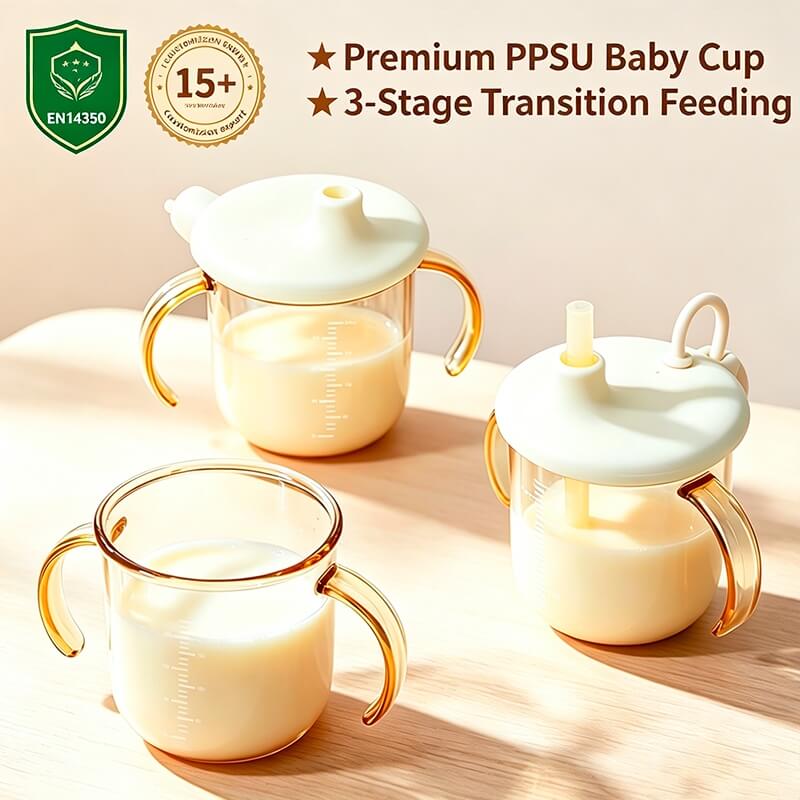
KEAN's CT15 PPSU Sippy Cup provides one example of this approach: instead of designing the cup around a single drinking method, the product is structured around different stages of drinking development.
The Real Challenge: Children Do Not Learn to Drink in One Step
The transition from bottle feeding to independent drinking is a process.
A child may first become familiar with assisted drinking, then begin using a straw, later experiment with a softer spout, and eventually practice drinking directly from an open cup. The exact progression varies between children, but the underlying product-development challenge remains the same: a drinking product designed around only one stage may have a limited useful life.
For parents, repeatedly purchasing different cups can become inconvenient.
For brands, the problem is different. Developing a completely separate SKU for every developmental stage increases product complexity, tooling requirements, inventory, packaging, and marketing costs.
This creates an opportunity for a different design philosophy:
Instead of asking, “What type of cup should we manufacture?” brands can ask, “How many stages of the drinking journey can one product system support?”
That shift from a single-function product to a multi-stage product architecture is increasingly relevant for baby-feeding brands looking for meaningful differentiation.
Why Material Selection Matters More Than It Appears
A baby drinking cup has to balance several requirements at the same time.
The body needs to be lightweight enough for everyday handling, durable enough for repeated use, visually suitable for a baby-product collection, and compatible with the intended temperature and cleaning conditions.
The components that come into contact with the mouth have a different set of requirements. They need to provide an appropriate tactile experience while fitting securely into the overall structure.
This is where a material combination can become more useful than relying on a single material for the entire product.
The CT15 concept combines a PPSU cup body with food-grade silicone components, creating a material architecture in which each material has a specific role. The product page specifies a 240 ml capacity and identifies PPSU for the cup body and food-grade silicone for the lid, straw, and related soft components.
From a product-development perspective, this is more significant than simply saying “the cup is made from PPSU.”
The real design question is:
Where should PPSU be used, and where does silicone provide a better functional solution?
That question affects the entire product structure.
PPSU Is Not the Whole Product — The Combination Is
|
|
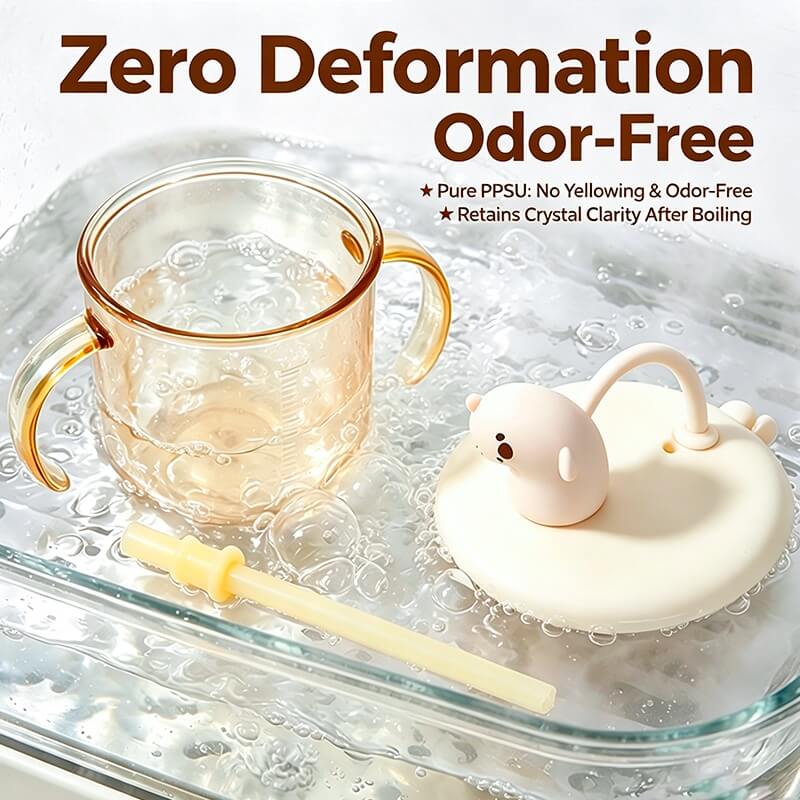
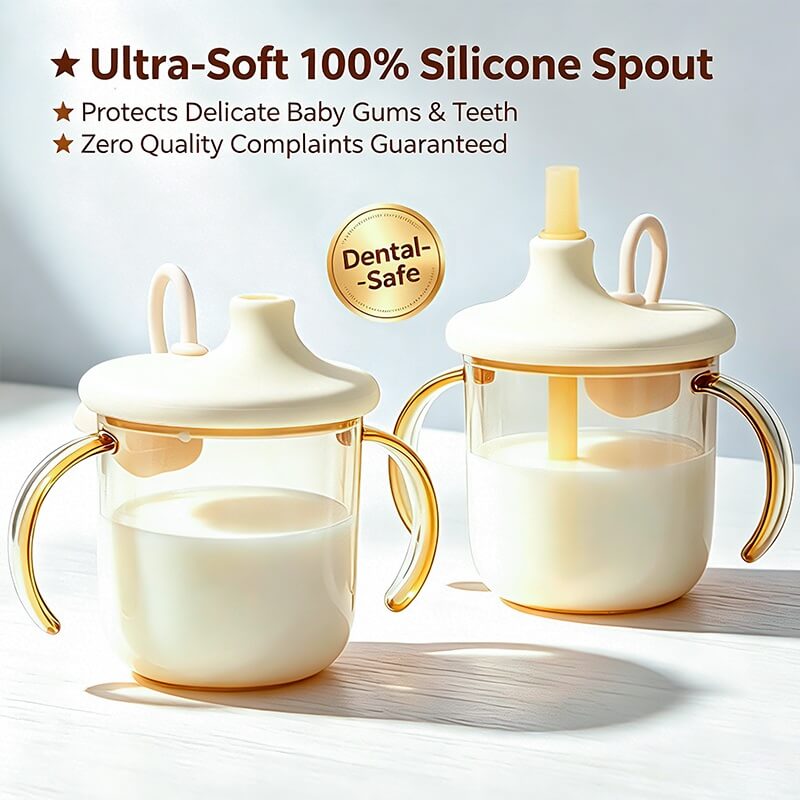
PPSU is particularly relevant in baby-feeding applications where heat resistance, durability, and material appearance are important considerations.
But a rigid PPSU body alone does not automatically create a good training cup.
The drinking interface still matters.
A rigid drinking component can provide a very different tactile experience from a soft silicone component. This is why hybrid construction can create opportunities for product differentiation.
In a multi-stage cup, the body can remain consistent while the drinking configuration changes.
This allows the same basic product platform to support different experiences without requiring the brand to develop an entirely new cup body for every stage.
For product developers, that means material selection becomes part of the system architecture, rather than a specification added at the end of development.
The More Important Innovation Is Structural: One Cup, Multiple Drinking Stages
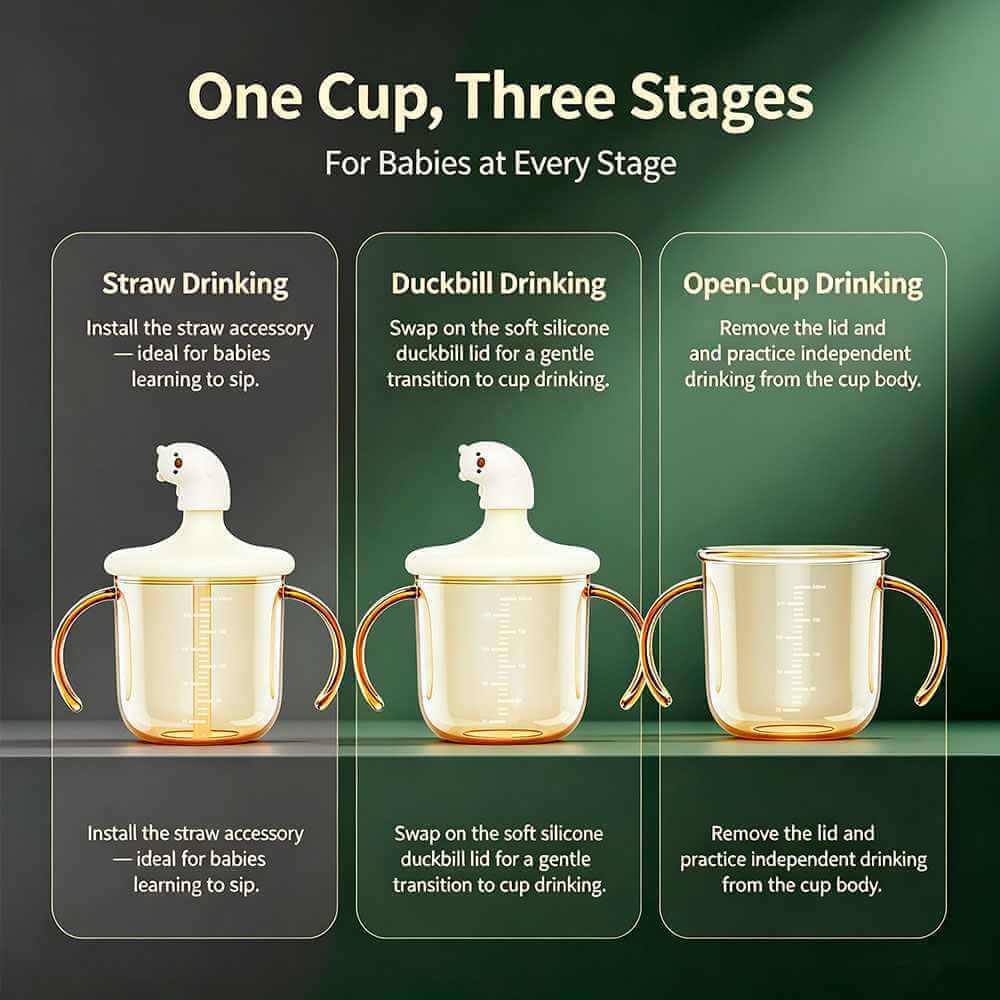
A multi-stage design changes the commercial logic of a baby cup.
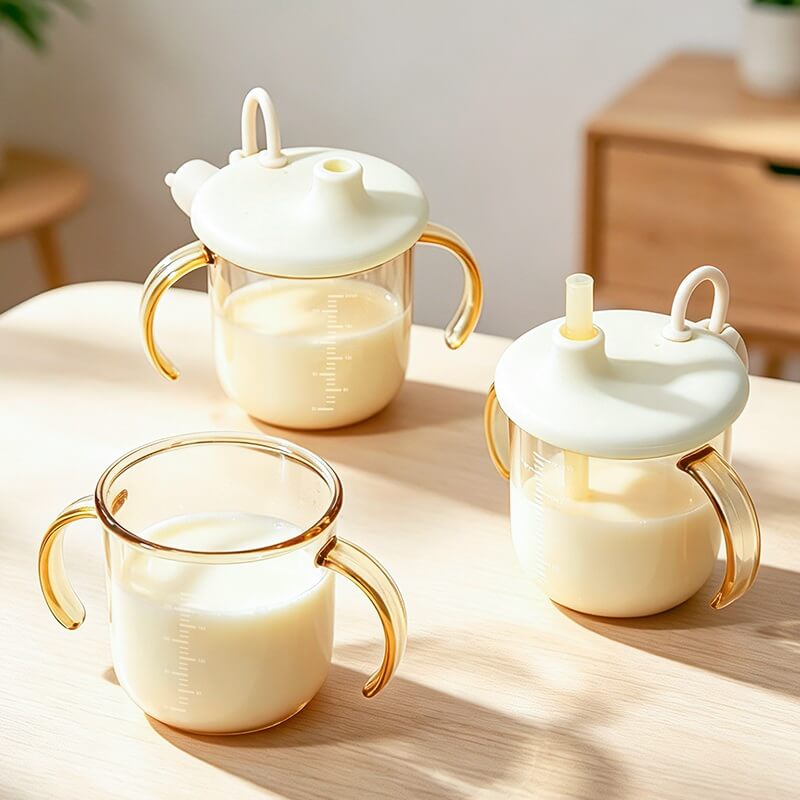
The CT15 is designed around three drinking configurations:
Stage 1 — Straw Drinking
The straw configuration supports children who are learning to drink through a straw.
Stage 2 — Duckbill Drinking
A soft silicone duckbill configuration creates another transition point between assisted drinking and more independent drinking.
Stage 3 — Open-Cup Practice
The lid can be removed so that the cup body can be used for open-cup practice.
The important point is not simply that one cup has three configurations.
The more important point is that the product story follows the child's development rather than forcing the child to remain in one fixed drinking mode.
For brands, this creates a stronger positioning opportunity.
Instead of marketing the product only as another “sippy cup,” the product can become part of a growth-stage drinking system.
That gives the product a broader story without requiring the brand to rely solely on visual styling.
Small Structural Details Can Create Real Product Differentiation
In competitive baby-product categories, differentiation does not always come from adding more components.
Sometimes it comes from solving a small but recurring problem more effectively.
For example, measurement markings may seem like a minor detail, but they can make a transparent drinking cup more practical for everyday use. The CT15 incorporates a 30 ml measurement scale, allowing users to visually reference liquid volume through the cup body.
The protective cover is another example.
Rather than leaving the drinking opening exposed when the product is stored, the design incorporates a character-style dust plug. At the same time, the recognizable form can become part of the product's visual identity.
For a consumer, these may appear to be small details.
For a product developer, they represent something more important:
Every structural element has the potential to serve both a functional purpose and a differentiation purpose.
That is particularly valuable when a brand is competing in a mature category.
Where Manufacturing Becomes Critical
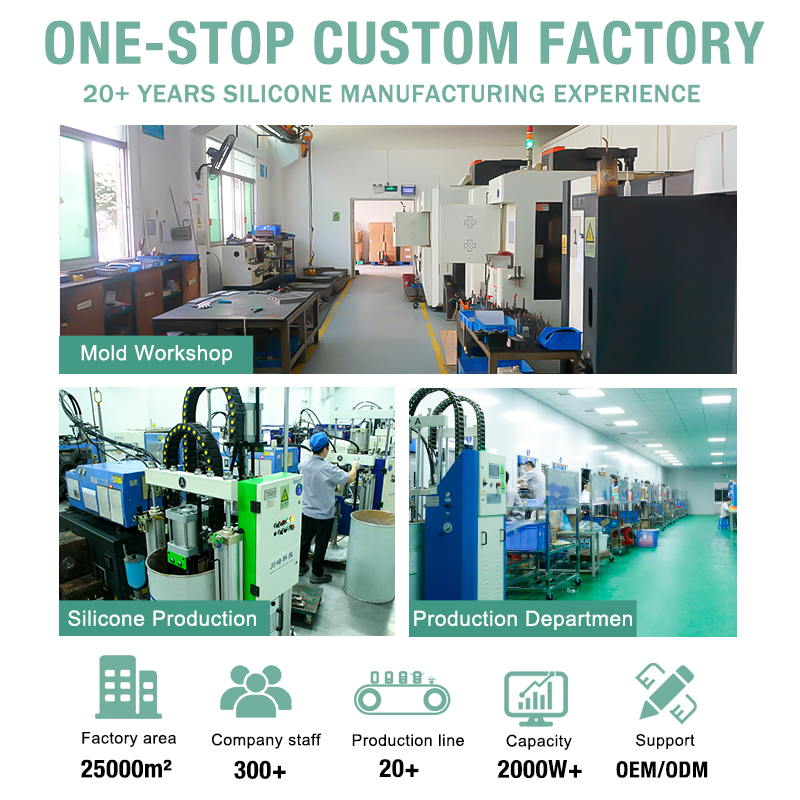
A concept can look convincing in a product rendering and still become difficult to manufacture at scale.
Baby drinking cups contain multiple interfaces: the cup body, lid, straw or duckbill, sealing areas, openings, and removable components.
The challenge is not simply producing each individual part.
The challenge is making the entire system work consistently.
For a PPSU and silicone combination, this means controlling several aspects during development and production, including dimensional accuracy, component fit, material consistency, appearance, and repeatability between production batches.
The cup body also needs to maintain consistent geometry so that the corresponding silicone and drinking components fit correctly.
This is where injection-molding process control becomes particularly important.
A successful production process needs to move beyond the first approved sample and establish repeatable parameters for mass production.
For B2B buyers, this distinction is critical.
A supplier may be able to produce a visually attractive prototype.
A capable manufacturing partner needs to demonstrate that the same design can be reproduced consistently across thousands of units.
Designing for Heat Conditions Requires More Than Choosing a Heat-Resistant Material
When developing baby-feeding products, temperature conditions should be considered at the product-system level.
The cup body and soft components may have different material characteristics, so the intended cleaning and sterilization conditions need to be evaluated against the complete product construction rather than one material in isolation.
The CT15 product information positions the cup for high-temperature sterilization and specifies different temperature ranges for its PPSU and silicone components.
This illustrates an important development principle:
Material selection, component design, assembly, and intended use conditions should be evaluated together.
For OEM/ODM projects, this should ideally be addressed during the engineering and sample-validation stage rather than after mass production begins.
From a Product to a Platform
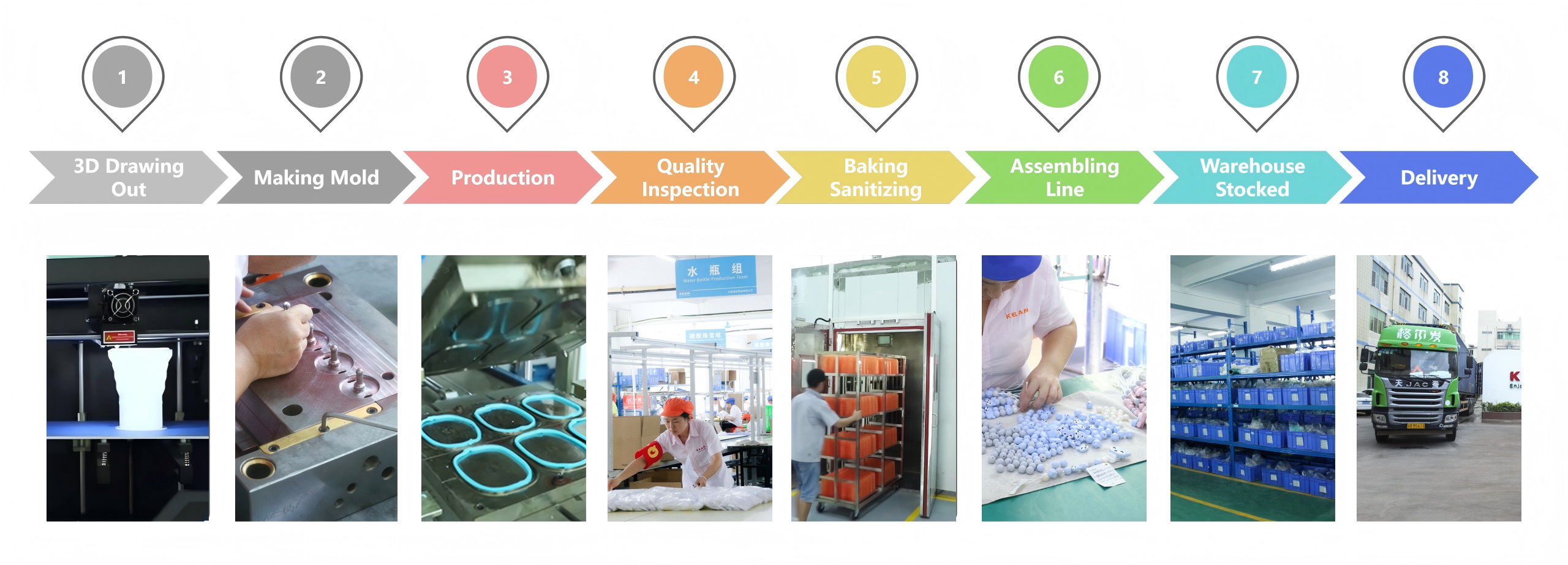
One of the most interesting opportunities in multi-stage baby products is the possibility of creating a product platform rather than a single SKU.
A brand could maintain the same core cup architecture while developing different color systems, character elements, silicone components, packaging formats, or accessory configurations.
The result is not simply one cup.
It becomes a framework that can support a broader product collection.
For example, a brand may develop:
One core PPSU cup platform
Multiple silicone color directions
Different character or visual themes
Different drinking-stage configurations
Coordinated retail packaging
Complementary feeding products using the same visual language
This approach can help brands build a more coherent product portfolio while reducing the need to reinvent the entire product structure for every new SKU.
KEAN's current CT15 offering supports OEM/ODM development, including custom silicone colors, logo branding, design adjustments, accessory configurations, and retail packaging development.
What B2B Buyers Should Evaluate Before Choosing a PPSU Cup Supplier
For procurement teams and baby-product brands, the lowest unit price should rarely be the only evaluation criterion.
A better evaluation should begin with the product architecture.
Can the supplier explain why PPSU is being used for the body and why silicone is used for the drinking components?
Can the design support the intended drinking stages?
Are the interfaces between components consistent?
Can measurement markings, logos, colors, and visual details be reproduced consistently?
Can the supplier provide samples before mass production?
Can the manufacturing process maintain dimensional and appearance consistency across larger orders?
And perhaps most importantly:
Can the supplier help transform a product concept into a commercially viable, repeatable product rather than simply manufacture an existing drawing?
These questions are particularly important for brands developing private-label or OEM/ODM baby products.
The Future of Baby Drinking Products Is Not Just About “Another Cup”
The baby drinking cup category is already crowded.
That means simply changing the color, adding a cartoon character, or changing the shape of the handle may not create enough differentiation.
More meaningful innovation often comes from looking at the product journey as a whole.
A better cup may need to combine:
Material selection + multi-stage functionality + ergonomic structure + appropriate soft-contact components + manufacturability + brand differentiation.
That is where PPSU becomes interesting—not because PPSU alone makes a product better, but because it can become one component of a carefully engineered product system.
The CT15 is one example of this philosophy.
Its 240 ml PPSU body, silicone components, three-stage drinking concept, measurement markings, and protective cover are not independent selling points. They work together around a larger idea:
one product that can accompany multiple stages of drinking development.
For baby brands, that creates a stronger product narrative.
For product developers, it creates more opportunities for structural and visual differentiation.
And for OEM/ODM buyers, it creates a more flexible starting point for developing a branded product collection.
Conclusion: Better Product Development Starts With a Better Question
The next generation of baby drinking products does not necessarily need more features.
It needs better integration between material, structure, user stage, manufacturing process, and brand strategy.
Instead of asking how to make another sippy cup, product developers can ask:
How can one product better support the transition from assisted drinking to independent drinking?
That question leads naturally to different design decisions—from material combinations and interchangeable components to measurement markings, protective details, manufacturing tolerances, and customization possibilities.
For brands looking to develop PPSU baby drinking products, the opportunity is therefore not simply to source a PPSU cup.
It is to develop a product that has a clear reason to exist in an increasingly competitive market.
PPSU is the material.
Multi-stage design is the strategy.
Manufacturing precision is what turns the concept into a scalable product.
Product Development with KEAN
KEAN supports OEM/ODM development for baby and toddler products, including material selection, structural development, silicone component customization, color development, branding, and retail packaging.
For brands developing a new PPSU drinking product, the starting point should not be the catalog.
It should be the product problem you want to solve.
|
|