Understanding Silicone Odor, Manufacturing Processes, Safety Considerations, and Quality Control for B2B Buyers
Silicone is widely used in baby feeding products, teethers, kitchenware, household goods, and other consumer products because of its flexibility, durability, and suitability for a wide range of applications. Yet a common question arises after production: if silicone itself is nearly odorless, why do some finished silicone products have a noticeable smell and need time to air out?
The answer lies in the difference between the base material and the finished product. The odor of a molded silicone product may be influenced by its formulation, curing system, processing aids, post-treatment, packaging, and storage conditions. In other words, the smell does not necessarily originate from the silicone polymer itself.
For brands, importers, wholesalers, and product developers, understanding these factors is important not only for improving the consumer experience but also for establishing appropriate quality specifications when sourcing custom silicone products.

Is Silicone Naturally Odorless?
High-quality silicone elastomers that have been properly formulated, cured, and processed are generally expected to have little noticeable odor. However, this does not mean that every silicone compound or finished silicone product will be completely odor-free.
Commercial silicone products are manufactured using formulated compounds rather than isolated silicone polymer alone. Depending on the product and manufacturing process, these compounds may contain curing agents, pigments, fillers, processing aids, and other additives. Some substances associated with processing may produce detectable odors, particularly when residual volatile compounds remain after molding.
It is therefore more accurate to distinguish between the intrinsic odor of the silicone material and the odor of the finished product.
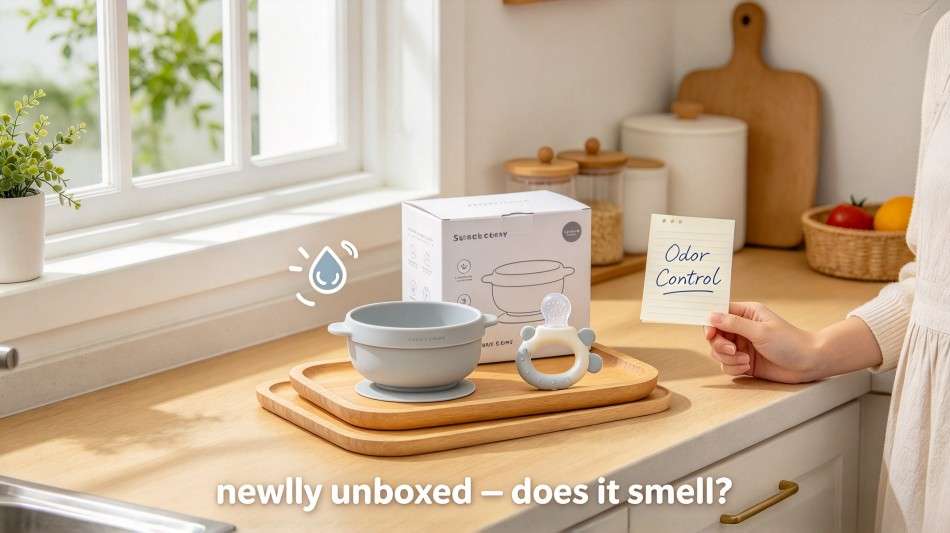
For example, a newly molded silicone baby bowl, teether, or kitchen utensil may have a faint rubber-like or process-related smell when first unpacked. This smell may diminish after suitable ventilation. However, a persistent, unusually strong, or irritating odor should not automatically be dismissed as normal.
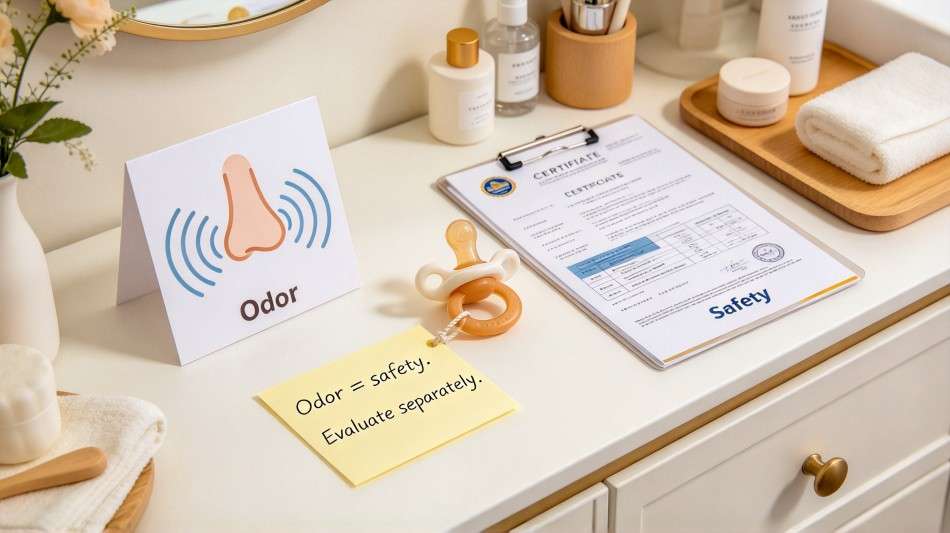
The key point is that odor is a product-quality observation, not a complete assessment of material safety. A product with little or no smell is not necessarily safe, and a noticeable smell does not, by itself, establish that a product is unsafe. The intended application, material documentation, manufacturing controls, and relevant test results must all be considered.
Why Do Finished Silicone Products Have an Odor?
Several factors may contribute to silicone odor. Identifying the actual source is more useful than assuming that every odor problem has the same cause.
2.1 Residual Compounds from the Curing Process
Curing transforms a silicone compound into an elastomer with the properties required for its intended application. Different curing systems work through different chemical mechanisms and may generate different reaction by-products or leave different residual substances.
For example, some peroxide-cured silicone formulations can produce volatile by-products during curing. If these substances are not adequately removed through an appropriate manufacturing process, they may contribute to the odor of the finished product.
Other curing systems can also have process-specific odor considerations. The exact result depends on the formulation, curing conditions, and subsequent treatment.
This is one reason why manufacturers need to evaluate the complete material and processing system rather than judging quality from the product's appearance alone.
2.2 Incomplete or Inadequately Controlled Curing
Curing temperature, time, pressure, and other process parameters must be appropriate for the specific silicone compound and product geometry. If the curing process is not properly controlled, the resulting product may have inconsistent properties or retain substances that contribute to odor.
Product thickness and geometry can also affect how readily residual volatile compounds escape during subsequent processing. Consequently, a process that works well for a thin silicone accessory may not deliver the same result for a thicker molded component.
However, odor alone cannot establish that curing was incomplete. A proper investigation should consider the material specification, process records, product characteristics, and appropriate testing.
2.3 Raw Materials, Pigments, and Processing Aids
The base silicone compound is only one part of the finished formulation. Colorants, additives, release agents, and other processing materials may also influence the final odor profile.
If a new product develops an unexpected smell, manufacturers should consider whether the odor is associated with the base compound, a particular color formulation, a processing aid, or a change in material batch.
This is particularly relevant for custom silicone products manufactured in multiple colors or across numerous SKUs. A problem that appears only in one color or production batch may justify a targeted review of the corresponding materials and processing conditions.
It is important not to assume that every odor problem indicates low-quality or recycled raw material. Such conclusions require supporting evidence.
2.4 Post-Processing and Surface Contamination
Some silicone products undergo additional finishing operations, such as printing, coating, bonding, or assembly. Depending on the product design, these operations may introduce other materials that contribute to the overall odor.
Manufacturing residues, inadequate cleaning, or contamination from the surrounding production environment may also affect the finished product.
For this reason, odor control should cover the complete production workflow rather than focusing exclusively on the silicone compound.
2.5 Packaging, Storage, and Transportation
A product may smell different after being sealed in a package or transported over a long distance. Packaging materials, the storage environment, and nearby odor sources can influence the smell noticed when the package is opened.
A strong smell immediately after opening does not automatically prove that the silicone itself is responsible. It may be necessary to evaluate the product, packaging materials, and storage conditions separately.
For B2B buyers, this is an important distinction: an odor complaint discovered at the destination may require investigation of both manufacturing and logistics conditions.
Does Airing Out Silicone Products Solve the Problem?
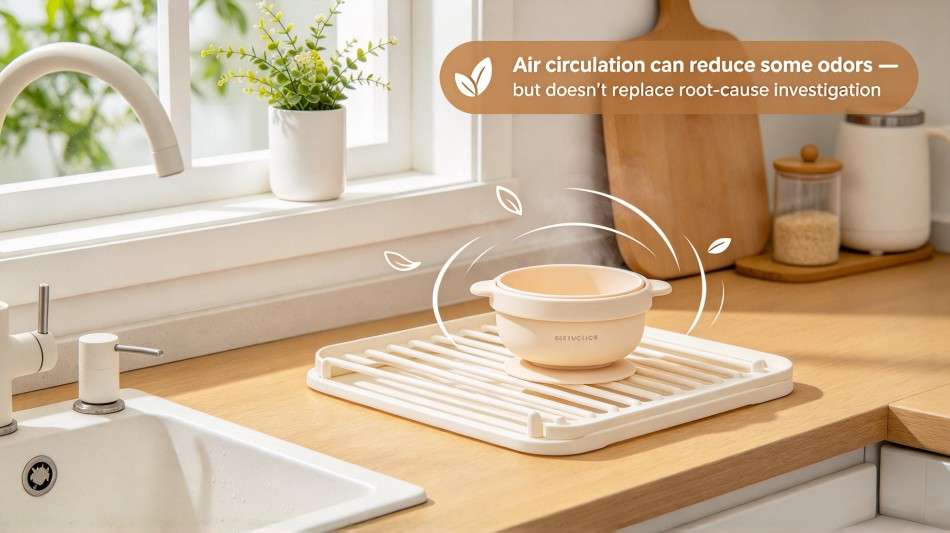
Air circulation can help reduce some odors when they are caused by volatile substances near the product surface or by odors trapped within the packaging environment. However, airing out is not a universal solution.
If the smell comes from an external source or a small amount of residual volatile material, suitable ventilation may reduce the intensity over time. If the underlying cause is an unsuitable formulation, inadequate processing, contamination, or a persistent source of volatile compounds, simply leaving the product exposed to air may not resolve the problem.
This distinction matters because reducing the smell is not the same as identifying and correcting its source.
For manufacturers, airing out should not replace appropriate production controls. For buyers, a product should not be accepted solely because its odor becomes less noticeable after unpacking.
Practical steps for handling a newly purchased silicone product
For an ordinary consumer product, the following steps may be appropriate, provided they are consistent with the manufacturer's care instructions:
Remove the product from its packaging and inspect it for visible residue, damage, or other abnormalities.
Allow it to ventilate in a clean, well-ventilated area away from direct sunlight, excessive heat, and strong external odors.
If cleaning is permitted, wash the product according to its care instructions using a suitable detergent, then rinse it thoroughly and allow it to dry completely.
Reassess the odor after cleaning and ventilation.
If a strong, unusual, or irritating smell persists, stop using the product and contact the supplier or manufacturer for further guidance.
Boiling, dishwashing, or other high-temperature treatments should only be used when the product is specifically designed to tolerate them. Unapproved heating, harsh solvents, and improvised chemical treatments may damage the product or introduce additional risks.
For baby products and food-contact items, it is particularly important to follow the product's instructions rather than relying on generic online odor-removal methods.
Does Silicone Odor Mean the Product Is Unsafe?
Not necessarily. Odor is one observation that may help identify a quality issue, but it cannot independently establish whether a product meets the relevant safety requirements.
Similarly, the absence of odor does not prove that a product is compliant or free from unwanted substances.
For silicone baby products, feeding accessories, and kitchenware, buyers should evaluate the product against the applicable requirements for its intended use and destination market. Depending on the application, this may involve reviewing material declarations, supplier documentation, traceability records, and relevant chemical or food-contact test reports.
In the United States, food-contact substances are subject to requirements that consider the safety of their intended use and potential dietary exposure. A general claim such as “food-grade silicone” should therefore not be treated as a substitute for verifying the documentation applicable to a specific product and use.
Reference: U.S. FDA — Understanding How the FDA Regulates Substances that Come into Contact with Food
For B2B buyers, the appropriate response to an unusual odor is to investigate it alongside the product's material and compliance information. Where necessary, additional testing should be selected according to the suspected source of the odor and the relevant regulatory or customer requirements.
Can Post-Curing Reduce Silicone Odor?
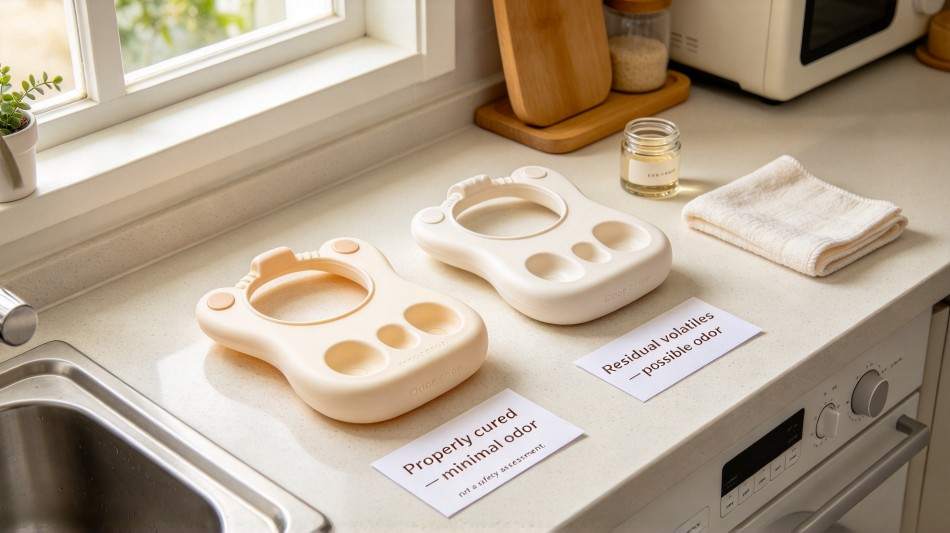
Post-curing is an additional heat-treatment process applied to certain silicone products after their initial molding and curing. Depending on the silicone compound and manufacturing requirements, it may help reduce certain residual volatile substances, improve material stability, and support odor control.
However, post-curing is not a universal requirement for every silicone product, nor does it guarantee that a finished product will be completely odor-free.
Its suitability and effectiveness depend on the curing system, formulation, product geometry, temperature, duration, ventilation, and other process conditions. A post-curing schedule that is appropriate for one compound may not be appropriate for another.
Manufacturers should therefore determine whether post-curing is necessary for the specific product and verify its effectiveness through suitable quality checks or testing.
A comprehensive odor-control strategy may include:
Selecting a silicone compound appropriate for the product's intended application.
Evaluating the compatibility of pigments and processing aids.
Controlling molding and curing parameters.
Applying post-curing where appropriate.
Maintaining clean production and finishing processes.
Reviewing packaging materials and storage conditions.
Investigating odor complaints by production batch and material lot.
For customized products, these controls should be considered during product development rather than introduced only after complaints arise.

How Should B2B Buyers Evaluate Silicone Odor Control?
For brand owners, importers, wholesalers, and procurement teams, odor control is best handled as part of the product specification and supplier-quality process.
Before mass production, buyers can discuss the following questions with a potential silicone manufacturer.
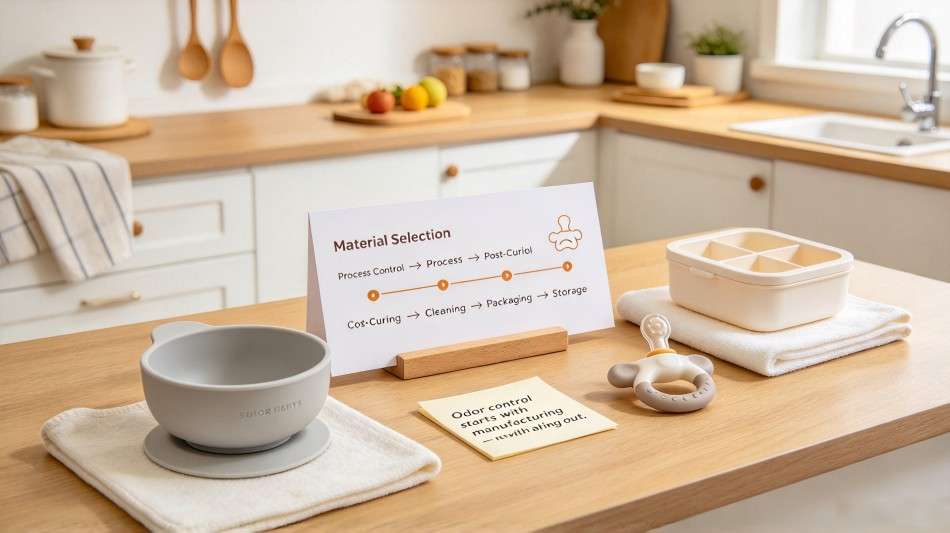
Material selection: What silicone compound and curing system will be used, and are they appropriate for the intended application?
Process control: Which curing and post-treatment steps are included in production, and how are their parameters controlled?
Odor evaluation: How will the finished product be evaluated for odor? Are samples assessed under consistent conditions, including after packaging and storage where relevant?
Testing and compliance: Which tests and documentation are required for the destination market and intended use? Can the supplier provide applicable reports and traceability records?
Batch consistency: How does the manufacturer investigate odor differences between colors, material lots, or production batches?
Packaging and shipping: How are packaging materials and storage conditions evaluated when a product develops an odor after transportation?
These questions help turn a subjective concern into a more manageable quality-control requirement.
Where odor is commercially important, buyers and manufacturers should agree on an appropriate evaluation method and acceptance criteria before mass production. Sensory evaluation can be useful for screening and consistency checks, but it should not be used as a substitute for chemical testing when chemical safety is the concern.
For manufacturers, keeping records of material batches, process parameters, inspection results, and corrective actions can also make it easier to investigate complaints and improve consistency across repeat orders.
Why Odor Control Matters for Custom Silicone Products
Odor control can be particularly important for products used in close contact with food or during everyday baby-care routines. Even when a product meets its applicable technical requirements, an unexpected smell may affect the user's perception of quality and generate complaints for the brand.
For a B2B customer, this can have consequences beyond the individual product: returns, additional inspections, delayed launches, and questions about the consistency of future orders.
For this reason, odor should be considered alongside material selection, appearance, mechanical performance, regulatory compliance, and packaging requirements during product development.
A custom silicone manufacturer should be prepared to discuss these requirements early, identify potential process-related risks, and establish appropriate verification methods before production scales up.
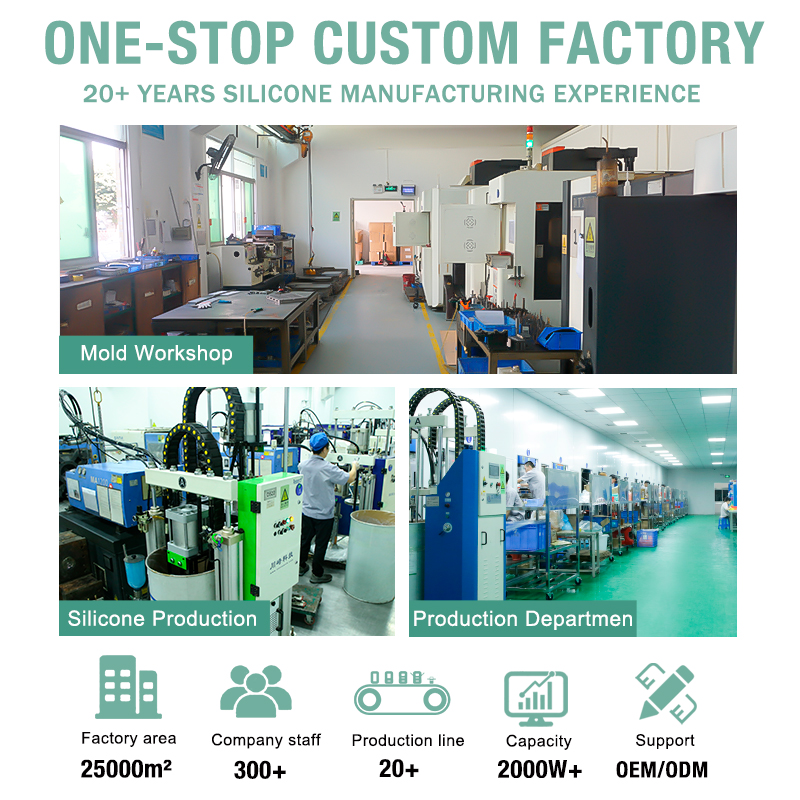
At KEAN Silicone, discussions about custom silicone products can begin with the product's intended use, design, color requirements, destination market, and applicable quality expectations. These details help establish which material and process considerations need to be evaluated for the specific project.

Frequently Asked Questions About Silicone Odor
Why does new silicone smell after opening the package?
The smell may come from residual volatile substances associated with the material or manufacturing process, or from packaging and storage conditions. The exact source depends on the product and should not be assumed without further evaluation.
How long should silicone products air out?
There is no universal airing-out period for all silicone products. The time required depends on the source and intensity of the odor, the product's construction, and its environment. A persistent or irritating smell should be investigated rather than managed by repeatedly extending the ventilation period.
Does platinum-cured silicone have no odor?
Platinum-cured silicone formulations can have low odor, but the curing system alone does not guarantee an odor-free finished product. Formulation, processing, post-treatment, and packaging also influence the result.
Does post-curing remove all silicone odor?
No. Post-curing can reduce certain residual volatile substances when the process is appropriate, but it cannot necessarily eliminate odors originating from every additive, contamination source, or packaging material.
Can I use boiling water to remove silicone odor?
Only if the product's manufacturer explicitly permits boiling. High-temperature treatment is not suitable for every silicone product, particularly products containing additional components or assemblies.
Is odor-free silicone always safe?
No. Odor is not a reliable stand-alone safety test. Product safety must be assessed using appropriate material information, intended-use requirements, and relevant testing.
Conclusion: Effective Silicone Odor Control Starts with Manufacturing
Silicone itself is generally low in odor when appropriately formulated and processed, but a finished silicone product is influenced by more than its base polymer. Curing chemistry, additives, finishing operations, packaging, and storage can all affect the odor experienced by the end user.
Airing out may reduce certain odors, but it does not replace identifying the source, correcting a manufacturing issue, or verifying product safety.
For B2B buyers, the most reliable approach is to discuss odor expectations early, establish consistent evaluation criteria, and review the material, process, and compliance evidence relevant to the product's intended application.
For silicone manufacturers, the goal is not simply to make a smell disappear after production. It is to understand the factors that influence odor, control the manufacturing process, and deliver products that meet the customer's agreed quality requirements consistently.