


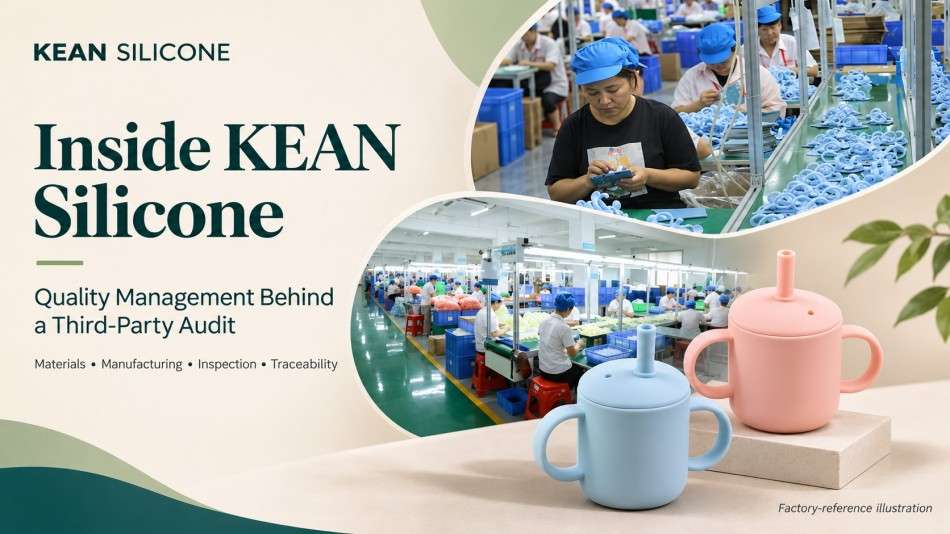
How material control, manufacturing records and product inspection support silicone baby product development.
A finished silicone baby cup, teether or feeding bowl reveals only part of its manufacturing story. Its appearance cannot tell a buyer which raw material batch was used, whether production followed the approved specifications, or how an unexpected defect would be investigated.
Those questions lead beyond the product sample and into the factory’s everyday quality management.
KEAN Silicone has passed a third-party factory audit conducted against FDA-related requirements within the audit scope. This milestone provides an opportunity to explain the manufacturing controls behind silicone baby products—and why those controls matter to brands developing custom products.
This was an independent third-party audit, rather than an inspection conducted by FDA officials. Its result applies to the scope assessed and does not constitute FDA approval of the factory or every product it manufactures. FDA also distinguishes establishment registration from approval; registration alone does not indicate FDA endorsement. Source: FDA — Is It Really “FDA Approved”?
For OEM and ODM customers, the practical value lies in understanding the connection between materials, production, inspection and supporting records.
What Does a Third-Party Factory Audit Tell a Buyer?
A third-party factory audit assesses a facility against defined criteria. Its meaning depends on the requirements referenced, the activities examined, the evidence reviewed and the conclusions recorded.
The audit report is therefore more informative than a general statement that a factory has “passed.”
For silicone baby product brands, useful questions include whether the assessed scope relates to the intended manufacturing activities, whether the factory’s procedures are supported by records, and whether any findings required corrective action.
Factory audits and product testing provide different evidence:
| Evidence | What it helps establish | Its practical limit |
| Third-party factory audit | How the assessed manufacturing activities and management controls compare with specified criteria | Applies to the documented scope and assessment |
| Raw material documentation | The identity, specifications and supporting information for a material grade | Does not fully represent a finished product |
| Finished-product testing | Results for identified samples under specified test conditions | Coverage depends on the sample and test scope |
| Production and inspection records | Whether a batch followed documented requirements and checks | Depends on accurate, complete recordkeeping |
A well-supported sourcing decision brings these pieces together. A factory audit helps buyers assess manufacturing management, while product-specific evidence addresses the requirements of the item being purchased.
Quality Begins Before Silicone Enters the Mold
Material selection is an early engineering decision in custom silicone baby product development. It affects flexibility, appearance, processing behavior and the evidence needed for the intended application.
A soft teether, a cup lid and a feeding spoon may all contain silicone, but their functional requirements differ. A teether needs an appropriate balance of flexibility and resistance to damage. A lid must maintain its intended fit. A spoon requires a suitable shape and stiffness for its design.
A useful material specification therefore goes beyond the phrase “food-grade silicone.” It identifies the selected grade, relevant properties, color formulation and intended conditions of use.
For food-contact applications, any cited regulatory provision must also be relevant to the material and use. For example, 21 CFR 177.2600 concerns rubber articles intended for repeated use and includes composition and extractives requirements. A reference to this provision does not replace an assessment of the finished article and its intended application. Source: 21 CFR § 177.2600 — Rubber Articles Intended for Repeated Use
In factory operations, material control connects that specification to the material actually used. Clear identification, suitable storage and traceable issue records help prevent approved materials from being confused with another grade or formulation.
Color deserves the same attention. A pigment addition changes the formulation, so a change in color should be reviewed alongside the relevant material documentation and testing coverage.
Turning an Approved Sample into a Repeatable Manufacturing Process
Sample approval establishes an agreed product. Production control establishes how that product will be made repeatedly.
This distinction matters because an attractive sample does not demonstrate that every subsequent batch will have the same dimensions, appearance or assembly performance.
At KEAN, products such as teethers, cup components and feeding accessories provide different opportunities to examine manufacturing consistency. The relevant controls depend on the selected material, mold and production method.
Material Preparation and Molding
Before molding, the specified formulation and preparation method need to be clear. Depending on the process, this may involve weighing and preparing material charges or controlling material delivery through the selected equipment.
During molding, temperature, time, pressure and material behavior can influence the finished part. Changes may appear as incomplete formation, trapped air, surface defects, excessive flash or dimensional variation.
Documented operating conditions give the production team a reference for running the process. They also provide useful evidence when a defect needs investigation.
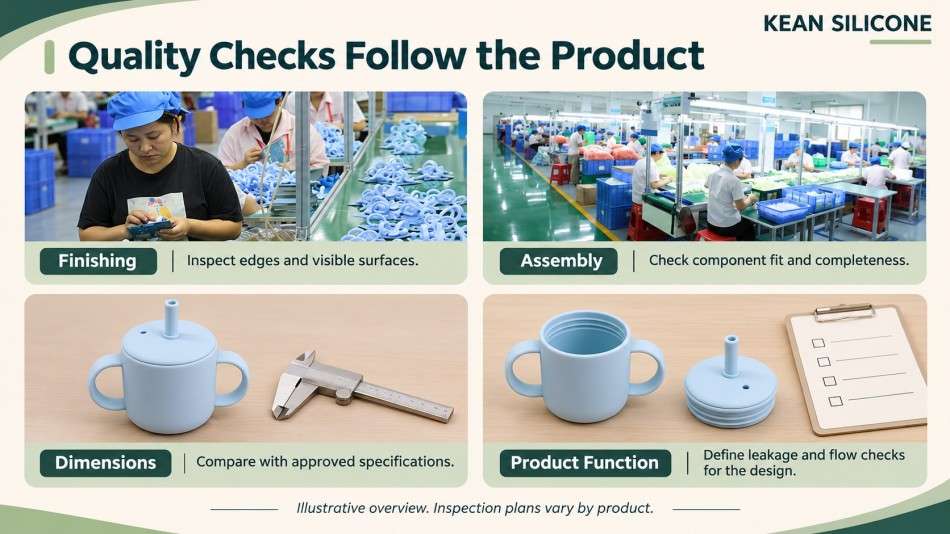
Finishing and Surface Inspection
After demolding, a silicone part may require trimming, cleaning or other specified finishing operations.
These steps deserve attention in baby products. A small area of flash, an uneven edge or damage caused during removal may affect appearance, assembly or usability.
Inspection must therefore relate to the actual component. A detailed teether surface, a thin cup-lid edge and a narrow straw opening present different inspection needs.
Where post-curing is specified, its conditions should follow the selected material’s processing guidance and the validated product requirements. A single temperature-and-time recipe should not be assumed suitable for every silicone formulation or product.
Assembly
Assembly connects individually acceptable parts into a functional product.
A lid may look correct on its own yet fit poorly on its intended cup. A straw may have an acceptable appearance but fail to seat correctly in the assembled lid.
For this reason, inspection of separate components and inspection of the assembled product answer different questions. Both may be necessary, depending on the design.
Different Baby Products Require Different Quality Checks
KEAN’s baby product range includes products with different geometries, material combinations and use conditions. The inspection plan should reflect those differences.
| Product example | Manufacturing details worth examining | Relevant checks to define |
| Silicone teether | Detailed molding, thin sections, surface texture and trimmed edges | Appearance, dimensions, edge condition and applicable mechanical testing |
| Silicone cup lid or straw | Drinking openings, sealing surfaces and component fit | Dimensions, assembly, leakage and liquid flow under defined conditions |
| Feeding bowl or plate | Rim geometry, base shape and molded surface | Appearance, dimensions, stability and any claimed functional performance |
| Baby food freezer tray | Cavity formation, lid fit and flexible sections | Dimensions, closure fit, demolding function and relevant temperature-use performance |
| Multi-material cup | Interfaces between silicone and the selected cup body | Fit, retention, assembly consistency and relevant repeated-use performance |
These are examples of checks to establish for a project, rather than a statement that every test applies to every product.
The important principle is that inspection follows the product’s design, intended use and claims. A generic checklist cannot fully address the differences between a teether and a straw cup.
Multi-Material Products Add Another Layer of Coordination
A product combining silicone with PPSU, stainless steel or ceramic requires coordination across more than one material and manufacturing process.
Each component has its own dimensions, tolerances and surface characteristics. Their interaction determines the assembled result.
For example, the fit of a silicone lid depends partly on the geometry of the cup body. A change in the body’s rim dimensions may alter assembly even when the silicone component remains unchanged.
Quality planning for these products should address:
Approved specifications for each component.
Identification of the suppliers and relevant material grades.
Dimensions that affect fit and retention.
Assembly instructions and acceptance criteria.
Review of changes to materials, tooling or component sources.
This is particularly relevant when developing a product family. Similar-looking lids or cup bodies should not be assumed interchangeable without checking the intended combinations.
Batch Traceability Makes Records Useful
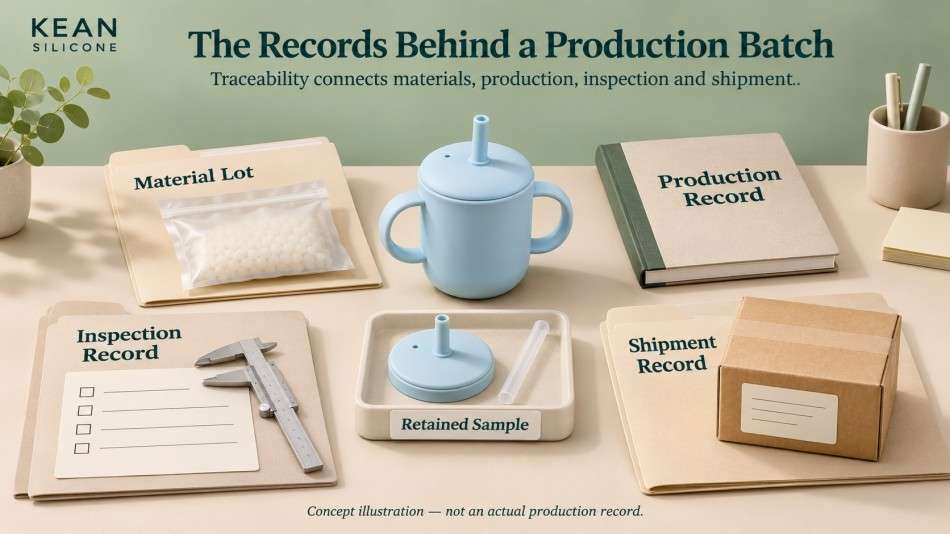
Traceability gives production records a practical purpose: identifying what was used, what was made and where it went.
Consider a hypothetical report that some cup lids from a shipment fit differently from the approved sample. An effective investigation would need to establish which production batch was involved, which material lots were used, which mold produced the parts and what the inspection records showed.
Without those connections, the investigation becomes broader and less precise.
A useful traceability structure links the finished batch to the relevant material, production, inspection and shipment information. Where applicable, mold or cavity identification can help narrow the investigation further.
The objective is to make it possible to distinguish an isolated issue from a wider problem and support a proportionate response.
Approved Samples Need Written Specifications
A retained sample is valuable for comparing color, texture, appearance and general assembly. However, it cannot communicate every acceptance requirement.
Written specifications should define the characteristics that matter to the product, including relevant dimensions, tolerances, material requirements and functional checks.
For a custom baby cup, the agreed reference package may include:
Approved drawings and component specifications.
Identified materials and colors.
Retained samples.
Appearance criteria.
Assembly instructions.
Defined leakage and flow evaluation methods.
Packaging and labeling requirements.
Together, these provide a clearer production reference than a sample alone.
Changes also need review. A different pigment, revised lid geometry or replacement component supplier may affect previously approved characteristics. The appropriate response depends on the change and can include further sampling, inspection or testing.
What the Audit Milestone Means for OEM and ODM Cooperation
For a brand developing silicone baby products, factory assessment supports a broader conversation about how the project will be controlled.
That conversation begins during development. The customer and manufacturer need to agree on the product specification, intended market, testing needs and approval stages.
It continues through production, where the approved requirements must be translated into working instructions and inspection criteria.
It also extends to repeat orders. A replenishment order should refer to the approved product revision, materials and packaging rather than rely on an informal understanding of what was supplied previously.
KEAN’s third-party audit milestone provides a basis for discussing the assessed manufacturing controls with customers. Project-specific product documentation and testing still need to be selected according to the actual product and destination market.
Frequently Asked Questions
Does passing this audit mean KEAN is an FDA-approved factory?
No. This was a third-party factory audit conducted against FDA-related requirements within its scope. It should be described according to the audit report, rather than as FDA approval.
Does the factory audit replace finished-product testing?
No. Factory assessment and product testing serve different purposes. The applicable tests depend on the product, materials, intended use, target market and claims.
Is a raw silicone material report sufficient for a colored finished product?
It can support material evaluation, but its coverage must be reviewed. Pigments, other components, processing conditions and the finished article’s use may require additional evidence.
Why does traceability matter for repeat orders?
Traceability helps connect a finished batch to its materials, production and inspection records. It supports investigation when a later order performs differently from the approved reference.
What should a brand confirm before starting a custom project?
Confirm the intended product and market, material and component specifications, approval process, inspection criteria, testing responsibilities and packaging requirements. Any audit claims should be checked against the relevant report and scope.
For custom silicone baby product development, contact KEAN Silicone to discuss product specifications, available supporting documentation and project-specific quality requirements.


