


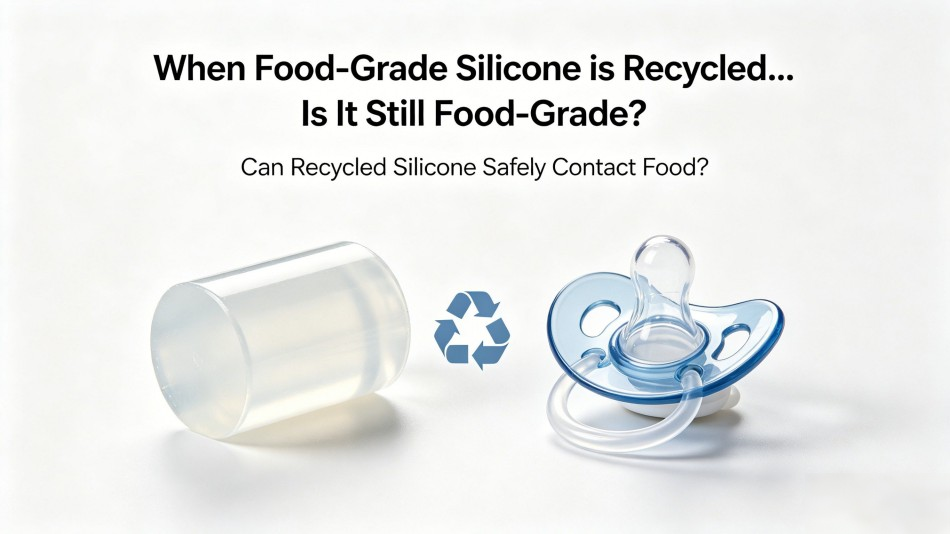
The short and accurate answer is: not automatically! A recycled food-grade silicone product does not automatically remain food safe due to its former grade. A recycled food-grade material will only become safe to contact food if it passes the regulatory requirements of the FDA, EU, and LFGB after recycling. The fact that it was food-safe initially doesn't mean it will remain food-grade. Instead, it must pass the food safety test again after it has been recycled.
What is Food Grade Silicone?
What does it mean when a silicone product is classified as food-grade? It simply means it is not a regular silicone product, but rather a pure and safe version that can be used to hold water, other types of liquids, and food items at different temperatures. Food-grade silicone is made from the naturally occurring silica (sand) combined with hydrogen and carbon.
Also, it's tasteless, non-toxic, odorless, and meets the strict health standards of the FDA, LFGB, and other relevant bodies.
Many manufacturers often rely on virgin silicone for the production of food-grade items. Virgin material refers to highly pure material, fresh, non-recycled, chemically stable, and non-harmful silicone. This type of material produces high-quality food-grade silicone items.
How Food-grade Silicone is Defined across Continental Markets
In the United States market, the FDA defines silicone as food grade when it passes the FDA 21 CFR 177.2600 regulations for rubber articles intended for repeated use in food contact applications. The regulations state that only non-toxic fillers and curing agents can be added to produce food-safe silicone products. It must be BPA-free, BPS free, and free of lead & phthalates.
As for the European market, the EC 1935/2004 framework, the Council of Europe resolution Res AP 2005(5), and the extremely strict German LFGB are what define silicone as food grade. It must be free of toxic material like the FDA regulations states. In addition, fewer fillers are allowed, and no unpleasant smell or aftertaste must result especially at high temperature.
Recycling Process for Silicone
So far, we've seen what determines if a recycled food-grade silicone item will retain its food-grade status. Now, we’ll examine the recycling process for silicone items. Since silicone is a crosslinked elastomer, only two major recycling methods are applicable.
Mechanical Recycling Process
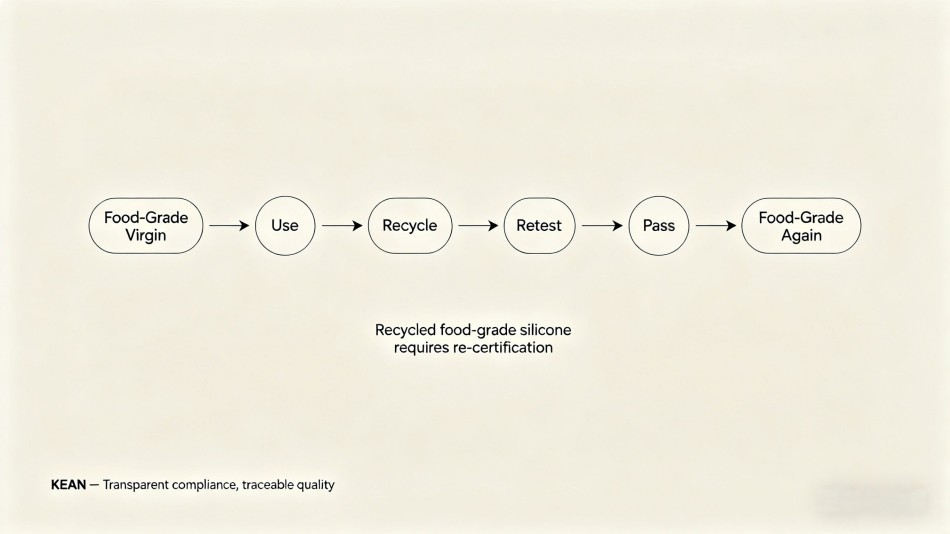
Mechanical recycling of silicone involves the collection, sorting, cleaning, and grinding of waste/used silicone into a powdery state, then using it as filler to produce new products.
Advantages of Mechanical recycling:
It consumes less energy than chemical recycling.
It requires simple technology and equipment.
Its processing cost is low.
Challenges:
The end result is low quality compared to fresh, non-recycled items made from virgin silicon.
Careful sorting is essential to avoid contamination
The silicone loses quality each time it is recycled. Some often call it downcycling instead of recycling.
Chemical Recycling
Chemical recycling uses a method called depolymerization to break down silicone waste into useful monomers through catalysts (acids or bases) and heat, allowing the waste to be re-polymerized into high-quality silicone.
Advantages of chemical recycling:
The process produces high-quality silicone, a lot better than mechanical recycling.
The recycled silicone is close to virgin silicone.
It can theoretically produce food-grade silicone if properly coordinated.
It retains quality over multiple recycling rounds.
Challenges:
The process is complex and expensive
It has high energy requirements
It requires sophisticated equipment
How Recycling Affects Food-grade Properties
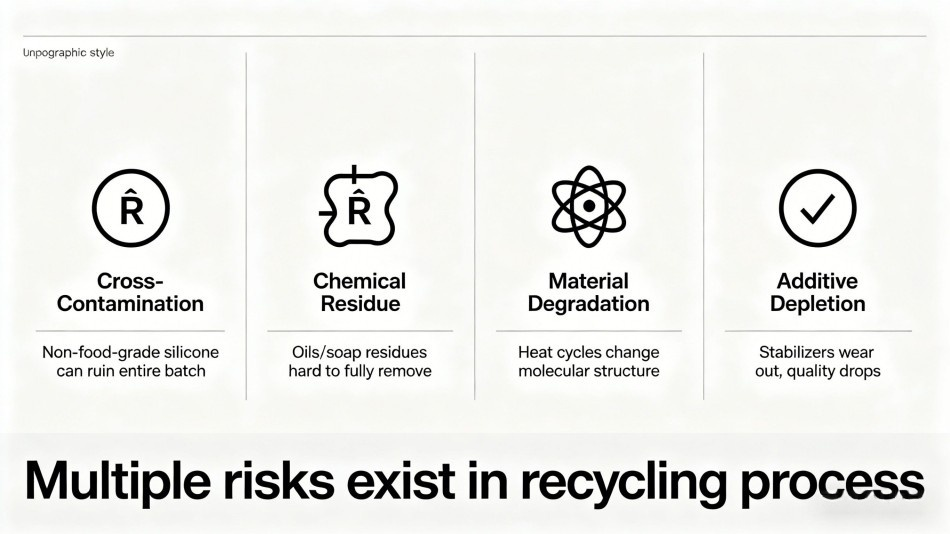
Be it mechanical or chemical recycling, retaining the food-grade property of silicone items comes with a lot of potential risks. Some of these include:
Cross Contamination: Cross-contamination during silicone recycling is a huge threat to retaining the quality and food-grade nature of a silicone item. It often occurs during material collection and sorting when non-food-grade silicone or an industrial silicone with prohibited additives finds its way into the food-grade pack. A trace amount of non-food-grade silicone is enough to contaminate the entire process, causing the final product to fail the migration test.
Chemical Residue: Food-grade silicone tends to have chemical residue after numerous uses. These residues can be food oils, soap or cleaning agent residue, microbial contaminants, etc. Of course, chemical recycling processes can eliminate these residues; however, mechanical recycling may fail to completely remove it, thereby affecting the final result.
Material Degradation: After repeated high temperature and pressure during recycling, the molecular structure of silicone starts to change, affecting the durability, strength, stability, and temperature resistance of the recycled product. Material degradation is highly likely to happen in mechanical recycling.
Additive Depletion: During silicone production using virgin material, stabilisers are often added. When recycling, the stabilizers can be exhausted, reducing the quality of the final product. The recycled item may be missing the additive that maintained the food safety in the initial version.
All of the risks examined explain why recycling affects the food-grade property of silicone.
Current Regulations and Certifications of Recycled Food-grade Silicone
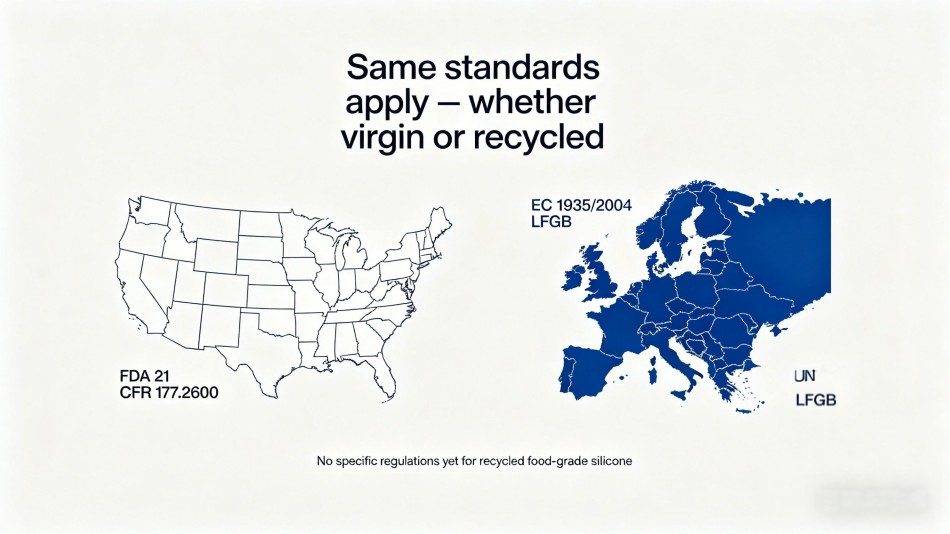
Currently, in Europe and America, there are no specific regulations designated to guide the production of recycled food-grade silicone items. However, recycled food-grade silicone is still covered by the frameworks that regulate the production of virgin silicone food-grade products in the US and Europe.
In Europe, all silicone products, whether new or recycled, must meet the (EC) No 1935/2004, which stipulates that the migration of any constituents shouldn't be at levels dangerous to human health. Additionally, the (EC) No 2023/2006 that ensures the best production practices provides principles to follow.
In the US, the FDA also doesn't have special guidelines for recycled food-grade silicone. What is expected under Title 21 of Federal Regulations — CFR 177.2600 is that every silicone product meets the purity, composition GMPs and other relevant requirements. It doesn't matter if it's recycled or virgin silicone.
Who Verifies the Quality and Safety of Recycled Food-grade Silicone
The responsibility of verifying the quality and food safety of recycled food-grade silicone lies with the manufacturer. Every manufacturer is mandated to ensure all food-grade silicone products meet the requirements of each jurisdiction they sell.
Important Recommendations and Tips for Businesses and Consumers about Recycled Food-grade silicone
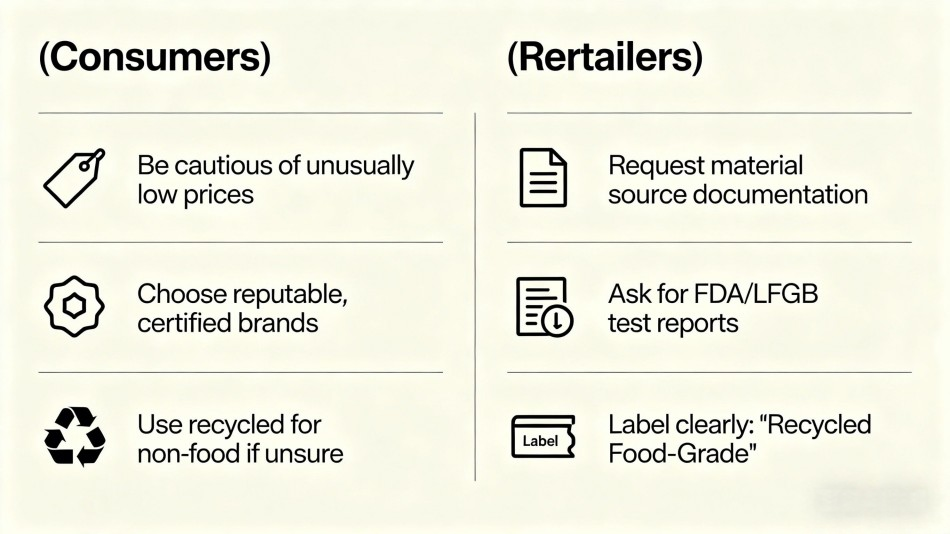
As a food-grade silicone distributor, retailer, food service owner, or end user, there are important points to consider before purchasing recycled food-grade silicone.
Recommendations for consumers
Be cautious of unusually cheap recycled food-grade silicone. Such claims are unreliable, especially without proper certifications.
Go for reputable manufacturers with a proven record of quality delivery and transparency. Make sure to look for information on their recycling sources and safety procedures.
FAQ
Q1: Does KEAN use recycled silicone in baby pacifiers or food-contact products?
A: No. As highlighted in the article, recycled silicone may lose its food-grade properties due to contamination and material degradation. KEAN exclusively uses 100% virgin, platinum-cured silicone to ensure the highest level of purity and safety for babies and food contact.
Q2: If recycled silicone isn't automatically food-grade, how does KEAN guarantee its products are safe?
A:We bypass the risks of recycling entirely by using 100% virgin material. Additionally, all our products are FDA and LFGB certified and undergo rigorous migration testing. We provide full material traceability documentation for every batch.
Q3: Are your materials traceable as mentioned in the "KEAN Solution"?
A:Yes. Our wholesale silicone baby products are made with fully traceable materials. We can provide raw material certificates upon request.
Q4: I'm a brand owner. How can I be sure you aren't mixing recycled material into production?
A:KEAN is a BSCI and ISO9001 certified manufacturer. We maintain strict incoming quality control and segregation of raw materials. We also offer Factory Transparency Audits (both virtual and in-person) at our Shenzhen facility to verify the production process.
Q5: How should I dispose of KEAN's silicone baby products responsibly?
A:While KEAN silicone is extremely durable and long-lasting, if you do need to dispose of it, please check with local recycling programs. As noted in the article, if you are unable to verify the recycling stream's purity, consider repurposing old silicone items for non-food uses (e.g., drawer liners, pet mats) as an environmentally responsible option.
Q6: What certifications do you hold to support the claims in this article?
A:We hold ISO9001 (Quality Management), BSCI (Social Compliance), and our products are compliant with FDA 21 CFR 177.2600 and LFGB standards. We also support additional testing such as F963 and EN71 upon request.


