


Have you ever shipped the silicone products and after receiving them, you noticed a thin layer of white powder on the surface of the product? It is a surprisingly common situation across the industry, yet many buyers still judge it as a defect. This kind of misperception may lead to unnecessary recalls, product launchs, and relationships with suppliers will be sour. Conversely, ignoring the problem without understanding the science behind it can hide deeper formulation flaws.
What appears to be an ordinary cosmetic problem is the apparent manifestation of known polymer chemistry. Having understood the cause of the formation of the residue and the variables that cause it, you can manage it with improved formulations, curing, and environmental management. For brands that rely on silicone for baby products, kitchenware, pet accessories, or consumer goods, understanding this phenomenon protects both product performance and your reputation.
What Exactly Is the White Powder?
The appearance of the powder is dust, but it is usually a surface bloom. In polymer science, the term "blooming" is applied to refer to the relocation of low molecular weight materials within the interior and exterior of the material. Silicone is a crosslinked elastomer, although the network will always have small unreacted molecules and additives. These molecules are dispersed to the surface under the right conditions and form a fine powder or produce a slightly matte appearance. That is why you may find little dots, a smoky look, or a chalky touch on silicone goods that have been in storage or transit.
There are several mechanisms that work to drive this.
1. Additive migration: This is caused by the fact that not all the additives are bonded fully to the silicone matrix. These molecules move upwards and build up when the polymer relaxes during storage.
2. Silicone oil exudation: In this case, excess silicone oil enhances flexibility and it moves freely with ease, particularly when crosslink density is minimal.
3. Volatile siloxane condensation: Cyclic siloxanes (D3, D4, and D5) have the ability to evaporate and condense later in the form of small particles.
4. Micro-abrasion: When the product is not completely cured, transportation vibration may form tiny flakes on its surface.
This is why the residue appears more frequently after long supply chain journeys involving heat, pressure, and weeks of vibration.
Why Transportation Makes Bloom More Noticeable
Silicone products are not bound to stay in one place for long. They tend to pass through a number of environments that do not appear similar before they are found in a warehouse or on a store shelf. In the case of most brands in the US, this trip typically begins in a hot and sticky factory, moves out through shipping ports, crosses several climate regions in a container and finally arrives in warehouse storage and domestic trucking. Every phase subjects the material to changes in temperature, pressure and humidity, which increases the visibility of blooming.
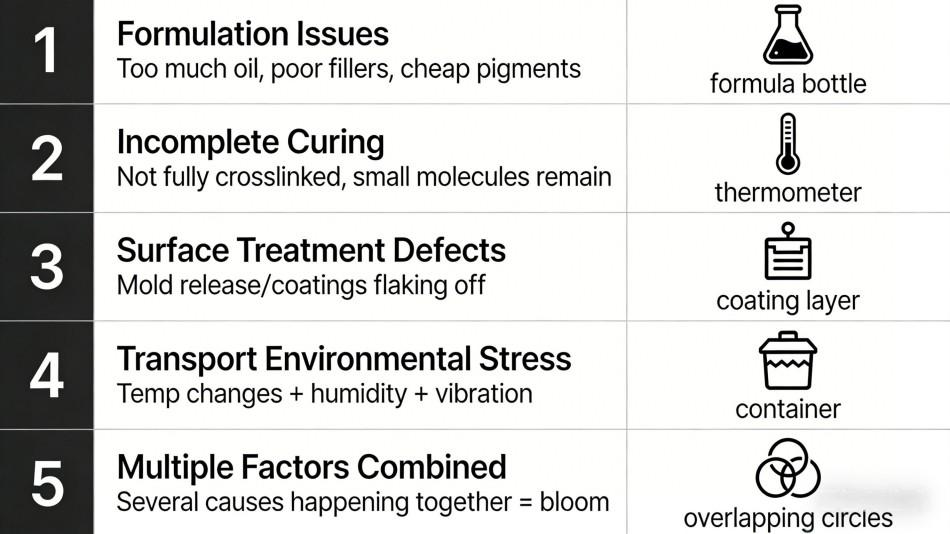
1. Formulation Problems
Not all silicone is created with the same care. When a formula contains more silicone oil than necessary, uses fillers that are not well dispersed, or includes cheaper pigments, the material becomes more prone to migration. Low quality silica fillers are especially risky because they create uneven surface energy inside the silicone. That imbalance encourages small molecules to separate and rise to the surface.
Brands often judge quality only by looking at the finished product. But many of the issues that cause blooming start much earlier, during formulation, long before the item ever leaves the factory.
2. Incomplete Vulcanization and Post-Curing
For silicone to stay stable, it needs to be fully crosslinked during curing. If the curing process is rushed or inconsistent, unreacted oligomers remain trapped inside the material. During transit, especially in warm conditions, these small molecules slowly migrate outward. When they reach the surface, they crystallize and create the powdery appearance we call bloom.
Post-curing plays an equally important role. A high temperature post cure is needed so that the volatile compounds can be emitted out of the silicone prior to being packaged. In case this step is not taken or made short, the material will keep on releasing volatiles in the course of storage and transportation, which ultimately appears on the surface.
3. Surface Treatment Defects
It is not the material that leaves some residue on silicone, but the surface treatments that are applied during its manufacturing. Mold release agents, coatings, or plasma treatments can fail under stress. Coatings that are not bonded or are uneven in nature tend to flake. These flakes may appear almost the same as the blooming, although the reason is different.
4. Environmental Stress During Transport
The conditions inside a shipping container are usually unstable. Temperatures rise during the day and fall at night. Humidity levels shift as the container moves across different regions. Boxes are stacked tightly, creating pressure, friction, and constant vibration.
All of these factors increase the mobility of small molecules inside the silicone. Heat makes them move faster. Humidity can trigger tiny crystallization reactions. Friction creates micro abrasion that releases small flakes. This combination is why blooming tends to be more noticeable after international ocean transport compared to shorter domestic routes.
5. Interaction Effects
In practice, blooming is almost always the result of several factors happening at once. A formulation that is slightly oily might still perform fine if the product is fully cured and stored properly. But if that same formulation receives weak post-curing and then goes through a long, warm shipping route, bloom becomes very likely.
These overlapping conditions create the perfect environment for silicone bloom to appear, even when the material is generally well made.
Does the White Powder Affect Performance or Safety?
The powder in most instances is harmless. It does not imply that the silicone is polluted, neither does it usually signify a threat to health. Nevertheless, the occurrence of bloom can tell something about the quality of the production process on the whole.
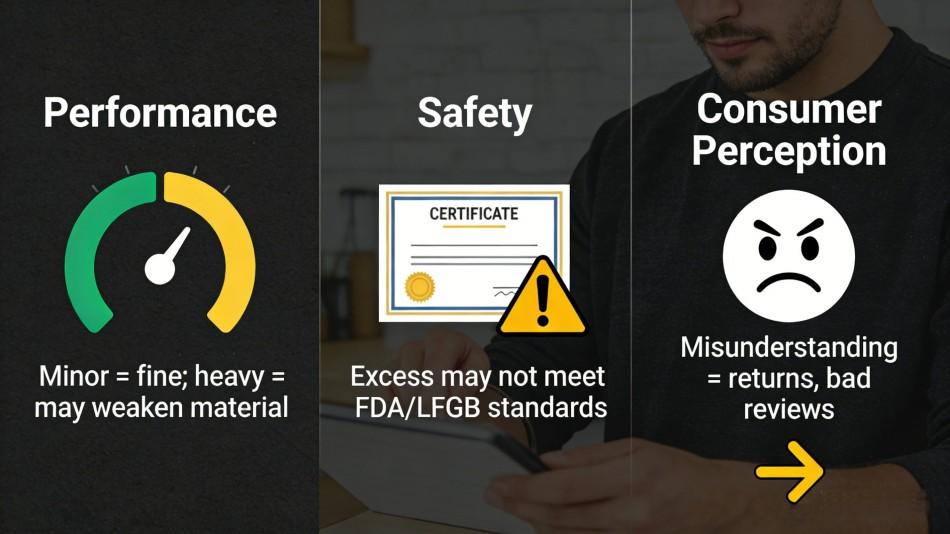
1. Performance considerations: A small cosmetic blossom is healthy and it does not interfere with performance. However, when the powder is thick or oily, then it could indicate that there is a low crosslink density in silicone. Elasticity, strength and recovery are influenced by low crosslink density.
2. Safety considerations: In the case of products that come into contact with food or those that are put in the mouth of a baby, regulations like FDA CFR 177.2600 and LFGB restrict the quantity of extractable and volatile product that can be permitted. The surplus bloom may be an indication that it has not been cured sufficiently to achieve those standards.
3. Consumer perception: This part is often overlooked. Even if the product is perfectly safe, consumers who do not understand blooming may assume something is wrong. A confusing first impression can lead to returns, negative reviews, and higher support costs.
How to Remove the White Powder
If the bloom is superficial, removal is straightforward.
1. Rinsing with warm water and a mild surfactant
2. Light wiping with a soft cloth
3. Gentle heating to evaporate volatile molecules
4. Plasma or ozone cleaning when the surface has stubborn residues
These methods clean the surface, but they do not correct underlying process flaws.
How to Prevent White Powder Formation
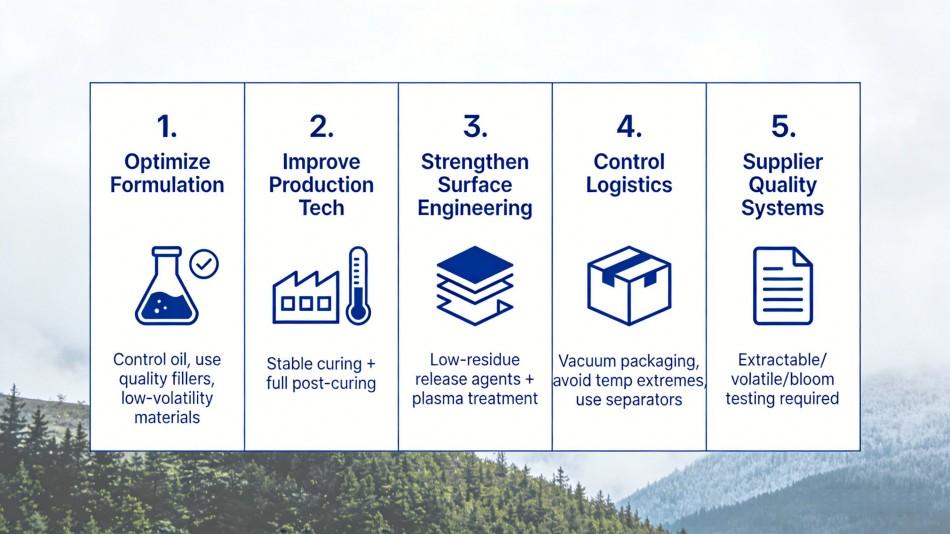
1. Optimize Formulation
This is a maximum leverage point of prevention.
● Minimize silicone oil content to an acceptable level.
● High dispersibility silica fillers should be used.
● Choose additives that are not volatile and are very compatible.
● Select polymer bases that have low cyclic siloxanes.
Downstream bloom is prevented completely by brands that specify formulation requirements early.
2. Improve Production Technology
● Stable vulcanization temperature and time windows are to be used.
● Use the correct post curing to eliminate the volatiles.
● Unify mixing and molding parameters.
● Keep a close monitoring of batch discrepancies.
A well controlled process reduces migration by increasing crosslink density.
3. Strengthen Surface Engineering
● Switch to low residue mold release systems.
● Enhance the adhesion of coating by plasma or corona treatment.
● Perform adhesion tests prior to production.
4. Control Logistics Conditions
● Use vacuum sealed or moisture barrier packaging.
● Restrict exposure to extreme temperatures .
● Reduce product-on-product friction using separators.
Even a perfect formula can still boom in cases where logistics are not well managed.
5. Build Better Supplier Quality Systems
Brands benefit from requiring extractable testing, volatile residue analysis, and bloom testing. It reduces risk and creates an objective standard for every batch.
KEAN’s Approach
At KEAN, we understand that surface bloom is more than a cosmetic issue—it’s a reflection of the entire manufacturing process. That’s why we’ve built a proactive, multi-layered production system designed to eliminate the risk of white powder formation at its source. By controlling every step from raw material selection to final packaging, we ensure your products arrive perfectly clean, maintaining their quality and your brand’s reputation.
1. Premium Raw Material Selection
We begin by sourcing only high-purity, low-volatility silicone polymers and food-grade additives from certified suppliers. Our strict incoming material standards minimize the presence of unstable siloxanes and non-bonding oils—the primary internal drivers of residue formation.
2. Precise, Stable Formulation Design
Our R&D team tailors each compound with carefully controlled silicone oil ratios and optimally dispersed fillers. We avoid over-plasticization and select additives with high compatibility to the silicone matrix, ensuring a homogeneous mix that resists molecule migration under thermal or mechanical stress.
3. Advanced Manufacturing & Curing Technology
Using automated, closed-system production lines and precise vulcanization controls, we achieve complete and uniform cross-linking. A mandatory high-temperature post-curing stage is applied to drive off volatile components before packaging, leaving no residuals to migrate to the surface later.
4. Rigorous Multi-Stage Inspection
Every batch undergoes our multi-tiered quality verification, including accelerated aging tests, volatility analysis, and surface residue checks. This comprehensive screening simulates long-haul transport conditions to catch potential blooming before your products leave our facility.
5. One-on-One Customized Solutions
We recognize that different products face unique logistical and usage environments. Whether you produce baby goods, kitchenware, or others, KEAN provides tailored formulation and process recommendations to meet your specific needs, ensuring product integrity from factory to end-user.
This ensures a stable product even under long transport cycles.
Conclusion
It is no enigma when you find white powder on silicone, nor an accident in manufacture. It is always because of something, which is connected to the behavior of the material and what it experiences during the manufacturing and transportation. When you realize the science of that reaction, it is much easier to prevent it.
Brands with more powerful formulations, more precise curing and smarter logistics have cleaner products and fewer returns all the time. The difference is also spotted by the customers. In the US market especially, where expectations are high and reviews can make or break a product, managing issues like bloom is about more than material science. It is a key part of building long-term brand stability and trust.
Partner with KEAN for Confident, Bloom-Free Deliveries
By integrating superior materials, scientific formulation, and disciplined manufacturing, KEAN delivers silicone products that stand the test of time and transit. Let us help you build a product experience defined by quality and reliability.


