


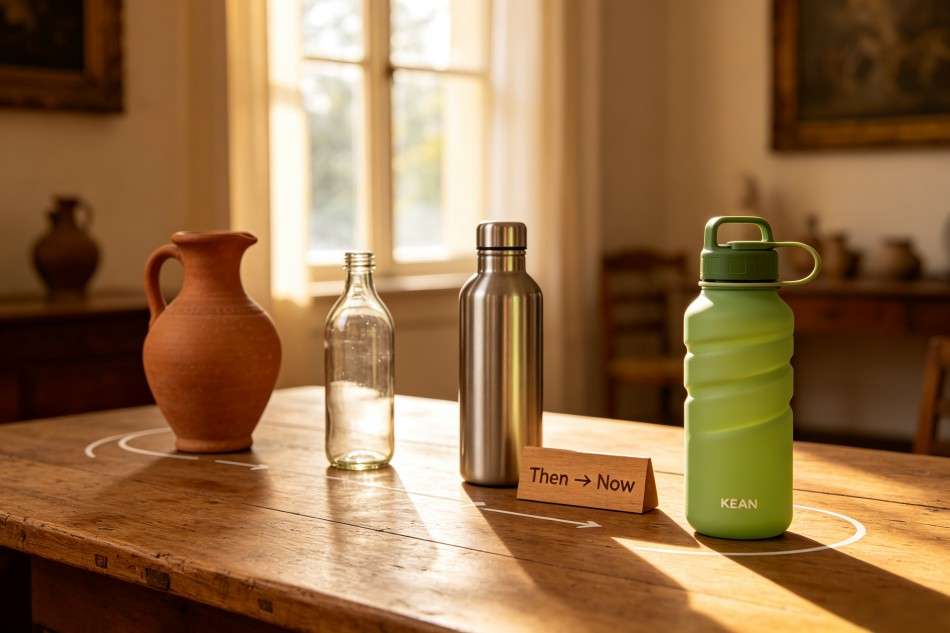
A journey through time — exploring how water containers evolved from clay and animal skins to the reusable, sustainable options we use today
Introduction: A Story as Old as Civilization
The need to carry water is as old as humanity itself. Before the first cities were built, before the first wheel was invented, humans needed a way to transport life's most essential resource from its source to where they lived, worked, and travelled. This need drove innovation across millennia — from animal skins and clay pots to glass, aluminium, plastic, and now silicone.
The water bottle is not a modern invention. It is a solution that has been evolving for thousands of years, shaped by technology, culture, and changing human needs.
This article explores the full history of water bottles — from ancient vessels to the rise of plastic, the environmental backlash, and the emergence of silicone as a superior, sustainable material. It also examines the history of travel bottles and explains why silicone is increasingly replacing plastic for brands and consumers alike.
Part 1: The Earliest Water Containers (Ancient Times – 1600s)
From Nature's Vessels to Early Craftsmanship
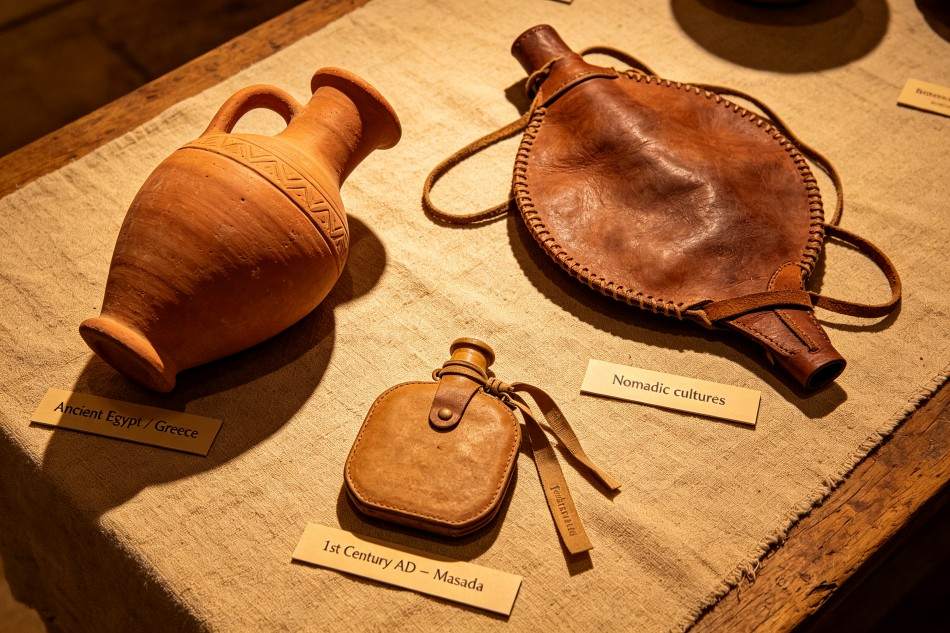
Long before bottles were "invented," people carried water in containers made from materials provided by nature. The earliest water carriers were practical, not decorative — they needed to be waterproof, portable, and durable enough for travel.
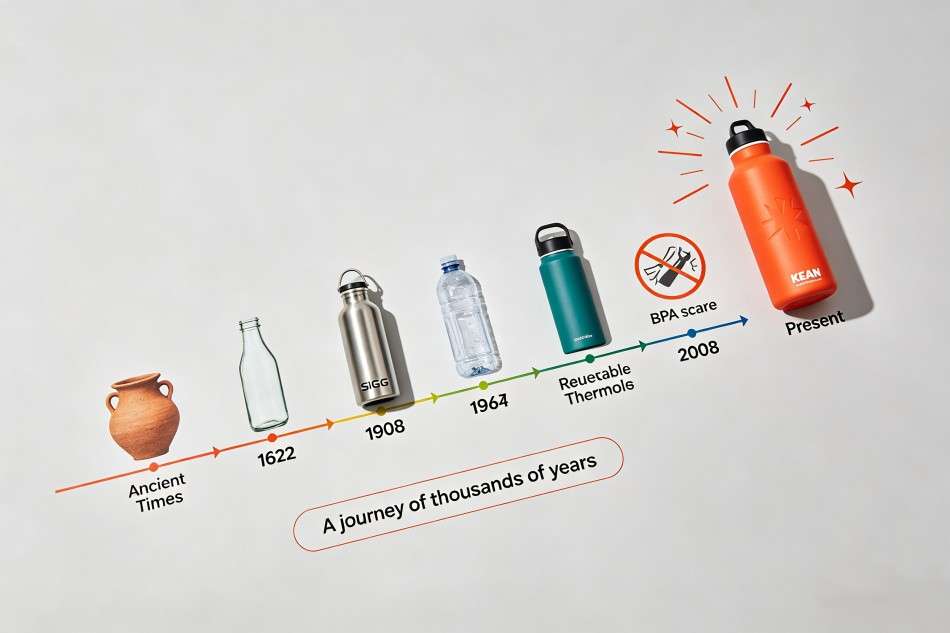
Ancient Egypt and Greece: The first known examples of water vessels date back to these civilisations. They were typically made from clay, ceramic, or glass and often took the form of amphorae or simple jugs .
Animal skins and bladders: In many cultures, people used water skins made from animal hide. Sometimes referred to as "water bladders," these were particularly effective for storing wine or water during long journeys. Knights in battle and travellers across desert regions relied on them .
Clay and stoneware: By the 1800s, bottles were crafted from clay or stoneware, primarily used to hold gin or whiskey from local distillers. Farmers in the 1900s kept cool in the fields with refillable glass bottles, filled by industrial well pumps .
The pilgrim bottle: One of the earliest known "travel bottles" dates back to the 1st century AD. Archaeological finds from the Judean fortress of Masada reveal a flat-sided bottle with two small handles on either side of the neck. A ribbon threaded through the handles allowed travellers to hang the bottle around their neck. The relatively flat side rested against the body, while the voluminous belly allowed for carrying sufficient water .
The Evolution of Shape and Form
Since the latter part of the 12th century, most bottles for containing water were constructed with necks . As the industry evolved, bottle forms and dimensions rapidly changed. By the time of the European pilgrimages, bottles were often designed specifically for travel — flat, portable, and sometimes decorated for more affluent travellers .
Part 2: The Glass Bottle Era (1600s – Early 1900s)
The Birth of Commercial Bottled Water
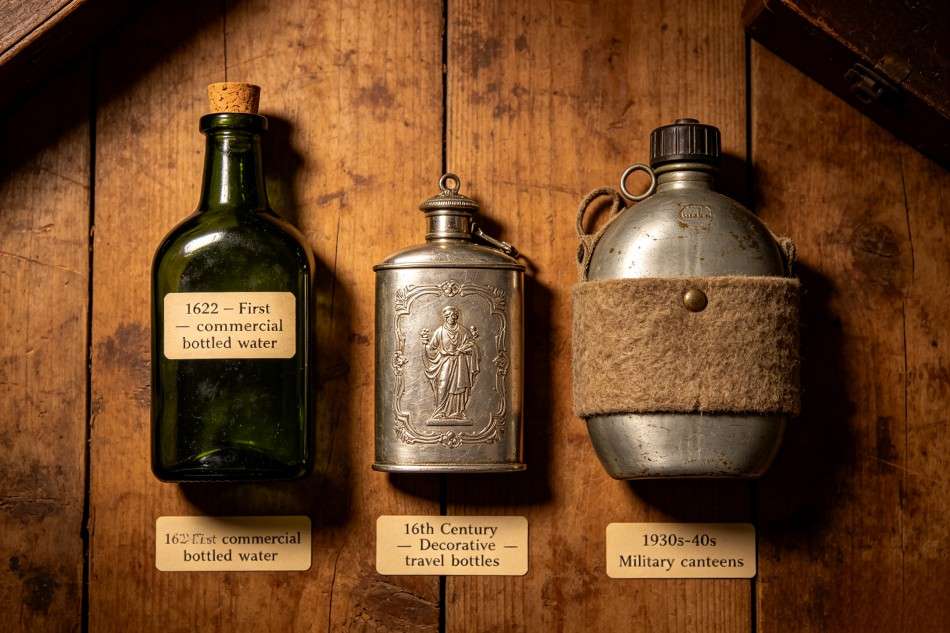
The first recorded instance of commercial water bottling occurred in 1622 at the Holy Well in the United Kingdom. People made religious pilgrimages to the site, believing the water had healing properties. Recognising the commercial potential, entrepreneurs began bottling the water in glass containers sealed with cork to sell to those who could not make the journey .
Glass bottles at this time were rudimentary compared to modern standards. They were heavy, fragile, and transported by horse-drawn carriages, limiting the reach of distribution. Yet they marked the beginning of the bottled water industry.
Industrialisation and Mass Production
The bottled water industry truly took off in the early 19th century when new glass technologies made bottles more affordable and practical for mass production. By 1856, over 7 million bottles were being produced annually at Saratoga Springs, one of the most popular early bottled water sources, selling for up to $1.75 per pint .
In the 1930s and 1940s, soldiers relied on reusable canteens made from enameled steel. These held roughly two pints and were covered in felt to make them easier to carry .
The First Metal Bottles
In 1908, SIGG was founded in Zurich, Switzerland. The company believed that aluminium was the future and began manufacturing not just metal bottles, but also cookware and household items. By the 1950s, SIGG had become a frontrunner in the production of metal water bottles .
Stainless steel products were mass-produced in the 1950s, marketed as more durable and healthier to drink from than plastic or aluminium .
Part 3: The Plastic Revolution (1947 – 2008)
The Rise of Plastic
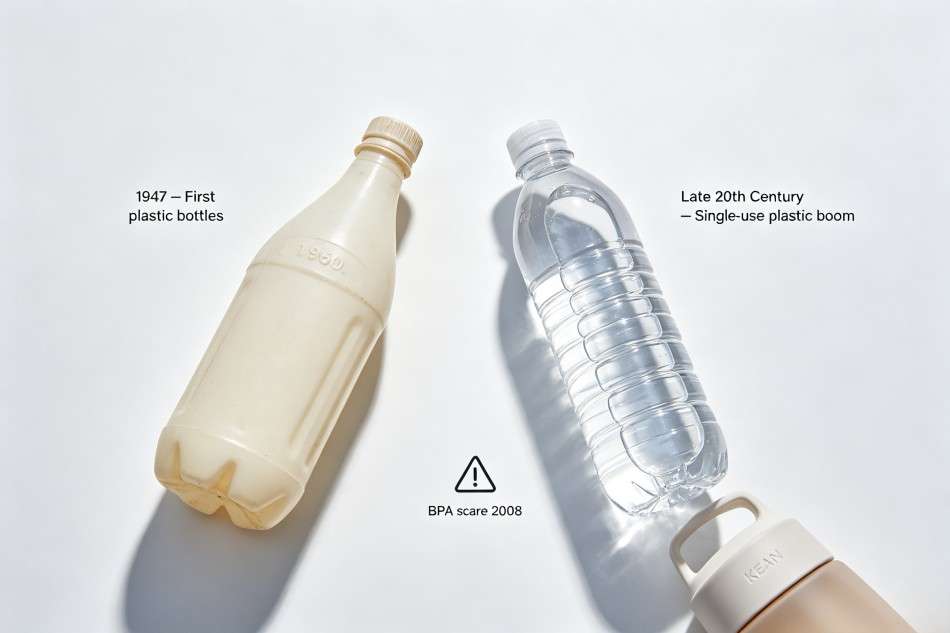
Plastic became a popular material after World War II. The first plastic water bottles appeared in 1947, though they were initially expensive before polyethylene became widely used .
In the 1960s, polyethylene started being used in water bottles. This material was more affordable, lightweight, and easy to shape into fun designs. Companies like Coca-Cola also began advertising on water bottles .
The Reusable Bottle Movement
Hydration became a mainstream concern. By the 1970s, carrying a water bottle was becoming a cultural norm, not just a practical necessity.
The BPA Scare and Industry Shift
In 2008, consumers began to question the presence of Bisphenol-A (BPA) found in some water bottles. The health concerns around BPA led to significant changes in the industry. Many companies today ensure that bottles used to contain liquids are certified BPA-free .
Part 4: The Sustainability Era (2008 – Present)
The Environmental Backlash
The widespread use of plastic water bottles has had significant negative impacts on the environment and the oceans. Billions of plastic bottles end up in landfills or oceans each year, taking hundreds of years to decompose .
In addition, the production of plastic requires large amounts of fossil fuels, contributing to climate change. The transportation of plastic bottles adds further to their carbon footprint .
The Rise of Reusables
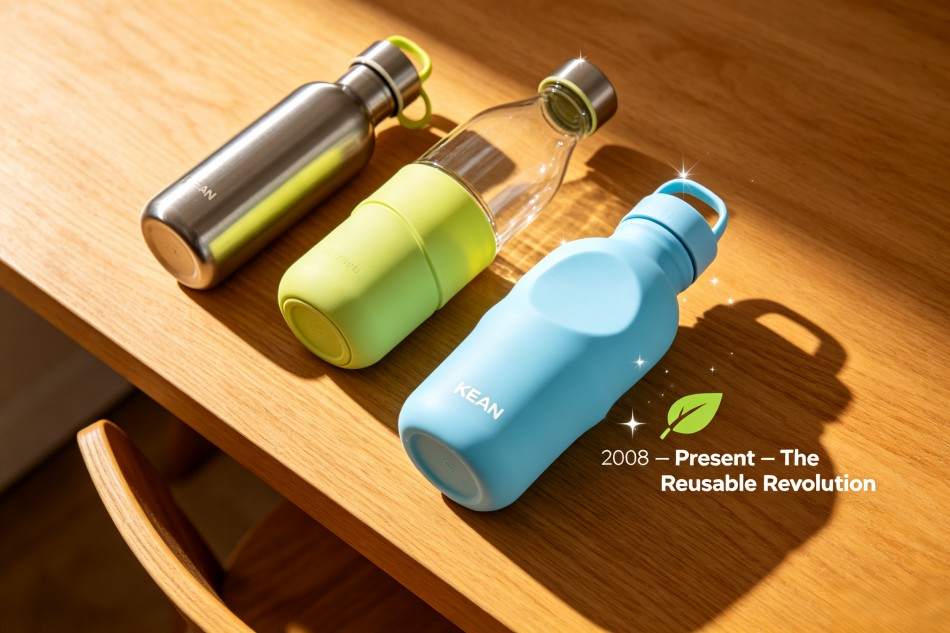
In light of these negative impacts, demand for sustainable alternatives has surged. Brands like Hydroflask (founded 2009) and Stanley (founded 1913, but gaining renewed popularity) have emerged, offering double-wall vacuum-insulated stainless steel bottles with optimal temperature retention .
Glass Makes a Comeback
Interestingly, glass bottles have also seen a resurgence. In 2012, CamelBak released its Eddy Glass bottle, which came with a removable silicone sleeve for protection and grip — recognising that glass, while perceived as "pure," is fragile for outdoor use .
The trend is clearly towards reusable, sustainable, and non-toxic materials. Consumers are increasingly aware of environmental impact and health concerns.
Why Silicone Is Replacing Plastic in Travel Products
Silicone offers a unique combination of benefits that make it ideal for travel and reusable products.
Feature | Silicone Advantage |
Durability | Won't crack, shatter, or dent — unlike glass, plastic, or metal |
Flexibility | Collapsible designs save up to 70-80% space when empty |
Heat resistance | Withstands -40°C to 200°C — dishwasher and microwave safe |
Non-porous | Doesn't harbour bacteria or absorb odours (high-quality grades) |
BPA-free | Safe for food and drink contact; certified to FDA and LFGB standards |
Reusable | Long lifespan reduces waste compared to single-use plastic |
Lightweight | Easy to carry — ideal for travel and outdoor activities |
Part 5: The History of Travel Bottles
Ancient Travel Vessels
Travel-specific bottles are not a modern invention. The 1st-century pilgrim bottle from Masada was specifically designed for travel — flat-sided, lightweight, and equipped with handles for carrying .
By the 16th century, "pilgrim bottles" made from silver or fine ceramic were produced, often more decorative than practical. In fact, most forms were drawn from silver because the clay was exceptionally plastic and lent itself to applied decoration .
The Dandy Flask
Between 1890 and 1920, "dandy flasks" — small, flat-sided bottles — became popular for travellers. The Illinois Glass Company catalog included similar bottles in 1906. The capacity was typically about 16 ounces or less, and their portable size made them easy to carry or place in a pocket .
By 1920, the external screw thread finish became the dominant style, indicating how bottle design evolved to meet changing needs .
From Military to Mainstream
In 1937, soldiers stayed hydrated with reusable canteens made from enameled steel, which were later adapted for civilian use . In 1964, Thermos and Aladdin introduced reusable water containers for children, decorated with popular movie and television stars .
The Modern Travel Bottle
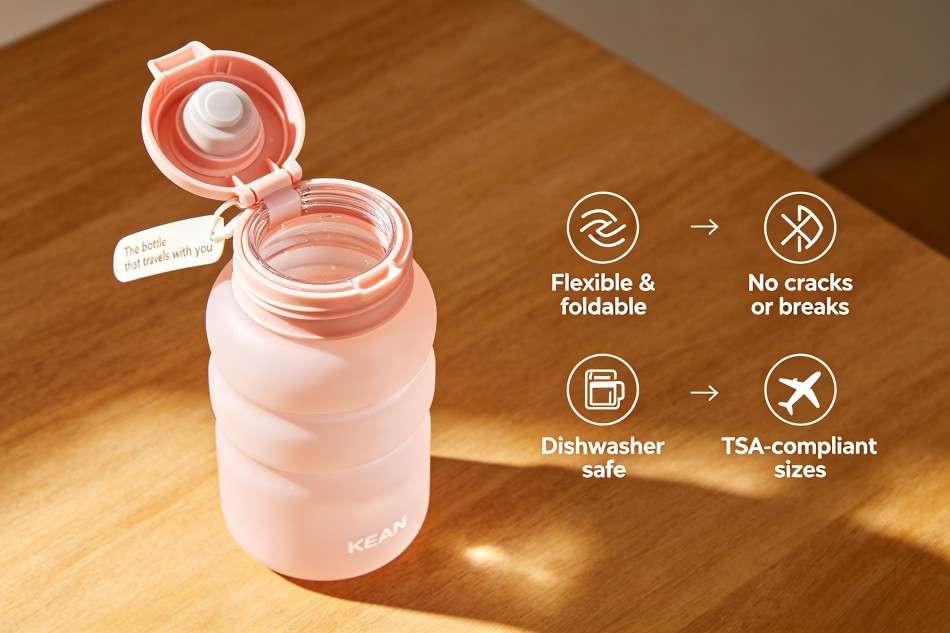
Today, collapsible silicone travel bottles meet the needs of modern travellers — lightweight, packable, and leak-proof. They are available in TSA-compliant sizes (3.4 oz / 100 ml) and are ideal for carry-on travel. Their collapsible design saves significant space when empty .
Part 6: The Future — Why Silicone Is Leading the Way
Trends Driving the Shift
Trend | Impact on Silicone Demand |
Carry-on travel growth | Collapsible silicone saves space |
Environmental awareness | Reusable replaces single-use plastic |
Health consciousness | BPA-free, non-toxic materials |
Minimalist packing | Lightweight, versatile designs |
Sustainable sourcing | Brands seeking certified, durable materials |
Key Takeaway
Silicone products, when manufactured to high standards, offer an optimal balance of convenience, durability, and sustainability. They are not just an evolution of the water bottle — they represent a new category of travel products designed for modern lifestyles.
What to Look For
Feature | Why It Matters |
100% food-grade silicone | Safe for food contact |
Platinum-cured | No byproducts, higher purity |
FDA / LFGB certified | Verified safety standards |
Collapsible design | Space-saving for travel |
Leak-proof | Reliable for carrying in bags |
Frequently Asked Questions
When was the water bottle invented?
The first known water vessels date back to ancient Egypt and Greece. The first recorded commercial water bottling occurred in 1622 at the Holy Well in the UK. The plastic water bottle emerged in 1947 .
When did bottled water become popular?
Bottled water became commercially significant in the early 19th century. By 1856, over 7 million bottles were being produced annually at Saratoga Springs . Plastic bottles dramatically increased popularity in the 1960s and 1970s.
How have water bottles evolved?
Era | Material | Key Characteristics |
Ancient times | Clay, animal skins | Portable, natural materials |
1600s-1800s | Glass, stoneware | Heavy, fragile, but reusable |
1900s | Enameled steel, aluminium | Durable, military and outdoor use |
1940s-2000s | Plastic | Lightweight, cheap, widespread |
2000s-present | Stainless steel, glass, silicone | Sustainable, reusable, safe |
Why is silicone replacing plastic bottles?
Silicone is durable, lightweight, BPA-free, flexible (collapsible), and heat-resistant. It does not crack or leach chemicals, and its long lifespan makes it more sustainable than single-use plastic .
What is the history of travel bottles?
Travel bottles date back to the 1st century AD — the pilgrim bottle from Masada was specifically designed for travel. Small, flat-sided bottles were used as "dandy flasks" in the 19th century. Modern silicone collapsible travel bottles have revolutionised the category .
When were silicone travel bottles invented?
Silicone travel bottles gained popularity in the early 21st century with the patenting of "semi-rigid beverage receptacles" made from food-grade silicone. They addressed the need for lightweight, collapsible, and unbreakable travel drinkware .
Conclusion: From Survival to Sustainability
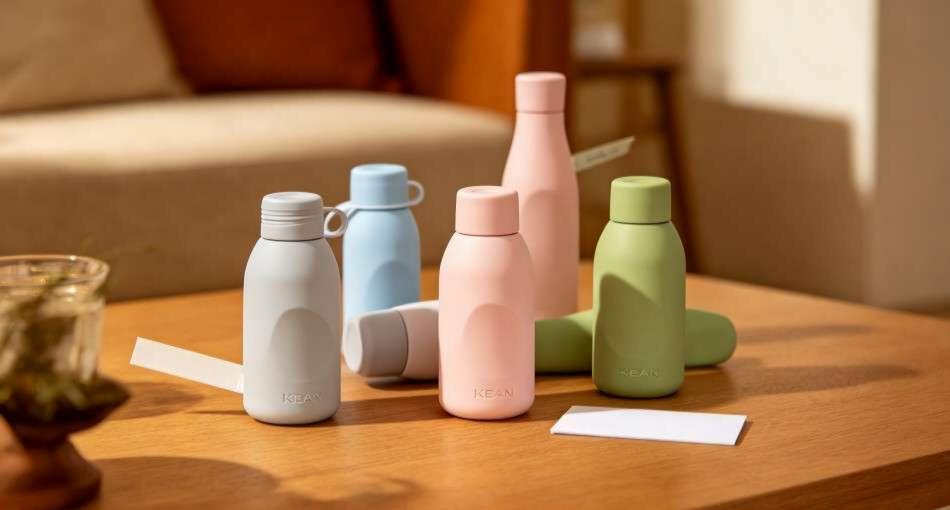
The history of the water bottle is a story of human ingenuity — from animal skins to clay vessels, from glass to plastic, from metal to silicone. Each era brought improvements in portability, durability, and convenience.
Today, we are at another turning point. The environmental and health costs of single-use plastic have become impossible to ignore. In response, consumers and brands are turning to materials that are safe, reusable, and durable.
Silicone represents the latest chapter in this story. It combines the best qualities of its predecessors — the durability of metal, the flexibility of plastic, the safety of glass — while addressing their shortcomings. It is a material for a world that values sustainability without compromising on convenience.
For brands, the shift to silicone is not just an opportunity — it is a necessity. Modern travellers expect products that are TSA-compliant, reusable, and lightweight. Silicone meets all these demands, making it the material of the future for travel bottles, food containers, and baby products.
This article is based on historical research, industry publications, and manufacturer specifications. Contact KEAN Silicone for custom silicone travel bottle solutions.


