


When sourcing custom silicone products, buyers often encounter a familiar distinction: liquid silicone rubber (LSR) is typically injection molded, while high-consistency rubber (HCR) is commonly compression molded.
But what happens when a manufacturer dispenses a viscous silicone material directly onto an open mold, closes the mold, and uses a compression press to form the product?
Does this mean liquid silicone rubber can also be compression molded?
The short answer is yes, under suitable material and processing conditions. However, not every LSR formulation is designed for compression molding, and the appearance of a liquid dispensing process does not necessarily confirm that the material is industrial LSR.
To understand this distinction, we need to separate two concepts: the physical form of silicone before curing and the manufacturing process used to shape it.
For brand owners, product developers, and procurement managers, this distinction is important when comparing tooling options, manufacturing costs, product quality, and production scalability.
This guide explains how silicone dispensing and compression molding work, how they differ from conventional LSR injection molding and HCR compression molding, and what B2B buyers should consider when selecting a manufacturing process.
1. How Does Silicone Dispensing and Compression Molding Work?
Silicone dispensing followed by compression molding combines two manufacturing operations: controlled material placement and mold-based shaping.
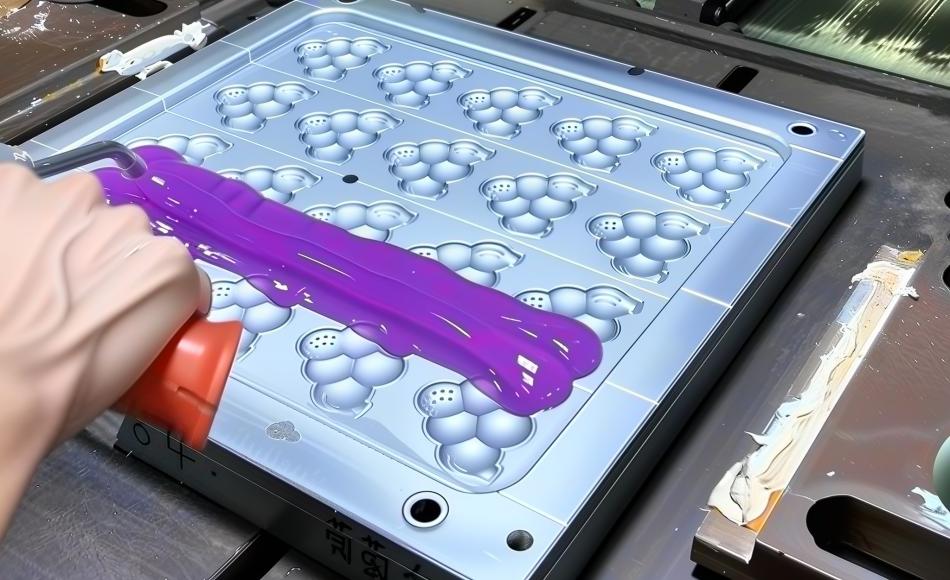
In this process, uncured silicone is dispensed onto an open mold. The mold is then closed, allowing the material to spread into the cavity under pressure. For heat-curable silicone formulations, the material subsequently undergoes crosslinking to form an elastic solid.
The term dispensing refers to delivering a measured amount of silicone to a specified location. It does not necessarily mean applying an adhesive or bonding two surfaces together.
Step 1: Silicone Material Preparation
The process begins with selecting a silicone formulation suitable for the intended manufacturing conditions.
For two-component liquid silicone systems, the components must be metered and mixed according to the material supplier's instructions. Color pigments may also be introduced when developing customized silicone products.
The processing requirements depend on the material formulation. Mixing ratio, viscosity, working time, cure behavior, and compatibility with pigments can all influence production performance.
For OEM buyers, simply specifying "liquid silicone" is not enough.
A more useful material specification should identify the required hardness, color, finished-product properties, and intended processing method.
Step 2: Controlled Silicone Dispensing
After preparation, the uncured silicone is delivered to selected locations on the open mold using a dispensing gun, metering system, or other suitable equipment.
The objective is to place the correct amount of material where it can be distributed effectively during mold closure.
This does not necessarily mean that every cavity must be completely filled before the mold closes. Depending on the tooling design and material behavior, a controlled dispensing pattern may allow the silicone to flow into the required areas under compression.
However, the amount and position of the material must be carefully controlled.
Insufficient dispensing may result in incomplete filling, while excessive material can increase flash formation, waste, and trimming requirements. Poor material distribution may also create difficulties with filling or air evacuation.
For multi-cavity molds, manufacturers must consider consistency across cavities rather than evaluating only a single finished sample.
Step 3: Mold Closing, Compression, and Curing
Once the silicone has been dispensed, the mold is closed.
Compression pressure causes the uncured material to spread and fill the available cavity space. Mold geometry, venting, material viscosity, and the closing sequence all influence how effectively the silicone fills the mold.
Air must be allowed to escape through an appropriate venting strategy. Vacuum assistance may be considered where suitable, but it is not a universal requirement.
For heat-curable silicone systems, the material is held under the specified curing conditions until sufficient crosslinking has occurred.
Unlike thermoplastic molding, where a material generally solidifies as it cools, silicone rubber curing involves a chemical reaction that creates an elastomeric network.
The appropriate mold temperature and curing time depend on the formulation, part geometry, and thickness.
Step 4: Demolding and Quality Inspection
After curing, the silicone product is removed from the mold.
Depending on the part and tooling, secondary operations may include flash trimming, visual inspection, dimensional checks, and performance testing.
Post-curing may also be required for certain formulations or applications, but it should not be assumed to be mandatory for every silicone product.
For B2B buyers, the important question is not simply whether the product can be molded.
It is whether the selected process can repeatedly deliver parts that meet the agreed specifications throughout mass production.
2. Liquid Silicone Compression Molding vs. LSR Injection Molding
One of the most common questions in silicone manufacturing is whether liquid silicone compression molding and LSR injection molding are essentially the same process.
They are not.
Although both may involve uncured liquid silicone materials, their material delivery and cavity-filling mechanisms differ.
What Is LSR Injection Molding?
Liquid silicone rubber injection molding typically uses a metering and mixing system to deliver two-component silicone into an injection unit.
The mixed material is then injected into a closed, heated mold, where it cures into the final product.
In technical terminology, LSR refers to liquid silicone rubber as a material, while LIM (Liquid Injection Molding) refers to the injection molding process.
Momentive makes this distinction in its technical overview of liquid silicone rubber.
Source: Momentive — Liquid Silicone Rubber
Key Differences Between the Two Processes
Comparison | Liquid Silicone Dispensing + Compression Molding | Conventional LSR Injection Molding |
Mold condition during feeding | Material is placed in an open mold | Material is generally injected into a closed mold |
Material delivery | Dispensing gun or metering equipment | Integrated metering, mixing, and injection system |
Cavity filling | Primarily driven by mold closure and compression | Primarily driven by injection pressure |
Process control | Dispensing volume, placement, closing sequence, venting, and curing | Metering, mixing, injection parameters, flow paths, venting, and curing |
Automation | Depends on equipment and process configuration | Often suited to integrated automated production |
Main sourcing considerations | Material suitability, labor, cycle time, flash, and consistency | Tooling investment, automation, cycle time, and production stability |
Is LSR Injection Molding Always Better?
Not necessarily.
LSR injection molding is an established manufacturing method and may offer advantages for projects requiring integrated material handling, precise filling, and repeatable production.
However, whether it is the most economical option depends on product geometry, mold design, production volume, equipment requirements, and acceptable quality standards.
A dispensing-and-compression process may be technically feasible for certain products, but buyers should not assume that it automatically reduces manufacturing costs.
Manual or semi-automatic material placement can introduce labor and process-control considerations. Flash removal, material loss, curing time, and cavity-to-cavity variation may also influence overall production efficiency.
For purchasing decisions, the correct comparison is the total cost of producing an acceptable finished part—not simply the hourly cost of operating a compression press or injection molding machine.
3. Liquid Silicone Compression Molding vs. Solid Silicone Compression Molding
Another important distinction involves the difference between liquid silicone rubber and solid silicone rubber.
In manufacturing, solid silicone rubber commonly refers to High Consistency Rubber (HCR), sometimes described as high-consistency silicone rubber.
Before curing, HCR is a highly viscous, gum-like material that can be supplied or prepared as sheets, strips, or preforms.
Unlike liquid silicone systems that may be pumped or dispensed, HCR typically requires different material-handling and preparation methods.
How Does HCR Compression Molding Work?
In conventional HCR compression molding, a measured amount of uncured silicone compound is placed into an open mold.
The mold is closed under pressure, allowing the material to fill the cavity. Heat and time are then applied according to the compound's curing requirements.
Before molding, HCR may require mixing, pigmentation, cutting, weighing, or preforming, depending on the supplied compound and production setup.
Comparing Liquid and Solid Silicone Compression Molding
Comparison | Liquid Silicone Compression Route | HCR Compression Molding |
Uncured material form | Viscous, flowable or pumpable formulation | High-consistency, gum-like compound |
Material preparation | Metering, mixing, and pigmentation as required | Compounding, pigmentation, cutting, or preforming as required |
Material placement | Dispensing or other controlled deposition | Measured preforms or pieces placed in the mold |
Main preparation controls | Mixing ratio, viscosity, working time, and dispensing consistency | Compound uniformity, preform weight, shape, and placement |
Shared molding controls | Mold design, venting, curing, demolding, and inspection | Mold design, venting, curing, demolding, and inspection |
Can HCR Only Be Compression Molded?
No.
Although compression molding is a common processing method for HCR, high-consistency silicone rubber can also be used in other manufacturing processes, including extrusion and suitable injection molding systems.
Dow identifies multiple processing options for high-consistency silicone rubber, demonstrating why material type should not be confused with a single manufacturing method.
Source: Dow — High Consistency Rubber
Is Liquid Silicone Always Softer Than Solid Silicone?
No.
Softness is determined by more than whether the uncured material is liquid or solid.
The final tactile performance of a silicone product depends on factors such as material formulation, hardness, wall thickness, product geometry, and surface design.
For example, a thin-walled silicone component may feel more flexible than a thicker component manufactured from a material with similar hardness.
When developing baby teethers, feeding accessories, or other soft-touch silicone products, brands should therefore define measurable product requirements rather than selecting materials based solely on the terms "liquid" or "solid."
Is Liquid Silicone Inherently Safer Than HCR?
Neither material category automatically guarantees product safety or regulatory compliance.
For baby products and food-contact silicone products, buyers must evaluate the actual material formulation, colorants, manufacturing conditions, intended use, and finished-product requirements.
Likewise, the use of a platinum-cured silicone formulation does not independently establish that a finished product complies with all applicable regulations.
The final product must be evaluated against the relevant requirements of its destination market.
4. What Are the Main Liquid Silicone Molding Processes?
The term liquid silicone molding is sometimes used broadly, but different liquid silicone formulations may require different processing and curing conditions.
Industrial LSR commonly refers to pumpable, two-component, addition-curing silicone rubber designed for heat-curing processes such as liquid injection molding.
Other liquid silicone materials, including certain room-temperature-vulcanizing (RTV) systems, may be intended for casting or other manufacturing methods.
Understanding these distinctions helps prevent confusion when discussing production capabilities with suppliers.
4.1 Liquid Silicone Rubber Injection Molding
LSR injection molding is one of the most established processes for manufacturing liquid silicone rubber products.
The process typically combines controlled material metering, mixing, injection, and mold curing.
It can be considered for products requiring intricate geometries, defined dimensions, or repeatable production, provided the selected material and tooling are suitable.
During product development, engineers must evaluate factors such as cavity filling, wall thickness, venting, gate location, parting lines, and demolding.
For B2B customers, these technical details can directly affect product appearance, quality consistency, and tooling costs.
Source: Dow — Liquid Silicone Rubber
4.2 Compression Molding with Suitable Liquid Silicone Formulations
Some liquid silicone formulations can be processed through a route involving controlled material placement in an open mold, followed by compression and curing.
However, the suitability of this approach must be evaluated for the specific formulation and equipment.
Important considerations include material viscosity, working time, curing characteristics, cavity filling, mold sealing, and flash control.
A formulation designed for conventional LSR injection molding should not automatically be transferred to a compression molding process without technical evaluation.
WACKER's silicone rubber processing guidelines describe conventional processing routes and illustrate the importance of matching material characteristics with appropriate manufacturing methods.
Source: WACKER — Solid and Liquid Silicone Rubber: Material and Processing Guidelines
For procurement teams, a supplier's ability to demonstrate successful trial molding, finished-part performance, and consistent production is more valuable than a broad statement that a process is possible.
4.3 Silicone Casting and Pouring
Certain low-viscosity silicone formulations can be processed through casting or pouring.
In these methods, uncured silicone is introduced into a mold and allowed to cure under the conditions specified for the material.
Some RTV silicone systems cure at room temperature, while other formulations require different curing conditions.
Casting should not be confused with conventional industrial LSR injection molding.
It is also important to distinguish between casting a finished silicone product and using silicone to manufacture a mold for reproducing other materials. Although both activities may involve liquid silicone, their manufacturing objectives are different.
4.4 Silicone Overmolding and Multi-Material Molding
Silicone overmolding involves combining silicone with another component or substrate.
It is better understood as a product construction and manufacturing approach rather than a single, universal method of filling a mold.
Depending on the design, overmolding may involve insert molding, injection molding, or other validated manufacturing arrangements.
For products combining silicone with rigid components, engineers must evaluate substrate temperature resistance, component positioning, interface design, and bonding or mechanical retention.
Even self-bonding LSR formulations are not universally compatible with every plastic or substrate.
Manufacturers should validate the selected material combination before committing to production.
5. How Should B2B Buyers Choose the Right Silicone Molding Process?
For brand owners, importers, and OEM/ODM sourcing managers, selecting a silicone molding process should begin with the finished product requirements rather than the manufacturing equipment.
Start with the Product Application
The intended use determines many of the technical requirements.
Baby feeding products, silicone teethers, kitchen accessories, and reusable consumer products may have different expectations regarding flexibility, durability, cleaning, dimensional accuracy, and regulatory compliance.
A supplier needs to understand where the product will be sold, how it will be used, and which performance characteristics are essential.
Evaluate Product Geometry and Appearance
Product structure strongly influences manufacturing feasibility.
Thin walls, deep cavities, undercuts, detailed textures, multiple colors, and integrated components can all affect mold design and processing requirements.
Buyers should also discuss visible parting lines, potential flash, gate marks, and acceptable trimming standards during product development.
These details are particularly important for consumer-facing products where appearance and tactile quality influence customer acceptance.
Consider Order Volume and Tooling Investment
A manufacturing process that is suitable for an initial trial order may not necessarily be the most efficient option for continuous large-scale production.
Similarly, a process designed for high-volume automated manufacturing may require tooling or equipment investment that must be evaluated against projected demand.
B2B buyers should share realistic purchasing information, including initial order quantity, color quantities, expected reorder frequency, and anticipated annual demand.
This allows manufacturers to assess tooling and production options against actual business requirements.
Compare Total Manufacturing Costs
The unit price of a silicone product can be influenced by material consumption, tooling, labor, production cycle time, automation, secondary processing, inspection, and yield.
For example, a process with relatively straightforward equipment requirements may still involve additional labor or trimming costs.
Conversely, a process with greater initial tooling investment may offer different economics at higher production volumes.
Buyers should request quotations based on the same approved specifications and quality requirements to make comparisons meaningful.
Validate the Process Before Mass Production
A successful prototype does not automatically demonstrate mass-production capability.
Before approving a manufacturing route, buyers should confirm the material specification, sample performance, dimensional requirements, quality criteria, and relevant testing arrangements.
For multi-cavity tooling, cavity-to-cavity consistency may also need to be assessed.
Where appropriate, buyers can ask how the manufacturer monitors critical production parameters and verifies consistency between production batches.
The best silicone molding process is the one that can repeatedly produce parts meeting the agreed specifications at a commercially sustainable total cost.
Frequently Asked Questions About Liquid Silicone Rubber Molding
Can liquid silicone rubber be compression molded?
Yes, certain liquid silicone formulations may be processed using controlled dispensing followed by compression molding. However, feasibility depends on the material formulation, mold design, equipment, and curing conditions. Not every commercial LSR grade is recommended for this process.
Is liquid silicone rubber the same as liquid injection molding?
No. Liquid silicone rubber (LSR) refers to the material, while liquid injection molding (LIM) refers to the manufacturing process. LSR is commonly processed through LIM, but the terms describe different concepts.
Does a dispensing gun prove that a manufacturer is using LSR?
No. A dispensing gun only shows how a material is being delivered. It does not independently establish the material's composition, curing chemistry, or commercial grade.
Can an HCR compression mold be used directly for liquid silicone?
Not necessarily. Differences in viscosity and flow behavior may require changes to mold sealing, venting, material placement, and flash control. The process should be evaluated through appropriate engineering review and trial molding.
Is compression molding cheaper than LSR injection molding?
Not always. Manufacturing cost depends on tooling, order volume, material usage, labor, cycle time, trimming, and production yield. Buyers should compare the total cost of producing parts to the same specifications.
Do all liquid silicone products require post-curing?
No. Post-curing requirements depend on the material grade, intended application, performance targets, and applicable testing requirements. The material supplier's instructions and finished-product specifications should guide the decision.
Which process is better for custom silicone baby products?
There is no universal answer. Material selection and manufacturing methods should be evaluated against the product's geometry, tactile requirements, intended use, applicable regulations, production volume, and quality expectations.
Work with KEAN on Your Custom Silicone Product Development
So, can liquid silicone rubber be compression molded?
Yes, under suitable conditions—but the real manufacturing question is whether the selected material and process can deliver consistent, compliant, and cost-effective finished products.
For B2B buyers, understanding the difference between silicone material types and molding processes helps create clearer product specifications, evaluate supplier proposals, and avoid unnecessary assumptions during sourcing.
At KEAN Silicone, we work with brand owners, wholesalers, and OEM/ODM customers on custom silicone consumer-product development.
When discussing a new project, providing product drawings or reference samples, intended applications, destination markets, color and hardness requirements, and estimated purchasing volumes can help establish a more productive technical discussion.
Rather than selecting a process based on terminology alone, buyers should work with their manufacturing partners to evaluate materials, product structure, tooling feasibility, quality requirements, and production planning.
Looking for a custom silicone manufacturing partner?
Website: KEAN Silicone
Additional Product Website: KEAN Travel
Email: op001@keansilicone.com
WhatsApp: +86 18926403849
Technical References
WACKER — Solid and Liquid Silicone Rubber: Material and Processing Guidelines
https://www.wacker.com/h/medias/6709-EN.pdfDow — Liquid Silicone Rubber (LSR)
https://www.dow.com/en-us/product-technology/pt-elastomers-rubber/pg-elastomers-lsr.htmlDow — High Consistency Rubber (HCR)
https://www.dow.com/en-us/product-technology/pt-elastomers-rubber/pg-elastomers-hcr.htmlMomentive — Liquid Silicone Rubber (LSR)
https://www.momentive.com/en-us/product-categories/formulated-products/elastomers/liquid-silicone-rubber-lsr
Technical note: Process feasibility, material compatibility, curing conditions, and finished-product compliance must be verified for each specific formulation and application. The processing methods discussed in this article are industry-level explanations and do not imply that every method is currently offered by KEAN.


