


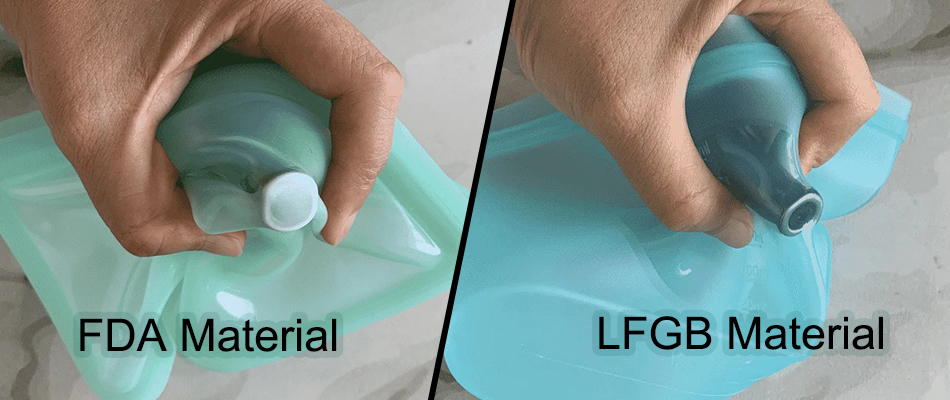
Are you a brand owner, retailer, importer, or e-commerce brand? Have you ever tried to send your food storage products outside the country? Germany wants it to have LFGB certification, while America stamps the passport with the FDA approval before letting the products through customs.
They both are saying 'Safe for food' , just in different languages – one in exact German, the other in American legalese. But the people in the customs department want the product approval certification in their own regulatory language.
Understanding the difference between LFGB and FDA and how the system works with them is crucial for any brand. As an expert in the silicone industry, today, we'll be doing a comprehensive comparison between LFGB and FDA to save you a thousand dollars in testing costs. And also, some unnecessary headache on the border.
What is LFGB and FDA Silicone
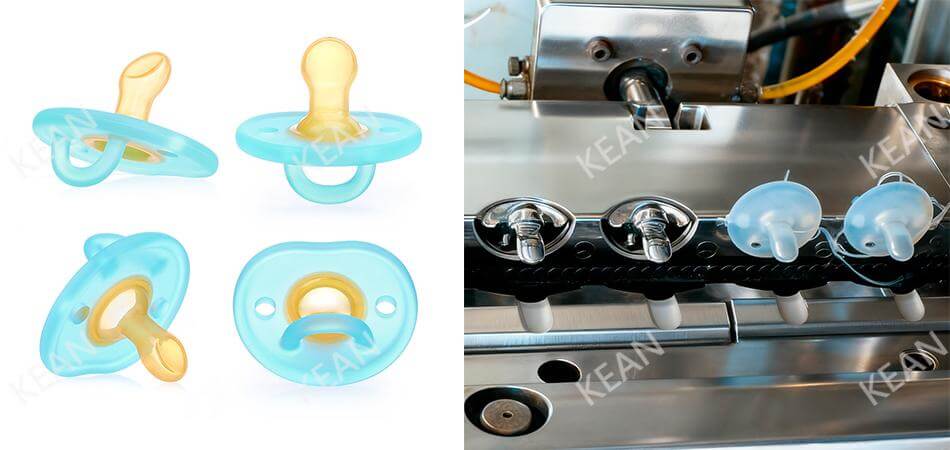
LFGB-grade Silicone Product
LFGB silicone products refer to silicone items that are safe for direct food contact and have passed the LFGB test, which is an important regulation under the German Food, Commodities and Feed Act aimed at ensuring the safety of materials intended to come into contact with food. From an industry perspective, LFGB-grade silicone products are considered "superior" to FDA-grade ones, as the LFGB standard is more stringent, the testing cost is higher, and the overall price tends to be more expensive.
What is LFGB certification?
Abbreviation for Lebensmittel- und Futtermittelgesetzbuch, which is the Food, Commodities Act of Germany. It is applied with the BfR recommendation, which is the German Federal Institute for Risk Assessment.
LFGB compliance indicates laboratory testing and sensory testing under the Section 30/31 Style Test. Laboratory testing includes overall migration, specific migration, elemental or compositional/trace analysis, heavy metal screening, and sensory testing, such as odor or taste migration. BfR also publishes recommendations for specific substances.
Under Section 31(1) LFGB, any food contact material manufactured can not transfer any compositional substance to food in quantities that can endanger human health, harm any organ, or create a harmful composition reacting with food.
This regulatory basis complies with EU Rules, notably EC/1935/2004 on Food-contact materials. This rule sets a general requirement that all materials must be safe, and the manufacturers of any food contact material must not harmfully affect food.
FDA-Grade Silicone Product
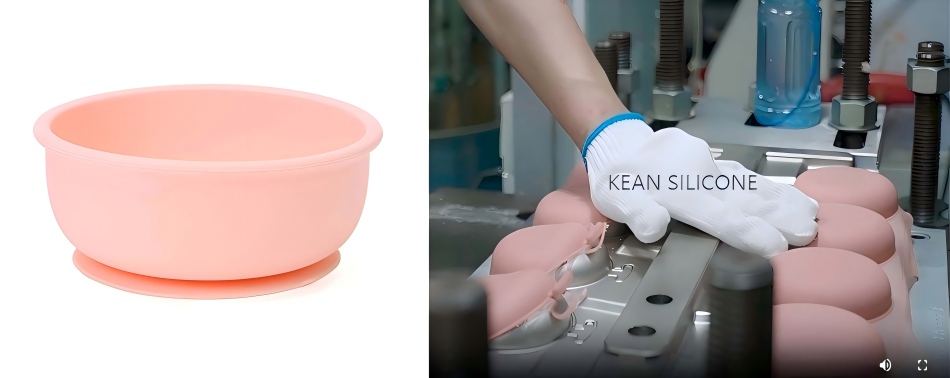
FDA silicone products refer to those made of silicone materials that have been certified by the FDA. They are non-toxic, odorless, and free from BPA, latex, lead, and phthalates. With excellent elasticity, transparency, and durability, FDA-grade silicone is safe for direct food contact and widely used in kitchenware and baby products.
FDA
The FDA regulates food contact substances under Title 21, Parts 170-199, Code of Federal Regulations of the United States. It is regulated under the Federal Food, Drug, and Cosmetic Act. A food contact material or product gets FDA approval documentation with the test data if it complies with the specifications or limitations published in the regulations by the FDA.
The key concept is that if any specific substance is to transfer or migrate from the Food-contact material to any food, the amount of the substance must be in compliance with the Threshold of Regulation (TOR) or authorized under Title 21 CFR.
The FDA does not issue a single LFGB-type product certification; it is more like a substance-based authorization. It publishes the intended usage of specific substances. For getting an FDA approval, each migrating substance must have a legal clearance for use in the Food-contact material.
Significance of LFGB and FDA Certification for Silicone Products
1. Market Requirements
For the European and American markets, obtaining LFGB and FDA certifications respectively is a key requirement for any silicone food-contact products, such as food bags, containers, water bottles, baby items, kitchenware, and pet products. Without proper certification, no brand owner, retailer, supermarket, small business owners, or food service supply chain can even keep them for their business.
2. Legal Access
LFGB and FDA approval is like an announcement for the products to be legally accessible. It is a de facto requirement to get all legal access to the customs. They get rid of any import risk and regulatory action when the products are in the shops. LFGB and FDA approval ensure that all downstream buyers, like retailers and food-service chains, can safely use the products without any second thought of safety.
3. Quality Recognition
LFGB testing doesn’t only involve the substance migration from the Food-contact material to the food, it also involves sensory testing. It evaluates the odor and taste of the food, which reassures the buyers that the product is not going to alter the smell, taste, and overall quality of the food.
4. Safety Aussurance
FDA regulations require the manufacturer or brand to show the migration data of all toxicological substances to get approval. So it works like a safety standard. A product with FDA approval indicates that the migrated substances are in quantity that complies with the American Code of Regulations.
5. Consumer Trust
Having an LFGB-compliant or FDA-certified stamp screams this product is 100% safe to use. So a brand or retailer can gain more consumer trust by selling all LFGB-stamped products in Germany or Europe and FDA-approved products in the United States.
6. Brand Enhancement
Brands with both LFGB and FDA-compliant product gets the competitive advantage over other brands that don’t have any regulatory approval or only one kind of approval. Brand owners with products with both LFGB and FDA-compliant can expand their business and go international by opening up stores in different parts of the world.
A brand with only FDA-approved products can only do business in America, but a brand that also has LFGB certification can open up many stores in Germany and many EU nations. So if you are a brand, always buy products from a manufacturer that has both certifications. For example, ‘KEAN’ produces Silicon baby feeding products, household items, and pet products that are both LFGB and FDA approved.
Differences in Testing Methods and Stringency
Testing Method and Stringency | LFGB | FDA |
Regulatory Approach | LFGB testing focuses on substance migration from material to the human body through food or other ways, and its sensory effects. It sets precise migration limits for specific substances. | The FDA provides a safety review on the basis of the substance. The migratory substances must have legal status by meeting the conditions of Threshold of Regulation (TOR) listing under the Title 21 CFR. |
Test Scope and Methodology | A typical LFGB test includes overall and specific migration for substances from the product. Usually, it has to be less than or equal to 10mg/dm². For Plastic, the PAA and BPA must be less than 0.01 mg/kg and 0.05 mg/kg, respectively.
| Though migration testing is also used, the key focus in the FDA remains the demonstration of the migratory substances to be within regulated limits by the manufacturers. |
Stringency | In the case of sensory checks, LFGB is seen as stricter. Besides all chemical migratory checks, it checks for any unwanted or bad smell or taste transfer. Technically, LFGB rules are non-binding, but German retailers strictly enforce them. | Sensory testing is totally skipped by the FDA. It only focuses on the chemical safety aspect of products. It usually takes longer to get FDA approval, as it involves complex and precise toxicology studies. In the United States, FDA regulations are legally mandatory. |
Impact on Product Cost and Market
In general, products that undergo additional LFGB certification have material costs about 5–15% higher than those certified only by the FDA. However, in many cases, obtaining LFGB certification is not a mandatory requirement. For example, when it comes to bulk order, the unit price of a baby feeding spoon with only FDA certification range from $0.30 - $0.65, while that of a silicone baby feeding spoon with LFGB certification may go up to $0.5 - $0.95.
Find a practical price-range comparison according to the market average for LFGB and FDA testing below. Cost may vary with various aspects like product type, number of analysis requirements, product material, lab location, country, etc. The comparison table can be used for planning budgets for the testing products in your business.
Test | Typical LFGB Test Price Range | Typical FDA-related Testing and Documentation | Side Note |
Basic Sensory and Migratory Test | $450 - $1500 (both sensory and migratory) | $300 - $1000 (only migratory) | Authorities like the EU, BfR, and FDA do not set an official fixed price for these tests. It’s set by private labs, and the price varies with various aspects. |
Multi-analyte Chemical Screen | $800 - $2500 (depends on method and number of analytics) | $600 - $2000 (depends on toxicological analyte panel) | |
Full Certification Package | $1000 - $3500 (Includes migration, sensory, targeted analysis, and full report for manufacturer or retailer)
|
n/a | |
Food Contact Notification | n/a | $10000 - $50000 (Includes consultation, testing, and drafting) | |
Typical Turnaround Time | 5-15 working days | 5 - 20+ working days |
How to Choose Between LFGB and FDA Regulations and Their Testing Options:
Compare your budget with the price comparison table. Choose the package that suits your budget more. Then consider the requirements of your target market. If your primary market is Germany, your retailers or distributors are most likely to ask for an LFGB certification.
Then you should prioritise a Full LFGB certification package. If your primary market is the US, get all your materials FDA-cleared. But if you want to sell globally, getting both certifications will be the safest for your business.
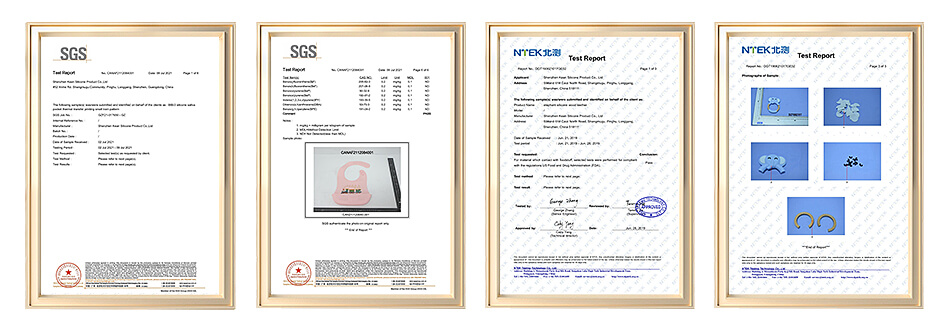
(FDA Certification - Silicone Bib LFGB Certfication - Silicone Baby Teether)
How to Determine Product Compliance
Map Your Product's Intended Use
Recognise and note your products' contact time, temperature, food type, and target market.
Pin Down Relevant Regulation Rules
For Germany or the EU, does the product in question fall under EC 1935/2004 and the regulations of material specification, and also the BfR Recommendations? For the US, does the migratory substance of the product follow the 21 CFR listing? Or do you have a requirement to submit a TOR?
Gather All Documentation
Collect all the material specifications and declarations from the supplier. Make sure to precisely document all raw materials, coatings, and additives before ordering for any test.
Order Testing
LFGB – Overall and specific migration, heavy metals, analytes, and sensory.
FDA – migration analytical data, substance approval, toxicity, exposure, documentation.
Compile All Reports
After getting the test reports and certifications, compile all those reports, documentation, and declarations in a file and maintain it for the importers/retailers’ request.
Recommendations
You see how important it is to have LFGB-certified or FDA-cleared products! If you are a brand owner, importer, retailer, or any businessman who is looking for food-safe, regulations-compliant compliant and global-ready products, KEAN can be a trustworthy manufacturing partner.
Specialized in Silicone items like food-contact products, baby products, household products, and pet products, KEAN holds complete LFGB and FDA-compliant certification for all its products. Teaming up with us opens up all doors to the European and US markets by meeting the highest international safety standards.
You can request samples to check our high-quality products yourself before any bulk order. Ready to get a seamless entry in the global market? - Partner with KEAN today!


