


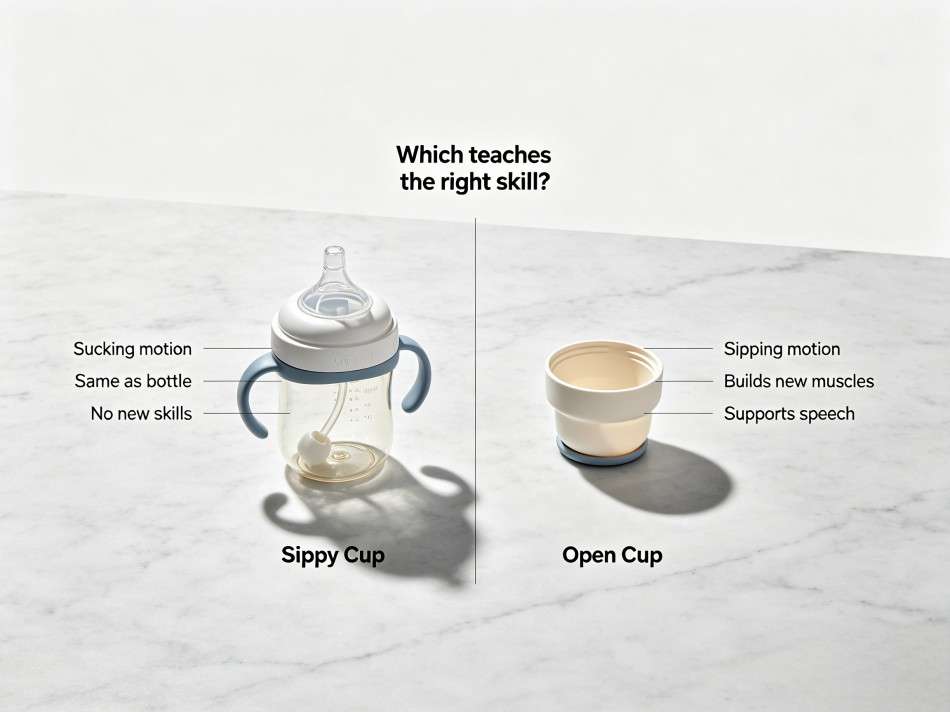
A complete guide for parents on timing, developmental milestones, and making the transition from bottle to open cup
Introduction: A Milestone Worth Celebrating
The transition from bottle or breast to an open cup is one of those quiet milestones that doesn't get as much attention as first steps or first words. Yet it matters — for dental health, speech development, and independence.
Many parents wonder: When is the right time to start? Should I use a sippy cup first? How do I teach my baby to drink without making a huge mess?
This guide answers these questions, drawing on recommendations from paediatricians, dentists, speech therapists, and feeding specialists. It covers when to start, why open cups matter, how to choose the right cup, and practical tips for a smooth transition.
Part 1: When to Start — The Recommended Timeline
The 6-Month Mark
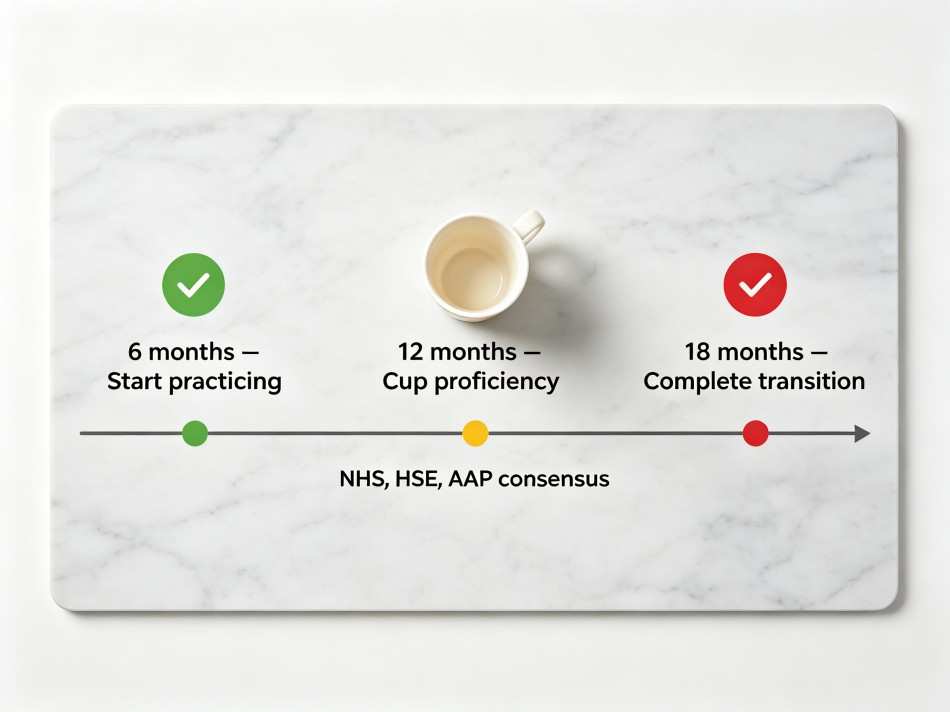
Most babies are ready to start practicing with an open cup around 6 months of age .
This is the same time they typically start solid foods — and for good reason. At this stage, babies can sit upright with support, are developing hand-eye coordination, and are naturally curious about what parents are doing .
The 12-Month Goal
By 12 months, babies should be drinking from an open cup .
This aligns with the World Health Organization's recommendation that babies be introduced to cup drinking by 12 months . The HSE in Ireland specifically recommends that by 12 months, your child should be drinking from an open cup .
The 18-Month Deadline
This isn't arbitrary. Prolonged bottle use is linked to dental problems, speech delays, ear infections, and even obesity risk later in childhood .
What the Experts Say About the Timeline
Source | Recommendation |
NHS / British Dietetic Association | Introduce open cups from 6 months |
HSE Ireland | Start at 6 months; drink from open cup by 12 months |
AAP | Transition from bottle by 18 months |
ASHA | Drinks from open cup with some spilling by 12-18 months |
WIC |
The consensus: Start practicing around 6 months. Aim for cup proficiency by 12 months. Complete the transition by 18 months at the latest.
Part 2: Signs Your Baby Is Ready
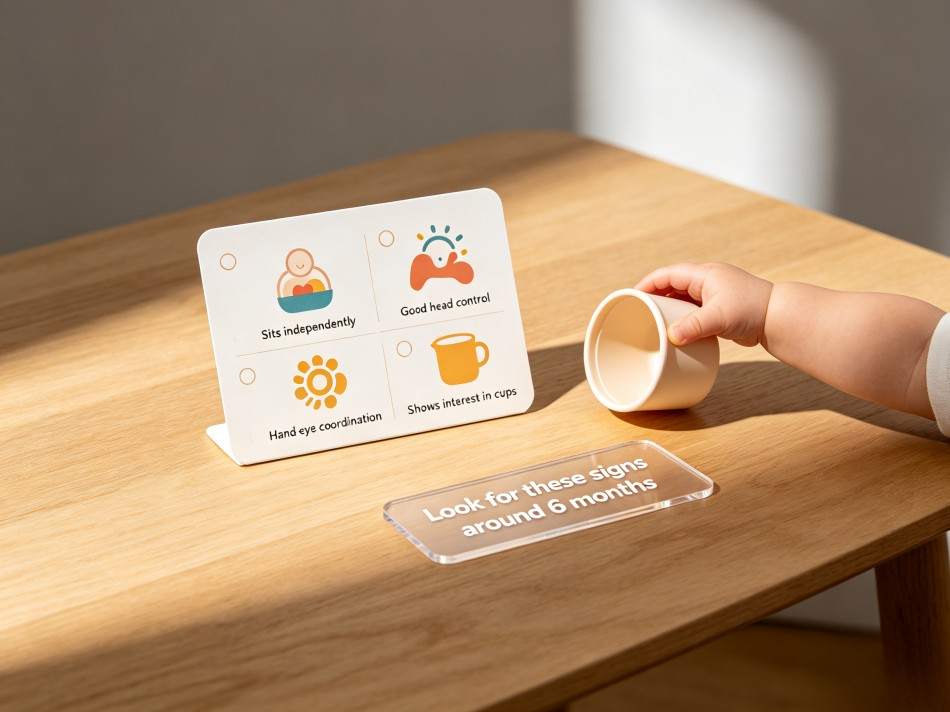
Every baby develops at their own pace. Look for these readiness signs :
Physical Readiness
Sign | What It Looks Like |
Sits independently | Can sit upright without support |
Good head control | Holds head steady and upright |
Hand-eye coordination | Picks up toys and brings them to mouth |
Grasping ability | Can hold objects with two hands |
Behavioral Readiness
Shows interest — watches parents drink from cups
Mimics behaviour — tries to copy drinking actions
May shorten breastfeeding sessions or be easily distracted during bottle feeds
Wants to hold the bottle on their own
If your baby is showing these signs around 6 months, it's a good time to introduce an open cup.
A Note of Caution: Some experts suggest that starting too late — after 8 months — may make it harder for a baby to accept the cup . Early exposure matters.
Part 3: Why Open Cups — Not Sippy Cups
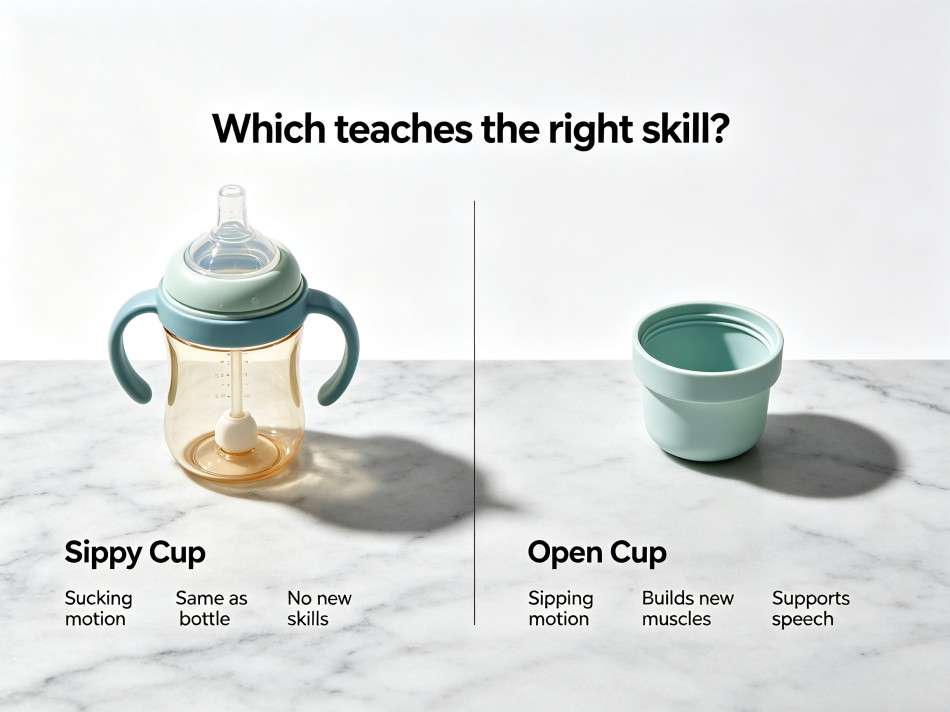
The Sippy Cup Problem
Many parents assume that sippy cups are the natural first step between bottle and open cup. This assumption deserves re-examination.
Sippy cups are not teaching the right skills .
Aspect | Sippy Cup | Open Cup |
Drinking action | Sucking (same as bottle) | Sipping (new skill) |
Tongue position | Protruded under spout | Elevated tongue tip |
Muscle development | No new oral-motor development | Builds muscles for speech |
Dental impact | Liquid pools around teeth | Less pooling; quicker swallow |
Hygiene | Can trap mould and germs | Easy to clean |
What Experts Say About Sippy Cups
The American Speech-Language-Hearing Association and other professional bodies have noted that the skills used for sippy cups are different from those required for open cups. Valved sippy cups require a sucking motion, not the sipping action that develops important oral muscles .
A Better First Cup: Free-Flow Cups
If you want a lid for practical reasons, choose a free-flow cup — one without a valve .
Free-flow cups allow liquid to flow freely when tipped, teaching sipping rather than sucking
Valved cups (non-spill) keep the sucking action and delay skills development
The HSE specifically recommends: "A cup with a snap-on or screw-on lid that has a spout, but no valve" .
The Straw Alternative
A straw cup is another good option — especially for children who struggle with open cups initially. Using a straw teaches a different skill from open cup drinking but is more mature than sippy cup use .
One recommendation: "A straw cup is another good option. It helps strengthen the muscles in your baby's mouth that make sounds, words and speech patterns" .
Bottom line: Start with a small open cup or a free-flow cup. Reserve non-spill sippy cups for occasional use only, and work toward open cups by 12 months.
Part 4: Why Open Cups Are Better for Development
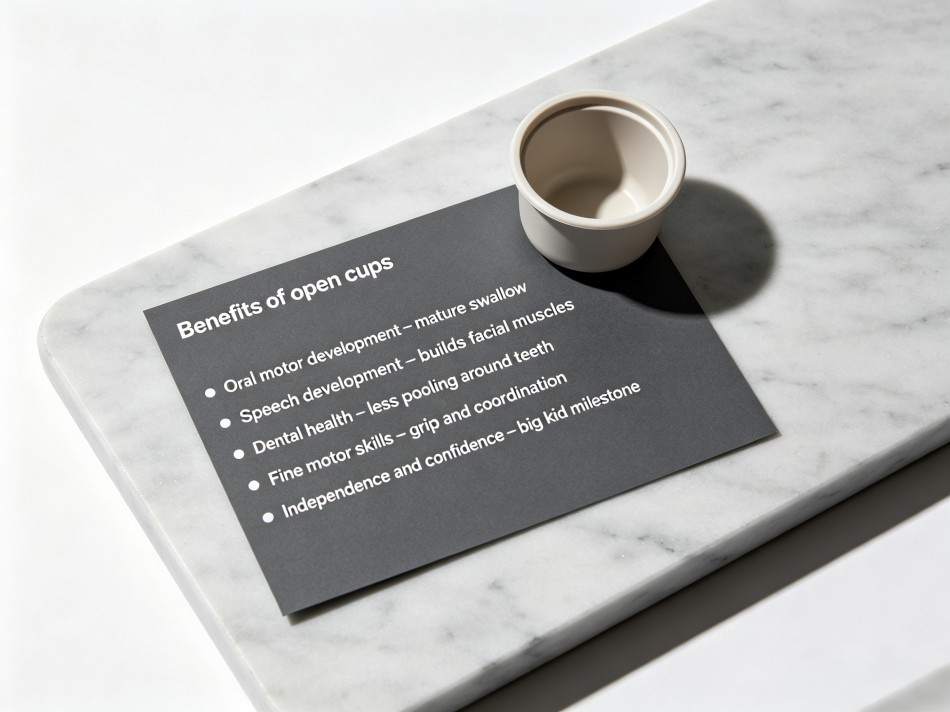
1. Oral Motor Development
Drinking from an open cup requires a more mature swallowing pattern.
Swallowing Pattern | Tongue Position | Typical Age |
Immature swallow | Tongue lies on bottom of mouth, tip forward | Infancy (breast/bottle) |
Mature swallow | Tongue tip presses firmly against roof of mouth | Develops with open cup use |
This mature swallow is the same pattern used for chewing and speech. The tongue tip needs to elevate — a movement that doesn't happen when sucking from a bottle or sippy cup .
Open cups promote oral motor skills that prepare babies for talking, eating, and safe swallowing .
2. Speech Development
"Open cups encourage a sipping action, instead of sucking, which helps with the development of facial muscles required for talking."
The same muscles used for sipping — lips, tongue, jaw, cheeks — are used for forming sounds and speaking clearly . Prolonged bottle or sippy cup use has been linked to speech delays and oral motor issues .
3. Dental Health
Bottles and valved sippy cups allow milk or juice to pool around the upper front teeth. This prolonged contact with sugars increases cavity risk .
Drinking from an open cup:
Moves liquid to the back of the mouth faster
Reduces pooling around teeth
Minimises tooth decay risk
4. Fine Motor Skills
Holding and lifting an open cup builds hand-eye coordination and hand strength . The grip required to hold and tip a cup without spilling is a genuine motor skill — and an important one for future self-care independence .
5. Independence and Confidence
Drinking from an open cup helps babies feel like "big kids" — and the sense of mastery builds confidence and self-esteem. It's also a practical step: by 12 months, children should no longer be dependent on a bottle .
Part 5: How to Introduce an Open Cup — Practical Tips
Getting Started
Tip | Why It Works |
Start with a small amount | Less mess, lighter for baby to lift |
Use water only | Easy to clean up; under 12 months, water is safest |
Help guide the cup | Hold the base, let baby hold the sides |
Model drinking | Let baby watch you sip from your cup |
Choose the right time | When baby is calm and not too hungry |
Mess Management
Accept that learning to drink from an open cup is messy. Embrace it:
Use a good bib — a coverall or apron bib helps
Start at home — breakfast when still in PJs, or before bath time
Let them play — practice with an empty cup at playtime or in the bath
Try not to react to spills — it might startle them or encourage repeat behaviour
Positive Reinforcement
Praise every attempt — no matter how small
Ignore signs of resistance — pouting, crying, tossing the cup
Be patient — some babies take longer than others
Practical Considerations
Always have baby sitting upright — never lying down or reclined
Never leave a baby unattended with an open cup — choking risk
Try little and often — small amounts add up
Use a brightly coloured cup — baby may see it as a new toy
Part 6: Milestone Timeline
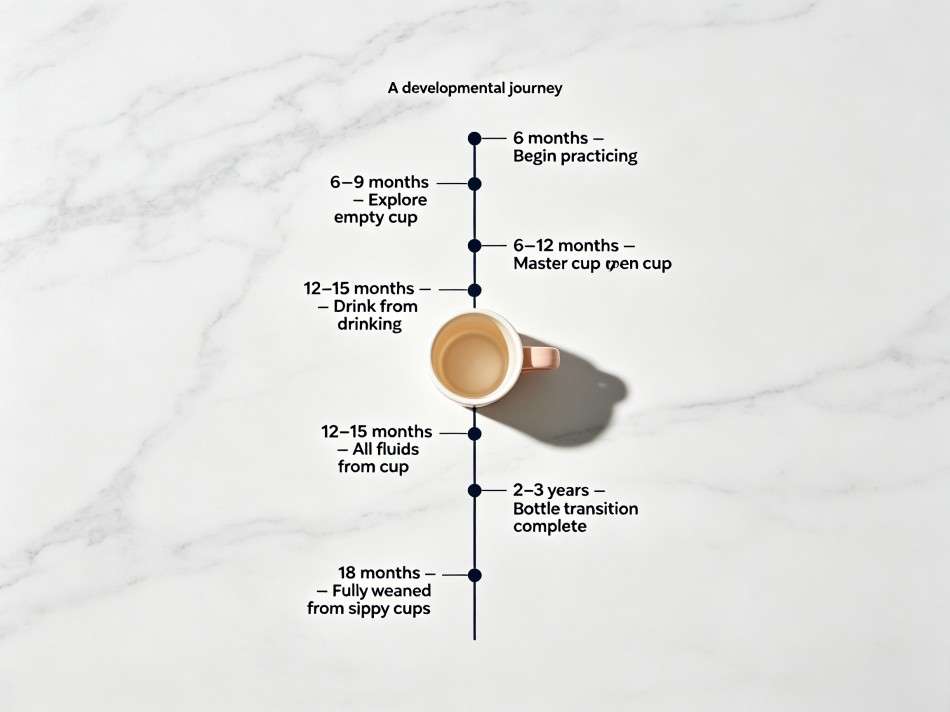
Age | Milestone |
6 months | Begin practicing with open cup (small amounts of water, minimal quantity) |
6–9 months | Allow exploration with an empty cup; practice holding and bringing to mouth |
9–12 months | Put a little breastmilk or formula in the cup; help baby hold it |
10–12 months | Babies start to master cup drinking |
12 months | Child should be drinking from an open cup |
12–15 months | Should be drinking all fluids from a cup |
18 months | Transition from any bottle should be complete |
2–3 years | Should be fully weaned from sippy cups |
Part 7: What to Put in the Cup
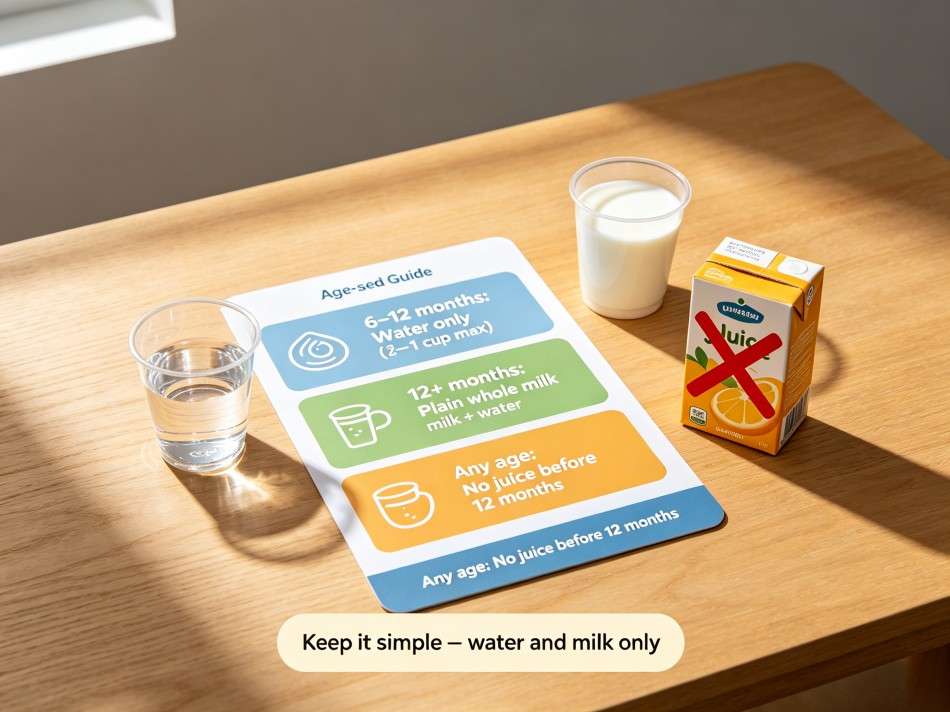
Age | What to Offer | Notes |
6–12 months | Water only in the cup | Breastmilk or formula still main nutrition |
6–12 months | Limit water to ½–1 cup (4–8 oz) per day | Don't fill baby up on water |
12+ months | Plain whole milk in addition to water | Can be offered from 12 months |
Any age | No juice before 12 months | AAP recommends no juice before first birthday |
Juice and Sugary Drinks
No juice before 12 months — it can lead to poor nutrition, tooth decay, and diarrhoea
After 12 months, limit juice — real fruit has more nutrients and less sugar
Avoid sugary drinks — water and plain milk are all children need
Part 8: For B2B Buyers — Why Open Cup Design Matters
For brands sourcing baby cups, understanding the developmental rationale matters. Open cups are not just a product category; they are an investment in child development — and parents are increasingly educated about the benefits.
What to look for in an open cup:
Feature | Why It Matters |
Small size | Fits a baby's hands |
Soft edges | Gentle on gums |
Non-slip grip | Babies learn to grip more easily |
Sturdy material | Withstands drops; shatterproof |
Weighted base | Prevents tipping while learning |
Why open cups are better for brands:
Alignment with health guidelines — NHS, HSE, AAP, WHO all support open cups
Growing consumer awareness — parents are researching the "sippy cup problem"
Premium positioning — open cups can be positioned as the developmental choice
Safety — no valves to clean, no mould risk, no parts to replace
Frequently Asked Questions
When should babies start using open cups?
Most babies are ready to start practicing with an open cup around 6 months of age, when they can sit upright and show interest in drinking. By 12 months, they should be drinking from an open cup .
Can I skip sippy cups and go straight to open cups?
Yes. Most experts recommend skipping valved sippy cups altogether and moving directly from bottle/breast to a small open cup or a free-flow cup (no valve) . Sippy cups teach sucking, not sipping, and don't build new oral motor skills.
Why not use a sippy cup?
Sippy cups with valves encourage the same sucking motion as bottles, not the sipping action needed for mature swallowing and speech development. They can also delay oral motor development and increase cavity risk. Free-flow cups are preferred .
What's the best cup for a 6-month-old?
A small open cup (or free-flow cup) with handles, soft edges, and a non-slip grip is ideal . It should hold a small amount and be easy for baby to lift. A cup with a weighted base can help prevent tipping .
How do I teach my baby to drink from an open cup?
Start with just a few sips of water, guide the cup to their mouth, model drinking, and expect mess. Use a small, lightweight cup and offer it when baby is calm. Practice at meal times and let them experiment .
What if my baby refuses the cup?
Be patient. Try a different cup. Let them practice with an empty cup. Offer it before they are too hungry. Try little and often. Some babies take longer to accept a cup .
Conclusion: Start Early, Start Simply
The evidence is clear: open cups should be introduced around 6 months and become the primary drinking vessel by 12 months . Sippy cups are not a necessary stepping stone — and in many cases, they delay the development of mature drinking skills .
The benefits of open cups are compelling:
Better oral motor development for speech
Healthier swallowing patterns
Lower cavity risk
Stronger fine motor skills
Greater independence
For parents: start small, expect mess, and be patient. For brands: open cups are not just a product — they are a tool for healthy development.
KEAN Silicone offers custom open cup solutions with food-grade, platinum-cured silicone — safe, easy to grip, and available in custom colours. Contact us for wholesale inquiries.
This guide is based on recommendations from the American Academy of Pediatrics, NHS, HSE, American Speech-Language-Hearing Association, and other health authorities.


