


Silicone material has gained strong market traction due to heat resistance, biocompatibility, durability, and the ability to be formed into precise, complex shapes. When it comes specifically to silicone molding, selecting the right method is important for balanced cost, material performance, and compliance with food-grade and medical-contact requirements.
KEAN, in this regard, follows a wide range of contemporary silicone molding processes that support multi-color integration, consistency, and strong material performance across a wide range of applications. These modern molding processes enable scalable production, high precision, and support global brands, OEMs, and other industrial buyers.
The sections below explain in detail the major molding processes implemented by KEAN. Each method covers the process flow, its usage, strengths, and limitations to support better B2B decisions. Let’s have a look at these processes,
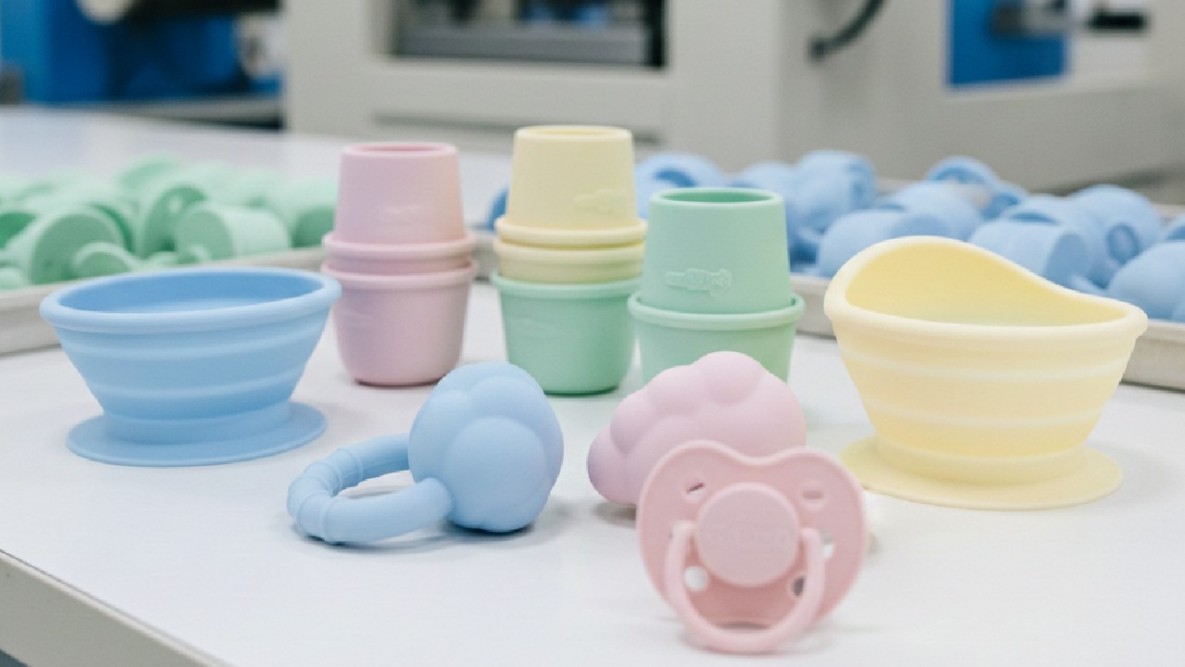
Understanding Silicone Molding
The use of heat and pressure to mold a raw silicone into a defined shape is termed “Silicone Molding”. It replicates the products that are highly accurate and provide stable mechanical properties. Molding offers resistance against high temperatures, is durable, and flexible.
The right silicone molding provides manufacturers with the desired product features, designs, faster production times, and efficient performance. Businesses depend on these products for their applications in the medical field, industrial sector, and consumer goods.
Solid Silicone Rubber
The type of silicone supplied in block or strip form and used with heat-curing during molding is termed Solid Silicone Rubber (SSR). It features flexible properties and is considered best for molding that delivers the required structure and durability.
Liquid Silicone Rubber (LSR)
The type of silicone rubber having low viscosity, processed via automated injection systems, is termed Liquid Silicone Rubber (LSR). LSR is ideal for electronic, medical, and high-end consumer products, enabling clean production, precise molding, and faster cycle times.
Silicone Molding Processes

1: Compression Molding
Introduction
Compression Molding is, in general, the traditional, widely used molding process best suited for the production of products and components from solid silicone rubber. Products (medium- to large-sized) that require uniform density and shape are produced using this method for cost-efficient, high-performance production.
Process
A measured block or strip of SSR is manually or semi-automatically placed in the mold cavity. The mold is closed and placed under the desired heat and pressure to get the required shape. Once done, the mold is opened, and the shape is removed. Minor shaping and processing are performed depending on the product’s design.
Applications
Use in automobiles, industrial components, silicone-sealed parts, and gaskets.
The Use of SSR and compression molding makes it ideal for such silicone parts that require robustness.
Core Strengths
Compression molding offers stable mechanical and uniform strength or quality.
It’s cost-effective and best for medium-level production.
The production of large product geometries is supported by compression molding.
Limitations
Likely less suitable for highly detailed designs.
Need longer cycle times as compared to automated injection methods
2: Multi-Color Integrated Molding
Introduction
For both functional and visual representation, KEAN uses multi-color integrated molding in silicone parts in a single structure. It replaces secondary assembly and delivers uniform bonding between color layers. It benefits businesses in brand visibility and customization.
Process
Under controlled temperature and pressure, different colored silicone materials are placed in a mold. Each color layer bonds chemically to another but maintains its own color and precise alignment. This process gives silicone components a new multi-color look.
Applications
Branded consumer silicone products use this molding to attract consumers.
Commonly used in daily life, wearables, kitchenware, and premium accessories.
Core Strengths
Chemically bonded layers support long-term durability.
It delivers aesthetics while reducing labor costs and lowering post-assembly time.
It reduces labor costs.
Limitations
Layering colors is more complex than typical molding.
Limited to layered structures.

3: Silicone Compression Overmolding
Introduction
KEAN prefers Silicone Compression Overmolding to bond silicone onto pre-molded silicone substrates, plastics, and metals. This method improves protective features, handling, and insulation by creating hybrid parts. Multi-integration in materials is better produced as it ensures consistency and performance.
Process
The process starts with placing the substrate into the mold cavity. During the curing phase, silicone flows and bonds to the surface under required compression and heat. The end product is a single integrated one.
Applications
Commonly used in handles, protective casings, grips, and silicone overlays for electronic parts.
Best for hybrid assemblies that need insulation and comfort.
Core Strengths
Substrates are combined with strong chemical and mechanical bonding.
Better ergonomics and functionality of products.
For multi-material designs, results are reliable.
Limitations
It requires the precise placement of the substrate.
Low-heat-tolerant substrates are not compatible.
4: Silicone Extrusion Molding
Introduction
For long-run, high-volume production, KEAN utilizes Silicone Extrusion Molding to produce consistent cross-section silicone profiles. It is efficient, producing stable output, and reliable for dimensional precision.
Process
An extrusion die is shaped to the required profile after the silicone material is placed. It is cured continuously in a heating tunnel. After a series of curing sessions, it is post-processed, cooled, and cut to the required lengths.
Applications
This molding is ideal in medical, automotive, and industrial applications.
It is also used to produce medical-grade hoses, silicone tubes, sealing strips, and insulation profiles.
Core Strengths
Multi-cross-section designs prefer this molding.
It offers continuous output, high-volume capability, and long production runs.
High volume capability with regular output.
Limitations
Multidimensional shapes do not support it.
Its application is limited to uniform profiles.

5: Multi-Color Liquid Silicone Rubber (LSR) Drip Molding
Introduction
Pre-cured surfaces that require silicone decorations, KEAN applies Multi-color LSR drip molding for details. Consumer products and goods that require branding and color elements benefit from this technique. The molding process combines material bonding and precision dispensing, providing flexibility for both mid- and small-volume production.
Process
The product in this molding undergoes a secondary stage of curing after being suspended in measured drops of low viscosity on the silicone surface. It delivers precision in small details and designs, and produces clean, integrated color results.
Applications
Commonly used in branding and decoration of baby products, sports, and lifestyle items.
It is also used with decorative silicone accents.
KEAN manufactures sports items, baby Accessories, and branded silicone components having fine details using LSR drip
Core Strengths
Highly accurate for design-focused components having color elements.
Strong bonding with longevity.
Limitations
Only used for small details and flat and medium-curved surfaces.
It is not suitable for structural features.
6: Solid-to-Liquid Molding
Introduction
KEAN uses solid-to-liquid molding for products that balance aesthetic appeal and functionality. It ensures silicone products have soft-touch performance and comfort. It is widely used for dual-hardness silicone products.
Process
In a single production, solid and liquid silicone are placed and molded. Solid silicone is placed first before injecting liquid silicone. Then both are cured together, into one. The result is uniform with a multi-phase silicone component.
Applications
Wearables made from soft silicone are used in lifestyle care products and the medical field.
Applied components need layered hardness.
Core Strengths
The improved bonding between solid and liquid provided functional performance and comfort.
Provides a wide range of designs.
Supports versatile product designs.
Limitations
Tooling is complex.
It requires accurate synchronization of processes.

7: Liquid Injection Molding/LSR Injection Molding
Introduction
KEAN values LSR injection molding for contemporary automation-driven processes. It delivers clean, high-precision products that meet global compliance standards. It is ideal for high-volume production of consumer, medical, and electronic goods.
Process
Two measured amounts of liquid are mixed and injected into the mold. Under controlled temperature and consistent cycles, automated systems reduce waste. It supports minimal variation with high precision in silicone parts.
Applications
This molding process is used to produce seals, electronics, and thin-walled parts.
Suitable for complex geometries and wearable devices.
Core Strengths
Exceptional precision for large volume production.
It has stable cycle times and low waste.
It has reliable repeatability.
Limitations
Not suited for low-volume production.
It is not cost-efficient in equipment and molds.
Table Comparison of Each Process
Process Name | Applicable Materials | Color Capability | Core Advantages | Main Risks /Limitations | Typical Applications |
Compression Molding | Solid Silicone Rubber | ★★★☆☆ Single color or simple two-color (requires secondary vulcanization) | - Low mold cost - Low equipment investment - Suitable for large-sized, thick-walled products | -Low automation, high labor dependency - Low production efficiency - Relatively poor product precision and consistency - Significant flash, high post-processing workload | - Automobiles, - Industrial components, - - Silicone-Sealed Parts, and Gaskets. |
Multi-Color Overmolding | Solid Silicone Rubber | ★★★★★ Achieves multi-color and multi-hardness in a single molding cycle | - Integrates colors and functions without assembly - Enhances product aesthetics and perceived value | - Extremely complex and costly molds - Very high requirements for equipment and process control - Difficult to control yield rates | Multi-color smartwatch bands, high-end kitchen utensil handles, complex toys |
Compression Overmolding | Solid Silicone Rubber + Metal/Plastic, etc. | ★★☆☆☆ The silicone part is typically a single color | - Achieves strong bonding between silicone and dissimilar substrates - Enhances grip, anti-slip properties, and sealing function | - High requirements for substrate pretreatment (e.g., pre-heating, adhesive spraying) - Differing material shrinkage rates may cause warping or bonding failure | Overmolded power tool handles, electronic product seals, and toothbrush handles |
Silicone Extrusion Molding | Solid Silicone Rubber | ★★☆☆☆ Single color or simple striped colors | - Continuous production, very high efficiency - Low mold cost - Ideal for elongated products | - Can only produce profiles with fixed cross-sections - Very low shape complexity - Relatively low dimensional accuracy | Silicone tubes, silicone strips, sealing strips, wire, and cable insulation |
Multi-Color Liquid Dispensing | Liquid Silicone Rubber / Epoxy Resin, etc. | ★★★★★ Achieves complex patterns, multi-color, and gradient effects with liquid materials | - Creates complex surface patterns without molds - Extremely high design freedom - Suitable for small-batch, customized production | - Non-contact dispensing relies on high-precision robotics and vision systems - High equipment investment - Relatively low production efficiency | Phone case patterns, brand logos, embossed products, and artistic models |
Solid-to-Liquid Transition Molding | Liquid Silicone Rubber | ★★★★☆ Flexible color matching, easy to achieve two colors | - Strategic process upgrade combining all LSR advantages - Improves production efficiency, product precision, and cleanliness | Transition challenges: high initial investment, technical skill requirements, need to redesign molds and processes | Products replacing traditional HCR processes, fields pursuing higher efficiency and quality |
Liquid Injection Molding | Liquid Silicone Rubber | ★★★★☆ Flexible color matching, easy to achieve two-color/multi-color (requires specialized equipment) | - Fully automated, highest production efficiency - Excellent product precision and consistency - Net-shape forming, minimal flash - Good biocompatibility, high cleanliness | - High initial investment in equipment and molds (cold runner systems) - High technical barriers | Baby bottle nipples, medical catheters, precision seals, infant teethers, sensor encapsulation |
Choosing the Right Silicone Molding Process
Product Complexity & Features
Geometric Details
Functional Tolerances
Production Volume
Low Batch
Mass Production
Mid Scale
Material Requirements
Mechanical Strength
Grade Selection
Heat Resistance
Cost Analysis
Per Unit Cost
Tooling Budget
Cycle Efficiency
Standard Certifications
ROHS Standards
ISO Compliance
FDA Approval
Conclusion
Choosing the right silicone molding process requires aligning product complexity, volume expectations, regulatory requirements, and material performance with a manufacturer capable of scalability and precision. KEAN’s molding expertise delivers consistent, reliable quality across high-volume runs and prototypes. Their engineering-driven method helps OEMs reduce lead times, accelerate market readiness, and optimize costs. With reliable certified facilities with strong technical support, KEAN promises to deliver production-ready silicone solutions efficiently.


