


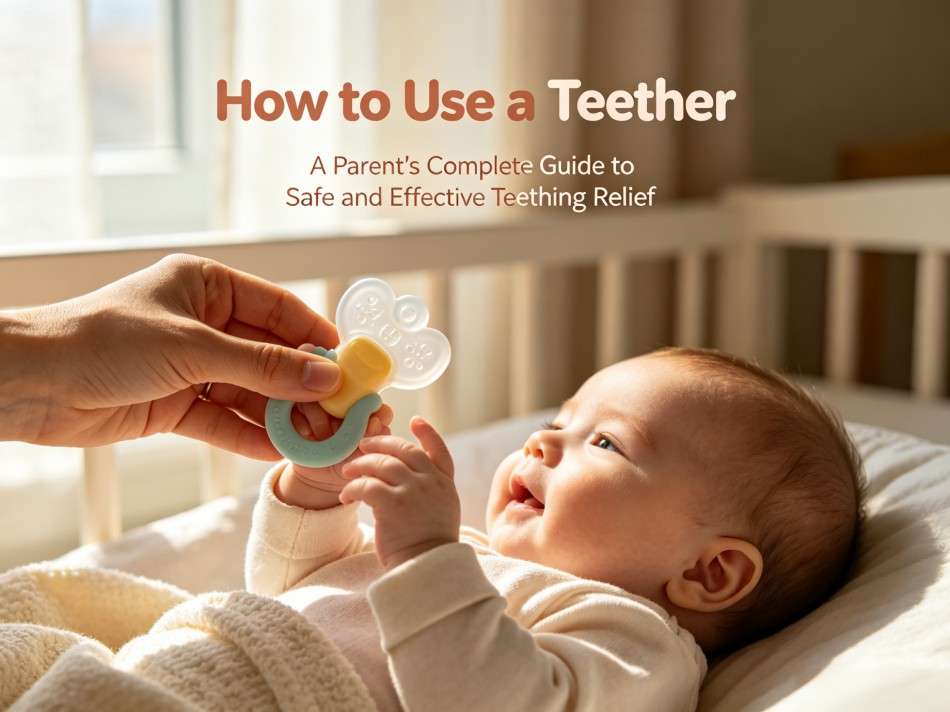
Your baby has been fussy for days. They’re drooling more than usual, chewing on their fists, and waking up at night crying. You’ve heard that a teether can help—but now you’re staring at a shelf full of options, wondering: How do I actually use one of these things?
You’re not alone. Many parents aren’t sure when to introduce a teether, how long to let their baby chew, or whether refrigerating or freezing is better. Some worry about safety. Others wonder if they’re doing it “right.”
This guide will walk you through everything you need to know about using a teether for your baby—safely and effectively.
You’ll learn:
When to start using a teether
How to choose the right type
Step-by-step instructions for safe use
Proper cleaning and storage
What to avoid (some popular “remedies” are dangerous)
Nighttime teething strategies
When to call the doctor
Let’s get started.
When to Introduce a Teether
Most babies begin teething between 4 and 7 months of age, though some start as early as 3 months and others don’t cut their first tooth until after their first birthday. Teething doesn’t always mean a tooth is visible—the discomfort often begins weeks or even months before the first white tip appears, as the tooth buds push upward through the gum tissue.
Signs your baby is ready for a teether:
Sign | What It Looks Like |
Excessive drooling | Soaking through multiple bibs; drool rash on chin/chest |
Chewing on everything | Fists, fingers, toys, crib rails, your shoulder |
Increased fussiness | More crying than usual, especially in the afternoon/evening |
Red, swollen gums | Visible puffiness or redness when you lift their lip |
Sleep disruption | Waking more often at night; trouble falling asleep |
Ear pulling or cheek rubbing | Referred pain from jaw nerves |
Reduced appetite | Pulling away from breast/bottle; refusing solids |
If you’re seeing several of these signs, your baby is likely ready for a teether.
Note on age: Teethers are generally safe from 3 months onward, but always check the manufacturer’s recommended age range. Some teethers with small parts or complex shapes are labeled for 6+ months only.
Choosing the Right Teether: What to Look For
Not all teethers are created equal—and some are downright dangerous. Here’s what to look for when choosing a teether for your baby.
Safe Teether Features
Feature | What to Look For | Why It Matters |
Material | Food-grade silicone, firm rubber, or natural wood with food-grade finish | Non-toxic, BPA-free, phthalate-free |
Construction | One-piece, seamless design | No crevices for bacteria; no small parts to detach |
Texture | Soft bumps or ridges | Massages gums without causing injury |
Size | Large enough not to be swallowed; easy for small hands to grip | Prevents choking hazards |
Cooling capability | Can be refrigerated (not frozen) | Provides soothing cold without gum damage |
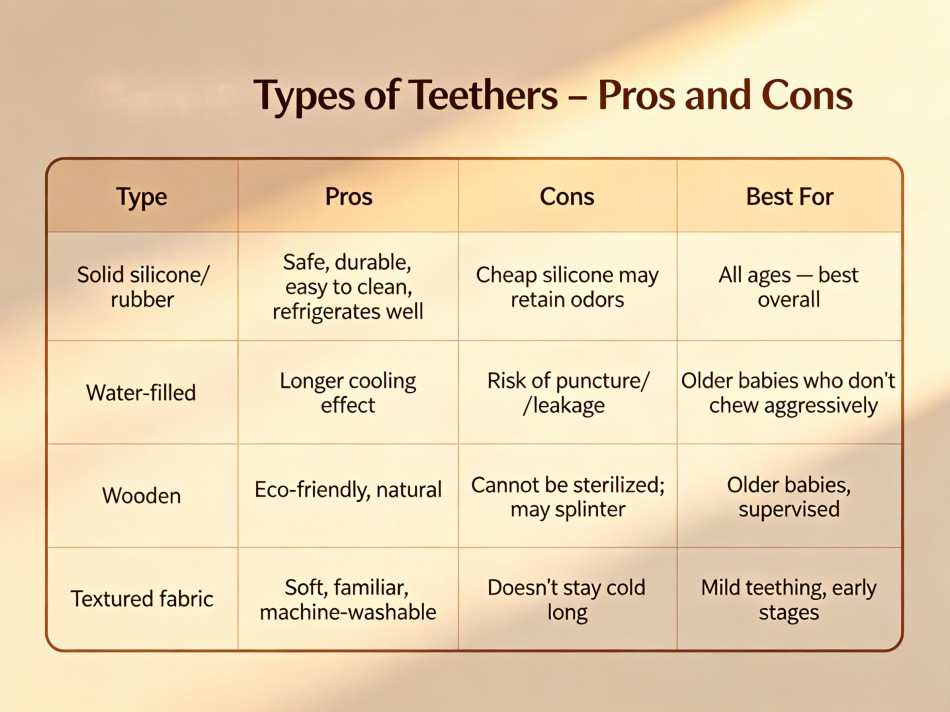
Types of Teethers: Pros and Cons
Type | Pros | Cons | Best For |
Solid silicone/rubber | Safe, durable, easy to clean, refrigerate well | Some cheap silicone retains odors | All ages; best overall choice |
Water-filled | Longer cooling effect | Risk of puncture/leakage (though water is non-toxic) | Older babies who don’t chew aggressively |
Wooden | Eco-friendly, naturally antimicrobial | Can’t be sterilized; may splinter | Older babies under supervision |
Textured fabric | Soft, familiar, machine-washable | Doesn’t stay cold long; can harbor bacteria | Mild teething, early stages |
What the Experts Say
ColumbiaDoctors (2025): Recommends teething rings made of nontoxic materials, noting that chilling (not freezing) is safe. Warns: “Don’t use fluid-filled teethers”.
Step-by-Step: How to Use a Teether Safely
Step 1: Prepare the Teether
Clean it first. Before the very first use, sterilize the teether:
Boiling water method: Place the teether in boiling water for 5 minutes (check manufacturer instructions first—some teethers cannot be boiled).
Dishwasher method: If labeled dishwasher-safe, place on the top rack.
Steam sterilizer: Use a baby bottle sterilizer if the teether is compatible.
Then chill it. Place the clean teether in the refrigerator for 30–60 minutes before offering it to your baby.
⚠️ Do not freeze teethers. The AAP, FDA, and multiple health authorities warn that frozen teethers become too hard and can injure a baby’s gums.
Step 2: Offer the Teether to Your Baby
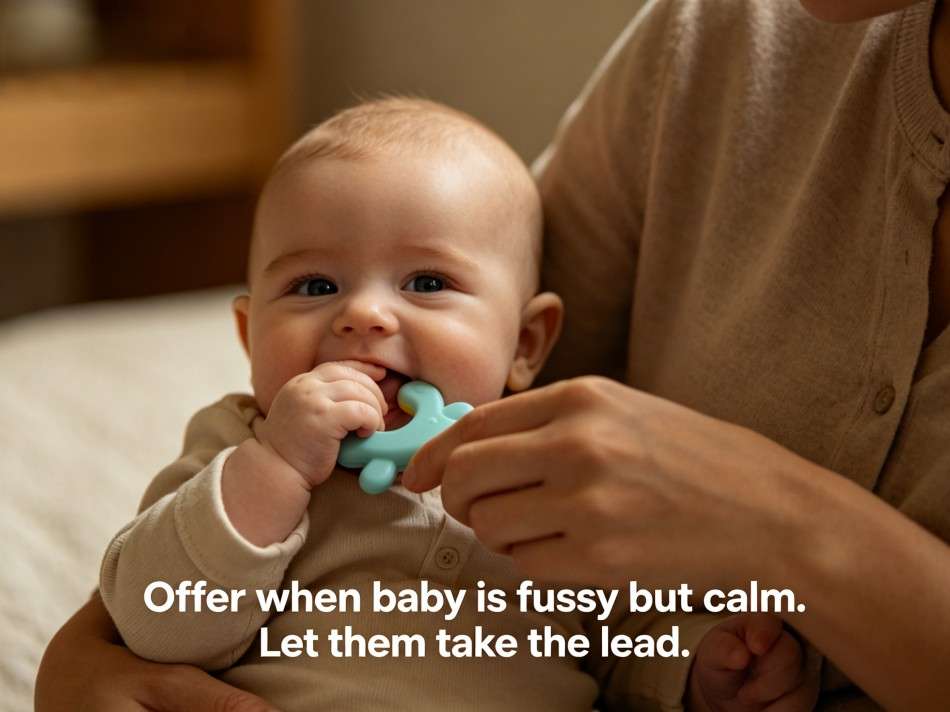
Timing matters. Offer the teether when your baby is:
Showing signs of teething discomfort (fussy, chewing on hands)
Calm enough to accept it (not already screaming)
Awake and alert (never give a teether to a sleeping baby)
How to present it:
Wash your hands first.
Hold the teether up to your baby’s mouth.
Gently guide it to their gums if they don’t grab it themselves.
Let them take over—they’ll instinctively bring it to their mouth.
What to expect: Your baby may chew on different parts of the teether, suck on it, or just hold it. All of these are fine. The goal is to provide pressure and cooling relief.
Step 3: Supervise the Entire Time
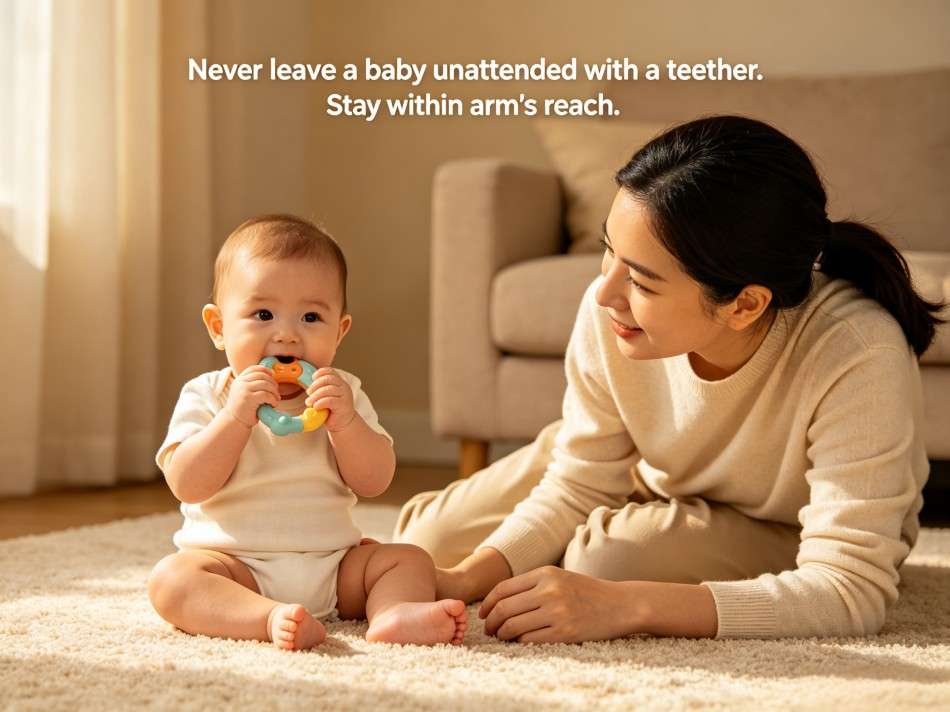
Never leave a baby unattended with a teether. This is the most important safety rule.
Stay within arm’s reach while your baby uses the teether.
Watch for signs of wear (cracks, tears, loose parts).
If the teether falls on the floor, clean it before giving it back.
Step 4: Know When to Remove the Teether
Take the teether away when:
Your baby falls asleep (never let them sleep with a teether—it’s a choking hazard)
The teether becomes warm (re-chill if needed)
You see any damage
Your baby loses interest
Pro tip: Keep 2–3 teethers in rotation. While your baby uses one, another can be chilling in the refrigerator, and a third can be clean and ready.
Step 5: Clean After Every Use
Teethers spend a lot of time in your baby’s mouth. Bacteria grow quickly on moist surfaces.
Daily cleaning:
Rinse with warm water after each use.
Wash once daily with mild, baby-safe soap and warm water.
Use a soft brush to clean any grooves or textured areas.
Rinse thoroughly to remove all soap residue.
Weekly deep cleaning (or after illness):
Boiling method: Submerge in boiling water for 5 minutes (check manufacturer guidelines first; some teethers cannot be boiled).
Dishwasher method: Run through a hot wash cycle on the top rack if labeled safe.
Steam sterilizer: Use a baby bottle sterilizer if compatible.
Storage: Store teethers in a clean, dry place—preferably a sealed container or bag—to prevent dust and germs from collecting on them.
How to Soothe a Teething Baby: Beyond the Teether
Teethers are just one tool in your teething relief toolkit. Here are other pediatrician-approved strategies.
Cold Foods (for babies on solids)
If your baby is eating solids (typically 6+ months), cold foods can double as natural teethers:
Food | How to Prepare | Age |
Chilled applesauce | Serve directly from refrigerator | 6+ months |
Cold yogurt | Plain, full-fat yogurt | 6+ months |
Chilled pureed peaches | Cold from refrigerator | 6+ months |
Frozen banana in mesh feeder | Place small pieces in feeder | 8+ months |
Cold cucumber spears | Supervised, peeled | 8+ months |
Gum Massage
A clean finger can provide immediate relief.
How to do it:
Wash your hands thoroughly.
Gently rub your baby’s gums with your finger or a piece of clean gauze.
Use gentle circular motions for 1–2 minutes.
Stop if your baby seems uncomfortable.
Cold Washcloth
This classic remedy is simple and effective.
How to do it:
Wet a clean washcloth.
Wring it out well.
Twist it into a rope shape.
Place in the refrigerator for 30 minutes (not freezer).
Let your baby chew on it under supervision.
Why this works: The cool temperature numbs the gums, while the fabric texture provides satisfying pressure. Unlike a teether, a washcloth is soft enough that you don’t have to worry about gum injury.
Nighttime Teething Strategies
Teething often feels worse at night. Lying down increases blood flow to the head, which can intensify gum pressure and pain.
Safe nighttime tips:
Elevate the crib mattress slightly. Place a thin towel under the mattress to create a very slight incline—never put pillows or blankets in the crib.
Offer a chilled teether before bed. Let your baby chew during the bedtime routine, then remove it before placing them in the crib.
Give a warm bath before bedtime. This relaxes the body and provides distraction.
Offer extra cuddles and rocking. Physical comfort releases calming hormones for both of you.
Consider medication if severe. Acetaminophen (for babies 2+ months) or ibuprofen (6+ months) can help—but consult your pediatrician first.
When to Consider Medication
If home remedies aren’t enough, over-the-counter pain relievers can help.
Medication | Minimum Age | Notes |
Acetaminophen (Tylenol) | 2 months | Safe when dosed by weight |
Ibuprofen (Advil/Motrin) | 6 months | Anti-inflammatory effects may work better for teething |
Never use aspirin for babies or children—it’s linked to Reye’s syndrome, a rare but serious illness.
What NOT to Use: Dangerous Teething “Remedies”
Some products marketed for teething are dangerous and have caused serious injuries and deaths. The FDA, AAP, and other health authorities have issued strong warnings against them.
❌ Teething Necklaces, Bracelets, and Anklets
Why they’re dangerous: Choking and strangulation hazards.
What the FDA says: “Teething necklaces and bracelets… can lead to choking or strangulation”.
Reported incidents:
An 18-month-old child was strangled to death by an amber teething necklace during a nap.
A 7-month-old choked on wooden beads from a bracelet while under parental supervision.
The AAP says: “Infants should not wear any jewelry”.
Bottom line: Do not use teething jewelry in any form. Not around the neck, not on the wrist, not on the ankle. Not ever.
❌ Topical Gels with Benzocaine or Lidocaine
Why they’re dangerous: Can cause methemoglobinemia—a life-threatening condition where the blood cannot carry enough oxygen.
What the FDA says: “Do not use teething gels for children younger than age 2”.
Brands to avoid: Orajel, Anbesol, and other “numbing” teething gels.
The Super Dentists (2025): “Avoid topical gels containing benzocaine or lidocaine—these ingredients can be dangerous for young children and may cause serious breathing problems”.
❌ Homeopathic Teething Tablets
Why they’re dangerous: May contain inconsistent amounts of belladonna (a toxic substance) that can cause seizures and breathing difficulties.
What the FDA says: The FDA has warned against using teething tablets because they may contain harmful levels of belladonna.
❌ Frozen Teethers
Why they’re dangerous: “If the object is too hard, it can hurt the child’s gums”.
What to do instead: Refrigerate, don’t freeze. Chilled is safe; frozen is not.
❌ Fluid-Filled (Gel) Teethers
Why they’re dangerous: Can leak if punctured. If the gel contains unknown chemicals, ingestion could be harmful.
ColumbiaDoctors (2025): “Don’t use fluid-filled teethers”.
Alberta Health Services (2024): Same warning: “Don’t use fluid-filled teethers”.
Note on water-filled teethers: Water is non-toxic, so a water-filled teether is safer than gel-filled. However, puncture and leakage remain risks. Solid teethers are the safest option.
❌ Tying Anything Around Your Baby’s Neck
Why it’s dangerous: Strangulation risk.
ColumbiaDoctors: “Never tie an object such as a teething ring or pacifier around your baby’s neck. The cord could tighten and choke your baby or, at the very least, irritate their skin”.
❌ Teething Powder or Aspirin on Gums
Why it’s dangerous: Inhaling small particles can cause lung problems. Aspirin is linked to Reye’s syndrome.
What to do instead: Stick to chilled teethers, gum massage, and doctor-approved medication if needed.
Cleaning and Maintenance: A Complete Guide
Proper cleaning isn’t just about hygiene—it’s about safety. A dirty teether can harbor bacteria that cause illness. A damaged teether can break apart and become a choking hazard.
Daily Cleaning Routine
Step | Action |
1 | Rinse the teether with warm water after each use |
2 | Once per day, wash with mild, baby-safe soap and warm water |
3 | Use a soft brush to clean grooves and textured areas |
4 | Rinse thoroughly to remove all soap residue |
5 |
Weekly Deep Cleaning
Method | Instructions | Compatible Teethers |
Boiling | Submerge in boiling water for 5 minutes | Most silicone and rubber teethers (check label) |
Dishwasher | Place on top rack; run hot cycle | Only those labeled dishwasher-safe |
Steam sterilizer | Follow sterilizer instructions |
⚠️ Check manufacturer instructions first. Some teethers should not be boiled or put in the dishwasher. When in doubt, wash with soap and warm water.
Replacement Schedule
Condition | Action |
Visible cracks, tears, or punctures | Replace immediately |
Sticky or tacky surface | Replace (material breakdown) |
Loose parts or detached pieces | Replace immediately |
Normal use, no damage |
Inspection Checklist
Before each use, check for:
Cracks or splits in silicone/rubber
Tears or holes that could trap bacteria
Loose beads, parts, or attachments
Discoloration that could indicate material breakdown
Mold in crevices (especially if not dried properly)
Frequently Asked Questions
Q: Can my baby sleep with a teether?
A: No. Never let a baby sleep with a teether. It’s a choking hazard. If your baby falls asleep while chewing, gently remove the teether from their mouth or hand.
Q: How long should my baby chew on a teether?
A: There’s no set time limit. Let them chew until they seem satisfied or lose interest—typically 5–15 minutes. If the teether becomes warm, you can re-chill it and offer it again later.
Q: Can I put a teether in the freezer?
A: No. The AAP, FDA, and multiple health authorities advise against freezing teethers because they become too hard and can damage a baby’s gums. Refrigerate instead.
Q: How many teethers should I have?
A: Pediatric dentists recommend 2–3 teethers so you can rotate them: one in use, one in the refrigerator chilling, one clean and ready.
Q: My baby doesn’t seem interested in the teether. What should I do?
A: Try a different texture, shape, or temperature. Some babies prefer smooth silicone; others like bumps. You can also try a chilled washcloth instead. If they’re still not interested, they may not be teething yet—or the discomfort may be from something else.
Q: When should I call the doctor?
A: Call your pediatrician if your teething baby has:
Fever over 100.4°F (38°C)—teething does not cause fever
Diarrhea or vomiting
Inconsolable crying for hours
Refusal to drink for more than 8–12 hour
Fewer than 6 wet diapers in 24 hours (signs of dehydration)
Rash on the body (diaper rash from drool is normal; body rash is not)
Final Thoughts
Knowing how to use a teether properly can make a significant difference in your baby’s teething experience—and your sanity.
The key takeaways:
Choose safe materials: Solid silicone or firm rubber, BPA-free, one-piece design.
Refrigerate, never freeze: Cold soothes; frozen injures.
Supervise at all times: Never leave a baby unattended with a teether.
Clean after every use: Bacteria grow fast on moist surfaces.
Avoid dangerous products: No teething jewelry, no benzocaine gels, no homeopathic tablets.
Teething is temporary. Each tooth typically causes discomfort for 3–7 days before it erupts. With the right tools and techniques, you can help your baby (and yourself) get through it safely.
This article is for informational purposes only and does not constitute medical advice. Always consult your pediatrician with concerns about your baby’s health.


