


From the 3-3-3 Rule to the 90/10 Principle – from puppy teething to senior cognitive care – how silicone toys become the perfect companion throughout your dog's life.
Every Dog Goes Through "Transition Periods"
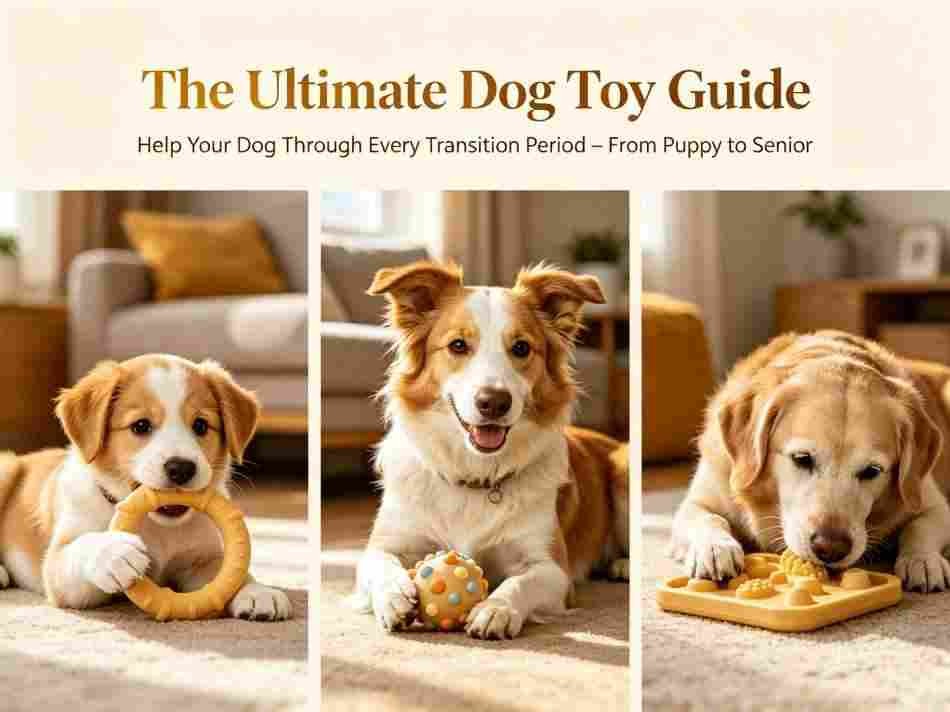
The term "transition period" might sound like something reserved for careers or life stages. But for dogs, their entire lives are actually a series of transition periods – from leaving their mother and entering a new home, to the gum pain of teething, to the boundless energy of adolescence, and finally to the slower pace of their senior years.
Every transition period is a vulnerable moment – physically and psychologically. During these times, dogs need understanding, patience, and the right tools.
Toys are precisely the most overlooked yet most effective tool. A well-designed toy can provide comfort during anxiety, channel excess energy, and keep cognitive function active during decline.
This article systematically explains several important "number principles" in dog ownership – the "3-3-3 Rule, the 90/10 Principle, and the 7-7-7 Rule" – and combines them with silicone toy categories and design advantages to help B2B brands understand why silicone is the ideal material for dogs at every life stage.
Three Key Principles for Understanding Your Dog's Needs
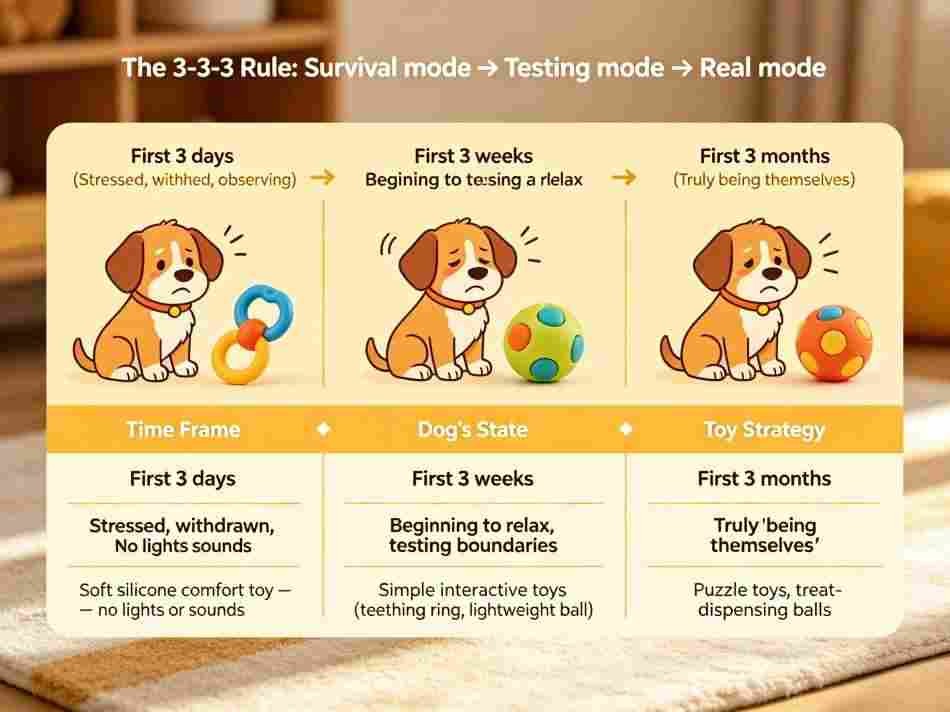
The 3-3-3 Rule: The Golden Rule for Acclimation to a New Home
What is the 3-3-3 Rule?
The 3-3-3 Rule describes the three stages of a rescued or newly adopted dog's adjustment to a new environment:
Time Frame | Dog's State | Owner's Tasks |
First 3 days | Stressed, withdrawn, observing; may not eat or drink, may hide | Provide safe space; don't force interaction; keep environment calm |
First 3 weeks | Beginning to relax, testing boundaries; may reveal "hidden" personality | Establish routine; introduce basic training; provide appropriate toys |
First 3 months | Truly "being themselves"; personality, habits, and behavior issues emerge | Continue socialization training; adjust environment to meet real needs |
Applying the 3-3-3 Rule to Toys
Days 1-3: Provide soft, edge-free silicone comfort toys for licking or gentle chewing to release stress. Avoid toys with lights or sounds.
Days 4-21: Introduce simple interactive toys like silicone teething rings or lightweight balls to build positive associations ("play = happy").
"The first 3 days are survival mode, the first 3 weeks are testing mode, and the first 3 months are real mode." – Consensus in animal behavior science
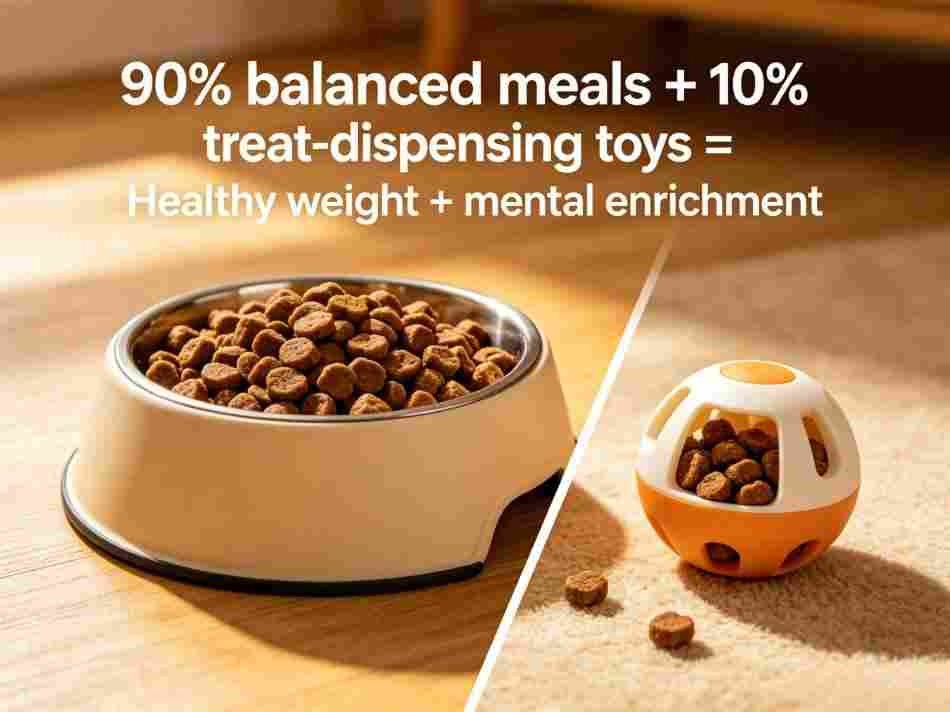
The 90/10 Principle: The Calorie Distribution Rule for Treats vs. Meals
What is the 90/10 Principle?
The 90/10 Principle comes from veterinary nutrition: **90%** of a dog's daily caloric intake should come from a balanced, nutritionally complete main diet (kibble/wet food/raw food), and **10%** can come from treats (including training rewards, chews, and food stuffed into treat-dispensing toys).
Why the 90/10 Principle Matters
Excess treats lead to obesity, picky eating, and nutritional imbalance
Obesity is the most common health problem in dogs, leading to joint disease, diabetes, heart disease, and more
Moving a portion of main meals into toys controls calories while increasing feeding enrichment
Applying the 90/10 Principle to Toys
A practical approach is to allocate 10% of your dog's daily calorie budget to toys:
Take a small portion (about 10%) of daily kibble and stuff it into treat-dispensing toys, lick mats, or puzzle balls
Feed the remaining 90% as regular meals
Provide the toy-stuffed portion during alone time or when the dog needs to burn energy
Comparison
Traditional Feeding | Toy + Main Meal Mix |
Finished in 5 minutes | 20–60 minutes of continuous engagement |
Single feeding experience | Eating + mental + physical – triple stimulation |
Easy to overfeed | Calories controlled |
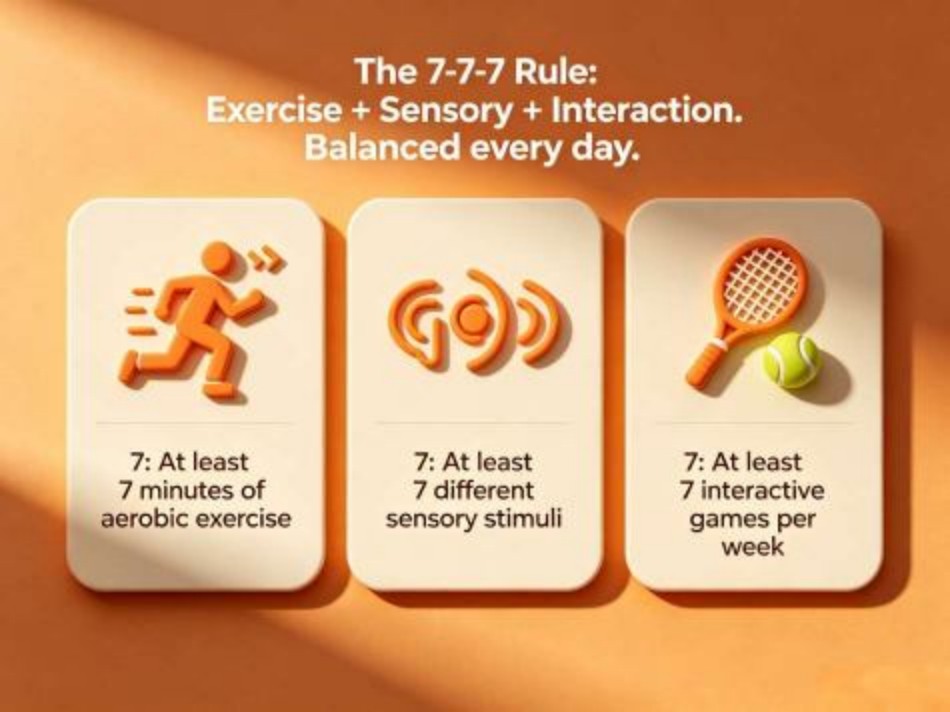
The 7-7-7 Rule: A Balanced Framework for Daily Dog Activity
What is the 7-7-7 Rule?
The 7-7-7 Rule is a simple, memorable framework for a dog's daily activities:
Number | Meaning | Specific Content |
7 | At least 7 minutes of aerobic exercise per day | Running, chasing, swimming – activities that raise heart rate |
7 | At least 7 different environmental/sensory stimuli per day | Different floor textures, sounds, smells, social interactions |
7 | At least 7 interactive games per week | Tug-of-war, fetch, hide-and-seek – human-dog interaction |
Note: "7 minutes" is the absolute minimum for small or senior dogs. For working breeds (Border Collies, German Shepherds, Huskies), 60–120 minutes of high-intensity exercise is needed daily. The 7-7-7 Rule is best understood as a reminder of **activity variety** rather than an absolute standard for exercise volume.
Applying the 7-7-7 Rule to Toy Design
7 Areas | Implications for Toy Design |
7 minutes of aerobic exercise | Design high-bounce, fetch-friendly balls |
7 sensory stimuli | Different textures (smooth/bumpy/ridged), different sounds (silent/gentle/squeaky), different scents |
7 interactive games | Design "tug + ball" combo toys suitable for two-person or two-dog play |
A Complete Guide to Your Dog's Transition Periods (0 to Senior)
A dog's life can be divided into the following transition periods, each with unique needs and challenges.
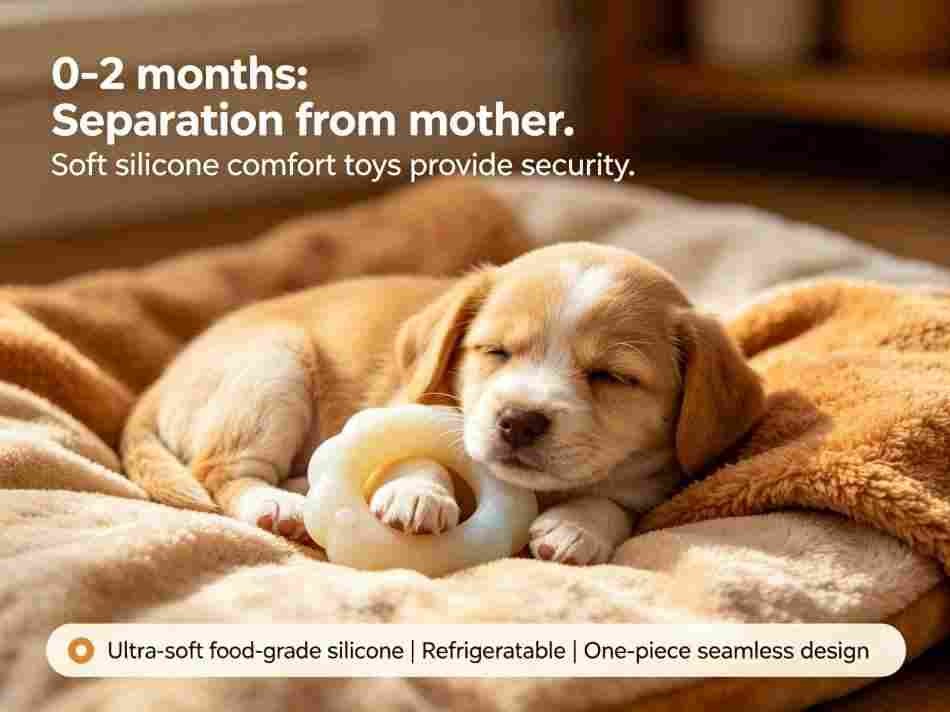
Transition 1: Weaning & Leaving the Litter (0–2 months)
"Physical Characteristics":
Baby teeth are erupting; gums are swollen and painful
Immune system not yet mature
Separation anxiety from leaving mother and littermates
"Behavioral Signs":
Chewing everything within reach (fingers, cords, furniture legs)
Whining at night; lack of security
"Toy Needs":
Soft materials that won't damage gums
Comforting, gentle chewing allowed
Easy to clean and sterilize
"Silicone Toy Design Directions":
Ultra-soft food-grade silicone teething rings with massage bumps
Refrigeratable silicone comfort toys – cold temperatures further relieve gum pain
One-piece, seamless design to prevent bacterial growth
Transition 2: Teething (3–6 months)
"Physical Characteristics":
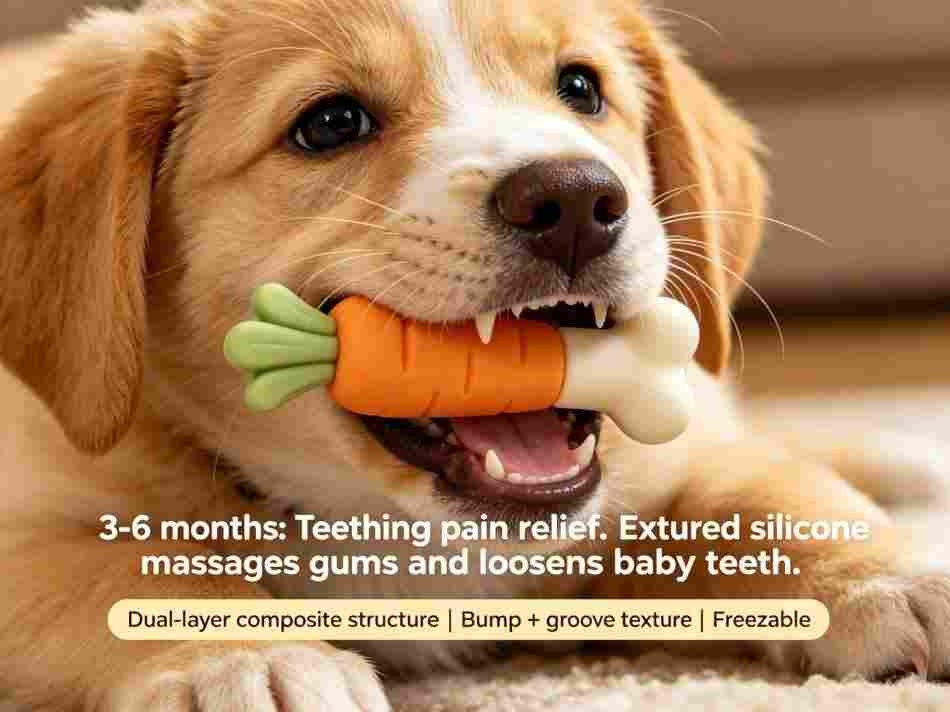
Baby teeth falling out; permanent teeth erupting
Sensitive gums; need for continuous chewing stimulation
Bite force gradually increasing
"Behavioral Signs":
Significantly increased chewing frequency
May begin destroying furniture and shoes
"Toy Needs":
Good resilience; able to withstand light to moderate chewing
Surface texture helps loosen baby teeth
Treat-dispensing capability to extend focus time
Silicone Toy Design Directions:
Dual-layer composite structure: outer food-grade silicone + inner TPE support skeleton – distributes approximately 70% of bite pressure
Bump + groove combination texture – cleans teeth and massages gums during chewing
Carrot or bone shapes – multi-angle tooth surface contact
Transition 3: Adolescence / High-Energy Period (6–18 months)

"Physical Characteristics":
Permanent teeth fully erupted; bite force reaches adult levels
Abundant energy; significantly increased exercise needs
Sexual maturity; may develop territorial behavior and social challenges
"Behavioral Signs":
Possible separation anxiety and destructive behavior
Need for substantial exercise and mental stimulation
"Toy Needs":
High durability to withstand intense chewing
Puzzle designs that provide mental challenges
Suitable for fetch, chase, and other interactive play
"Silicone Toy Design Directions":
High-bounce silicone balls with unpredictable bounce patterns to increase chase excitement
Treat-dispensing toys with internal maze channels – extend feeding time to over 30 minutes
Freezable, stuffable licking toys – uses licking behavior to release endorphins and relieve anxiety
Transition 4: Adult Stability (18 months – 6 years)

Physical Characteristics:
Physically mature
Stable personality
At peak of physical ability and health
Behavioral Signs:
May develop specific preferences (ball-obsessed, chewer, tug-lover)
May develop behavior problems due to monotonous routine
Toy Needs:
Variety; rotation to maintain novelty
Specialized toys for specific preferences
Suitable for owner interaction
Silicone Toy Design Directions:
Modular toys that can be combined (silicone rings + ropes + squeakers)
Product lines with different hardness levels (Soft/Medium/Hard) – adaptable to different breeds and bite strengths
Floating designs – expand play to water activities
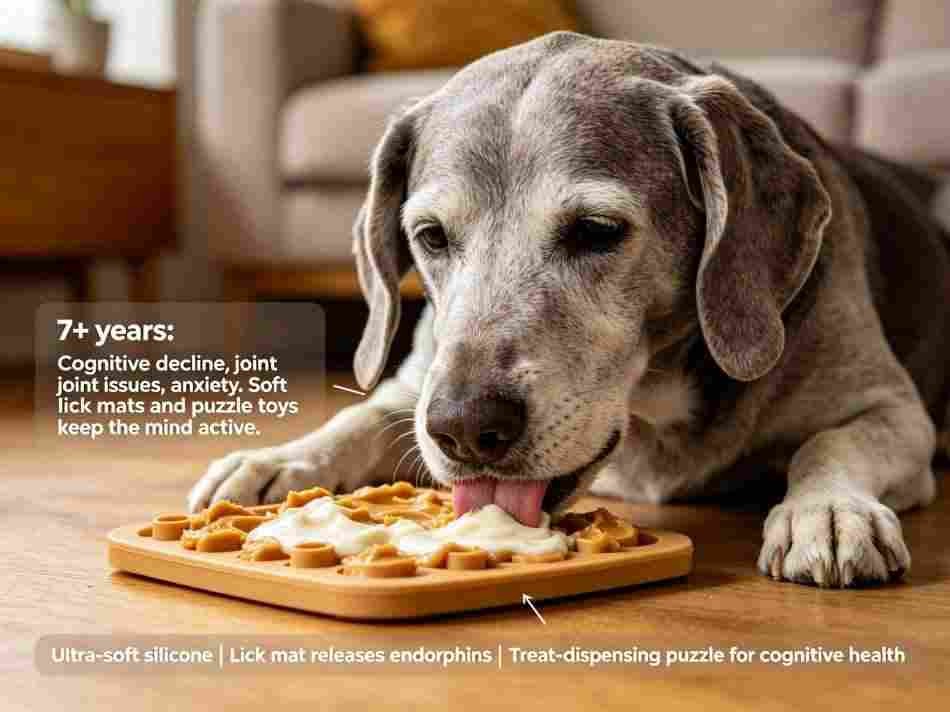
Transition 5: Senior Years (7+ years)
"Physical Characteristics":
Tooth wear, gum recession; possible loose or missing teeth
Decreased bite force
Cognitive decline (similar to Alzheimer's in humans)
Joint problems; reduced mobility
"Behavioral Signs":
May lose interest in toys
More prone to anxiety (due to hearing/vision loss)
Altered sleep patterns
"Toy Needs":
Extremely soft materials – won't damage fragile teeth and gums
Cognitive stimulation features
Anxiety relief and companionship
"Silicone Toy Design Directions":
Ultra-soft silicone comfort toys – licking behavior releases anxiety
Interactive toys with built-in squeakers – sound attracts attention
Treat-dispensing puzzle toys – maintains cognitive activity; slows cognitive decline
Deep Dive into Silicone Toy Design Advantages (Essential Reading for B2B)
As a silicone product manufacturer and R&D company, understanding the unique advantages of silicone and translating them into product selling points is key to serving B2B clients.
Safety: Food-Grade Certification Is the Baseline
Certification | Scope | Silicone Advantage |
FDA | US food contact materials | Food-grade silicone passes FDA certification – safe for direct food contact |
LFGB | Germany/Europe food grade | Stricter than FDA – silicone easily meets standards |
ASTM F963 | US toy safety standard | Silicone meets both physical and chemical testing requirements |
EN71 | European toy safety standard | Silicone meets strict EU requirements |
GB 4806.11 | China food safety standard | Silicone meets national standards |
B2B Selling Points Summary:
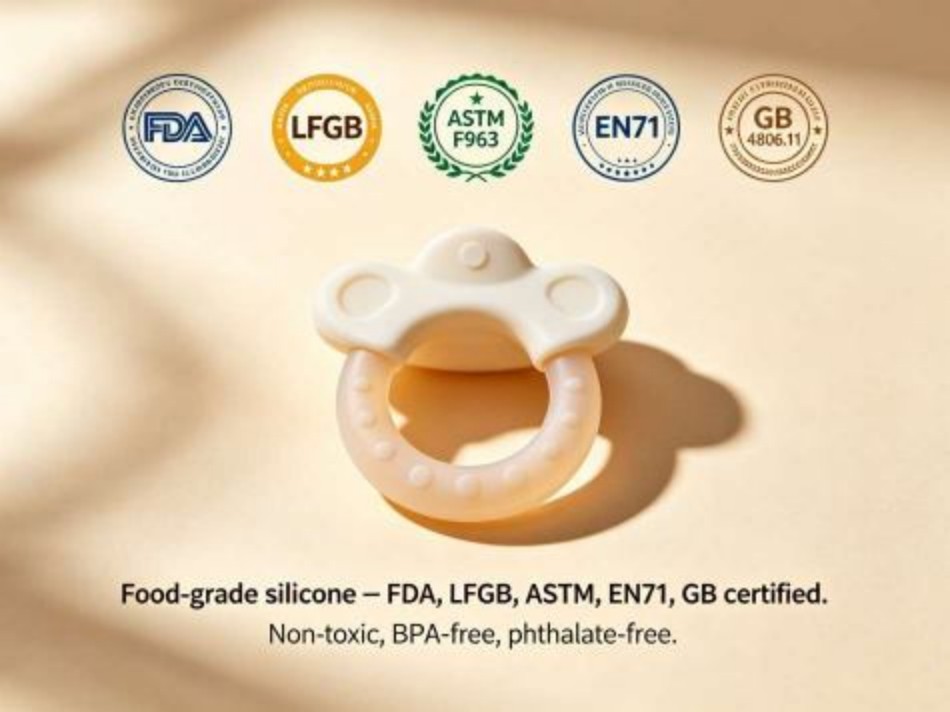
Silicone is one of the few toy materials that can simultaneously pass FDA, LFGB, ASTM, and EN71 certifications
Non-toxic, odorless, BPA-free, phthalate-free, latex-free
Risk of accidental ingestion of silicone fragments is far lower than plastic or rubber
Temperature Resistance: Freezable + Sterilizable
Use Scenario | Silicone Temperature Tolerance | Competitor Comparison |
Freezing/Refrigeration | Below -40°C | Natural rubber hardens; TPR becomes brittle |
Boiling water sterilization | Up to 200°C | Most plastics deform; natural rubber degrades |
Dishwasher | Top-rack safe | TPR may warp |
Direct sunlight | Long-term UV exposure causes aging (same for all materials) | — |
B2B Selling Points Summary:
Silicone toys are a "3-in-1" design: freezable (soothes teething pain), boilable (hygienic), and dishwasher-safe (convenient)
In summer, silicone toys can be filled with water or broth and frozen as "cooling popsicles"
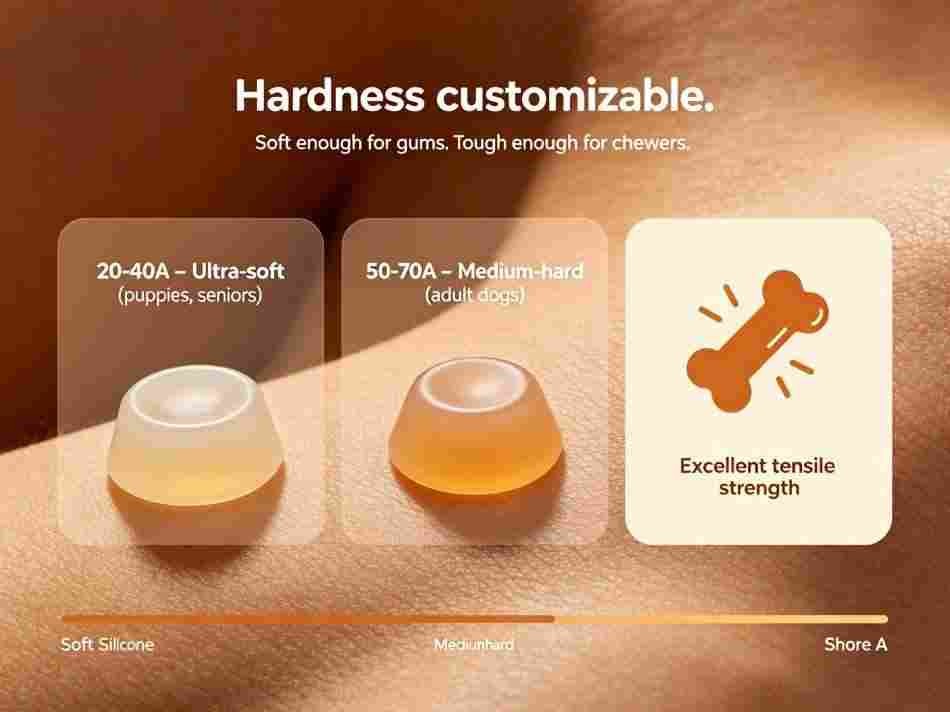
Physical Properties: The Perfect Balance of Softness and Bite Resistance
Physical Property | Silicone Performance | Design Implications |
Hardness (Shore A) | 20A–80A adjustable | Soft for puppies (20–40A), medium-hard for adult dogs (50–70A) |
Tensile strength | Excellent | "Stretchy toys" possible – adds play variety |
Tear strength | Good (formulation-dependent) | High-quality silicone withstands continuous chewing |
Resilience | Good | Suitable for balls and bouncing toys |
B2B Selling Points Summary:
Silicone hardness is customizable – one mold can produce product lines for different breeds/ages
Silicone's "soft yet resilient" nature achieves the best balance between "won't damage teeth" and "won't break easily"
Teething puppies benefit from silicone's gum protection; adult dogs can use silicone+rubber composite structures for cleaning effectiveness
Design Flexibility: Complex Shapes Without Compromise
Silicone's processing characteristics (liquid injection molding, compression molding) enable:
Complex 3D structures (rings, maze channels)
Different hardness zones within the same product (two-shot/two-hardness molding)
Seamless combination of different materials (silicone + rope, silicone + squeaker, silicone + ABS clip)
Rich color options (any Pantone color matchable)
B2B Selling Points Summary:
Silicone toy appearance is virtually unlimited by material constraints
"Functionality" and "aesthetics" can be perfectly combined for shelf appeal
Hygiene & Maintenance: Easy Cleaning = Frequent Use
Hygiene Dimension | Silicone Performance |
Surface porosity | Food-grade silicone has smooth surface – resists dirt and bacteria |
Bacterial resistance | Does not easily harbor bacteria; can be sterilized at high temperatures |
Cleaning methods | Hand wash, dishwasher, boiling, steam, UV – all acceptable |
Drying speed | Does not absorb water; dries quickly |
B2B Selling Points Summary:
Silicone toys are "lazy-owner friendly" – rinse clean, quick-dry, no odor retention
For treat-dispensing toys, silicone's washability is especially important
Silicone Toy Product Matrix (By Function)
Below are four functional categories of silicone toys. Each can be developed as an independent product line or combined into a "Dog Growth Set" for B2B clients.
Category 1: Lick & Calm
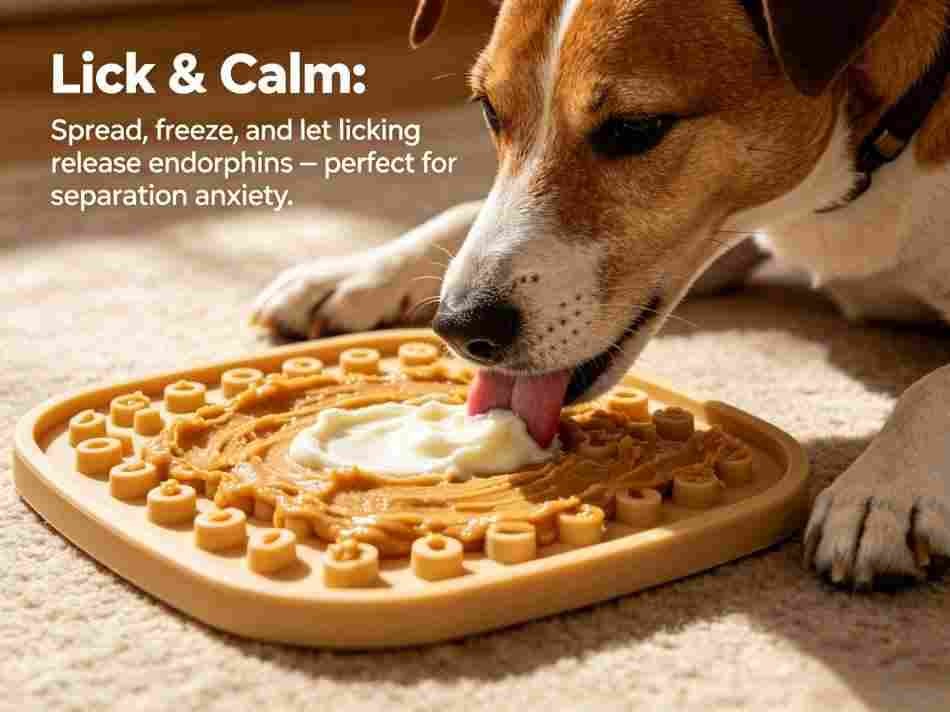
Core Function: Uses a dog's licking behavior to release endorphins – relieves anxiety, calms emotions
Use Scenarios:
Separation anxiety (when owner leaves home)
Adjustment to unfamiliar environments (travel, moving, boarding)
Cool-down after training sessions
Post-bath/grooming/vet visit soothing
Typical Product Forms:
Silicone Lick Mat: Surface covered with textured patterns; can be spread with peanut butter, yogurt, or meat paste and frozen
Silicone Popsicle Mold: Fill with broth or yogurt and freeze – summer cooling + soothing in one
Silicone Licking Ball: 360° licking surface
Design Considerations:
Moderate texture depth for easy cleaning
Can adhere to floor/wall (suction cup or non-slip design)
Won't deform when frozen
Category 2: Chew & Teethe
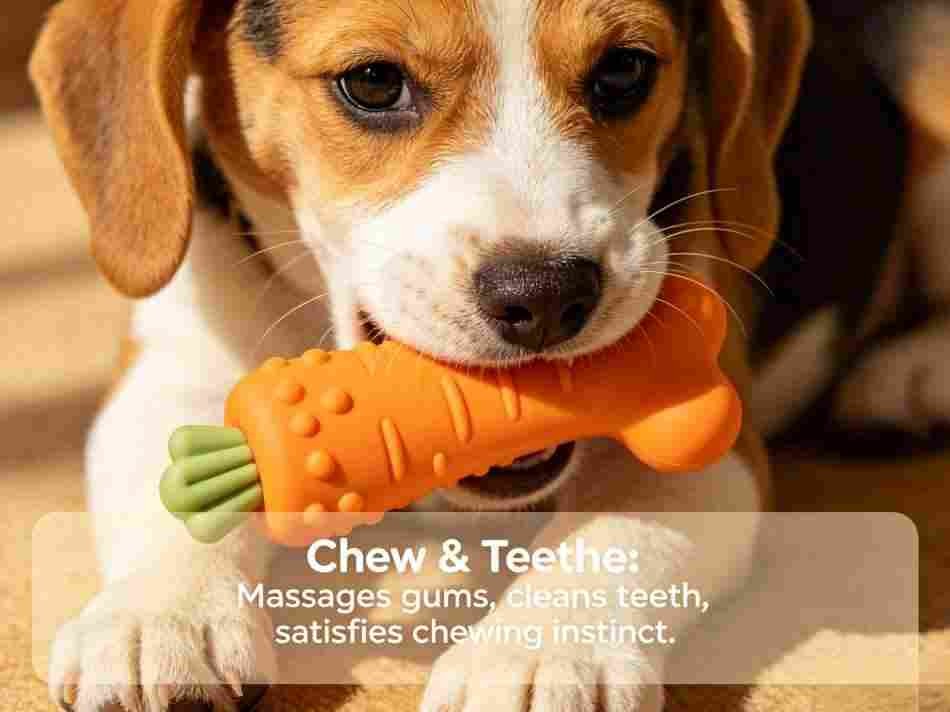
Core Function: Satisfies chewing instinct, cleans teeth, massages gums, releases energy
Use Scenarios:
Puppy teething (3–6 months)
Daily chewing for adult dogs – energy outlet
Gentle stimulation for senior dogs with gum recession
Typical Product Forms:
Silicone Teething Ring: Ring structure with even force distribution – suitable for multi-angle chewing
Silicone Bone: Classic shape; surface can feature different texture zones
Silicone Carrot/Corn: Playful shapes; built-in squeaker adds appeal
Silicone Stretchy Toy: "Caterpillar" shape that can stretch to several times its original length – combines chewing and tugging
Design Considerations:
Hardness grading (Soft/Medium/Hard) – adaptable to different breeds and ages
Surface texture design (bumps, grooves, spirals) – balances cleaning and massage functions
One-piece seamless construction – prevents delamination and swallowing
Category 3: Puzzle & Treat

Core Function: Provides mental stimulation through "problem-solving to access food" – extends playtime, relieves boredom and anxiety
Use Scenarios:
When dog is home alone (owner at work/away)
Rainy days when outdoor exercise isn't possible
When high-energy breeds need "cooling down"
Typical Product Forms:
Silicone Treat-Dispensing Ball: Maze-like internal channels – treats must be rolled out to fall out – focus time can exceed 58 minutes
Silicone Pull-and-Play (Carrot/Bone): Multiple small pieces must be pulled out one by one to access treats
Silicone Puzzle Spinner: Rotating opening/closing design – adjustable difficulty levels
Design Considerations:
Hole sizes compatible with standard kibble
Adjustable difficulty (beginner vs. advanced)
Disassemblable and easy to clean (hygiene is critical for treat-dispensing toys)
Category 4: Fetch & Tug
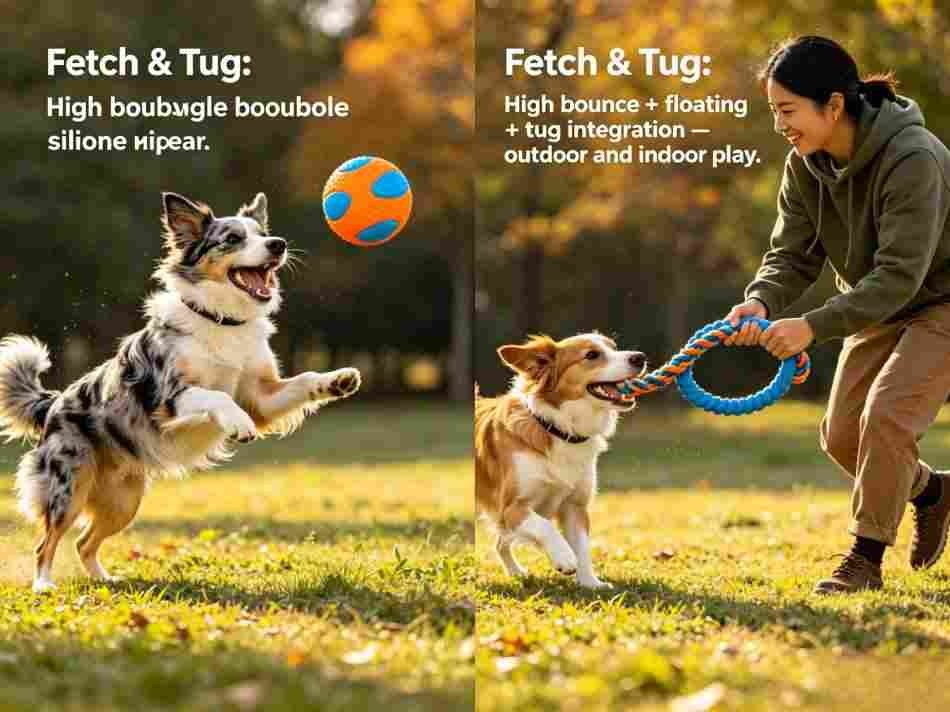
Core Function: Promotes human-dog or dog-dog interaction – burns physical energy, builds emotional bonds
Use Scenarios:
Daily interactive games (fetch, tug-of-war, retrieve)
Outdoor activities (parks, beaches, yards)
Basic training rewards
Typical Product Forms:
Silicone Bouncy Ball: High-bounce, unpredictable bounce patterns, floating design
Silicone Frisbee: Soft on teeth, won't hurt gums; foldable for storage
Silicone Tug Ring: Ring + rope combination – suitable for two-person or two-dog tug-of-war
Silicone Squeaky Toy: Built-in air squeaker – squeezing produces sound to attract attention
Design Considerations:
High-visibility colors (orange, fluorescent green, blue) for outdoor tracking
Floating design expands use scenarios (beaches, pools)
Squeaker mechanism must be bite-resistant and non-detachable
Toy Rotation – Why "New" Matters More Than "Good"
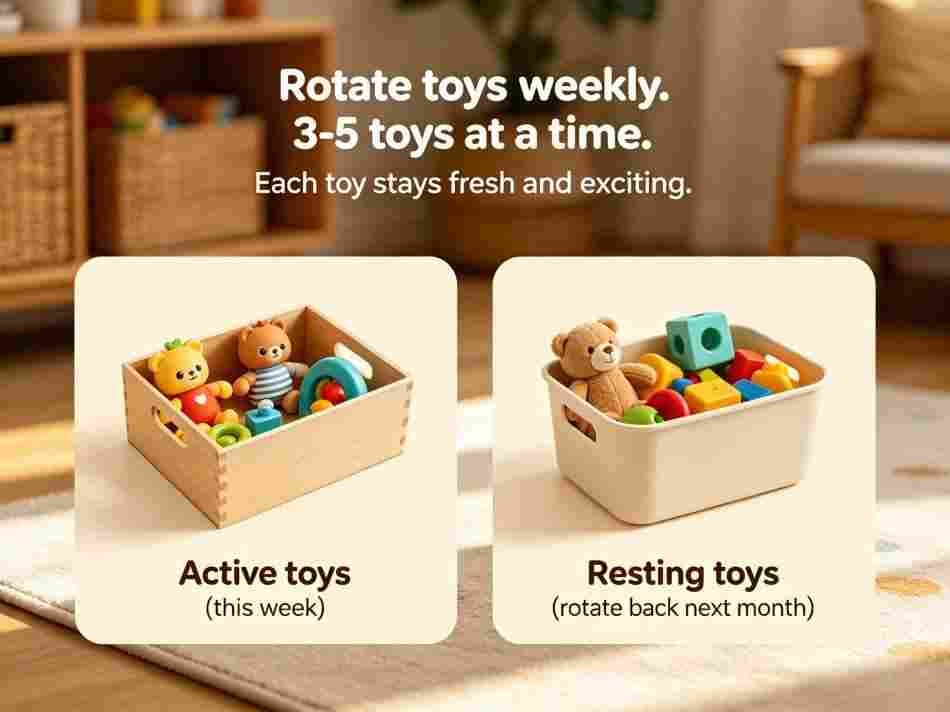
This is often overlooked in dog toy design: "No matter how good a toy is, it will lose its appeal if it's always available."
The Psychology Behind Toy Rotation
Neophilia (the desire to explore novelty) and habituation (boredom with familiarity) exist in all mammals. When a toy is available for too long, dogs gradually lose interest – not because the toy is bad, but because of the brain's adaptation mechanism.
Solution: Toy Rotation System
Strategy | Method | Effect |
3–5 toys in rotation | Only 3–5 toys "on duty"; the rest stored away | Each toy stays fresh |
Weekly rotation | Swap 1–2 "on duty" toys each week | Sustained mild novelty |
"New" toy introduction | Add 1 new type of toy every 1–2 months | Maintains long-term interest |
"Old" toy rest period | Stored toys are cleaned, left for several weeks, then rotated back in | Regains novelty |
Implications for B2B Brands
Silicone toys are especially well-suited for "multi-piece sets" and "subscription box models":
Silicone's easy-clean, easy-store nature makes it ideal for long-term rotation
Different functions within the same theme (lick + chew + puzzle + fetch/tug) can be packaged as a "Growth Set"
Subscription service by life stage: Puppy Box → Adult Box → Senior Box
Conclusion: Silicone – A Lifelong Companion Material
From the eruption of the first baby tooth to the loosening of the last in old age, silicone – with its five key advantages of "safety, temperature resistance, balanced softness and bite resistance, design flexibility, and easy cleaning" – is the ideal toy material for dogs at every life stage.
For B2B brands, silicone toys are not just a product category – they are a "lifelong solution":
Transition Period | Core Needs | Silicone Toy Design Directions |
Weaning (0–2 months) | Comfort, softness, safety | Ultra-soft silicone comfort ring, refrigeratable teething toy |
Teething (3–6 months) | Chewing, gum massage | Textured silicone teething ring, hardness-graded design |
Adolescence (6–18 months) | Energy outlet, mental stimulation | Treat-dispensing ball, bouncy ball, stretchy toy |
Adulthood (18 mo – 6 years) | Variety, interaction | Squeaky toy, floating ball, tug ring |
Senior (7+ years) | Cognitive maintenance, anxiety relief | Lick mat, puzzle toy, ultra-soft comfort toy |
Final important reminder: Toy rotation is key to maintaining a dog's interest. No matter how good a silicone toy is, it needs a "rest period" to stay fresh. Pass this methodology on to B2B clients – help them understand that toys are not disposable items, but lifelong companions on a dog's journey.


