


A step by step framework for B2B buyers – from defining your needs to sealing the partnership
Introduction
Silicone is everywhere. It lines your baby's bottle, seals your coffee mug, and cushions your air fryer basket. But behind every great silicone product is an often invisible decision: choosing the right manufacturer.
For B2B buyers – brand owners, wholesalers, retailers, and e commerce sellers – the choice is rarely simple. Dozens of factories claim to be "the best." Prices vary wildly. Certifications are thrown around without proof. And by the time a bad batch arrives, you've already lost customers.
This guide gives you a proven, step by step framework to evaluate and select a silicone products manufacturer. It draws on industry best practices, regulatory requirements, and lessons learned from successful (and failed) sourcing relationships.
Whether you are sourcing baby teethers, kitchen spatulas, pet toys, or medical parts, the same principles apply.
Define Your Needs – The Foundation of a Good Partnership
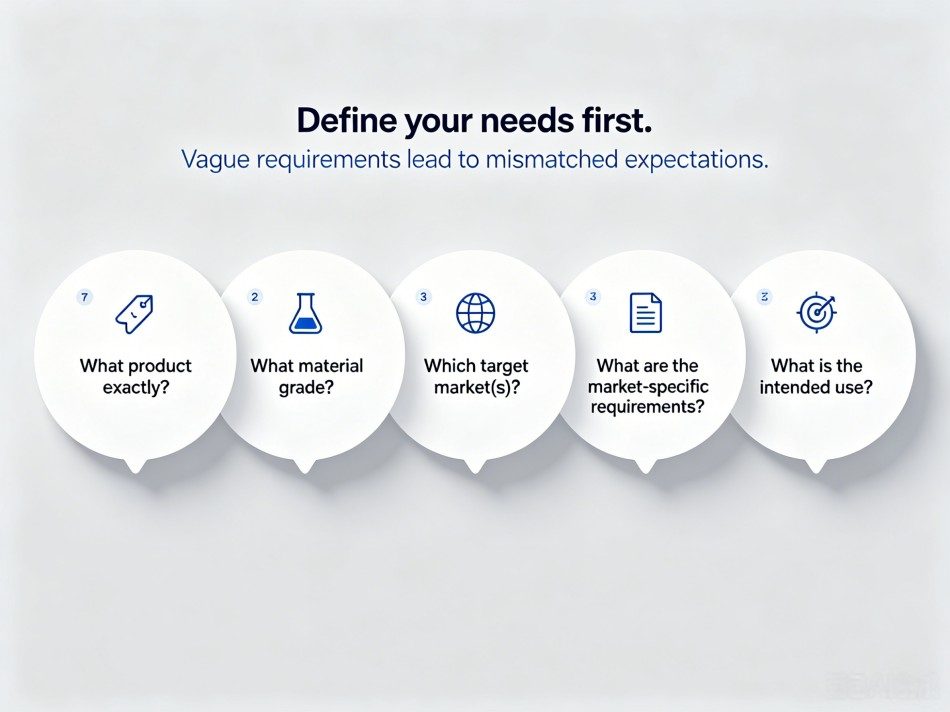
Before you contact a single factory, you must be crystal clear about what you want. Vague requirements lead to vague quotes – and eventually to mismatched expectations.
Define Your Product, Target Market & Its Requirements
Start by answering five questions:
Question | Why It Matters |
What product exactly? | A teether has different safety requirements than a kitchen spatula. |
What material grade? | Food-grade? Medical-grade? Industrial? |
Which target market(s)? | US, EU, China, Japan – each has different certification demands. |
What are the market-specific requirements? | LFGB for Germany, FDA for USA, GB for China. |
What is the intended use? | Daily heavy use? Occasional? Single use? |
Example – Baby Teether for the EU Market:
Product: Water-filled teether (straw shape)
Material: Food-grade silicone, BPA-free, phthalate-free
Target market: Germany, France, Italy
Required certifications: LFGB (Germany), EN71 (EU toy standard), CE
Use case: Daily chewing, 0-24 months, can be refrigerated
Why this matters: A manufacturer that only holds FDA certification cannot legally sell LFGB-certified products into Germany. Knowing your target market upfront filters out unsuitable suppliers immediately.
Define Order Quantity & Timeline
Silicone manufacturing has fixed costs: mold creation, setup, minimum runs. Your quantity determines which manufacturers will take you seriously.
Order Volum | Typical Manufacturer Type | What to Expect |
< 500 pcs | Small workshops, trading companies | Higher per-unit cost, limited customization, slower lead times |
500 – 5,000 pcs | Mid-tier manufacturers | Mold cost shared, reasonable per-unit price, minimum order flexibility |
5,000 – 50,000 pcs | Established manufacturers | Competitive pricing, dedicated production lines |
50,000+ pcs | Large-scale manufacturers | Lowest per-unit cost, priority scheduling, potential exclusivity |
Timeline considerations:
Mold development: 15–30 days (depends on complexity)
First sample: 7–14 days after mold completion
Sample revision (if needed): 7–10 days
Mass production: 15–30 days (depends on quantity)
Shipping: 15–40 days (sea freight)
Total typical timeline: 2–4 months from mold start to your warehouse.
Advice for new brands: Start with a flexible manufacturer that accepts lower MOQs (e.g., 1,000 pcs) for neutral packaging. You can test the market before committing to large volumes.
Define Your Budget
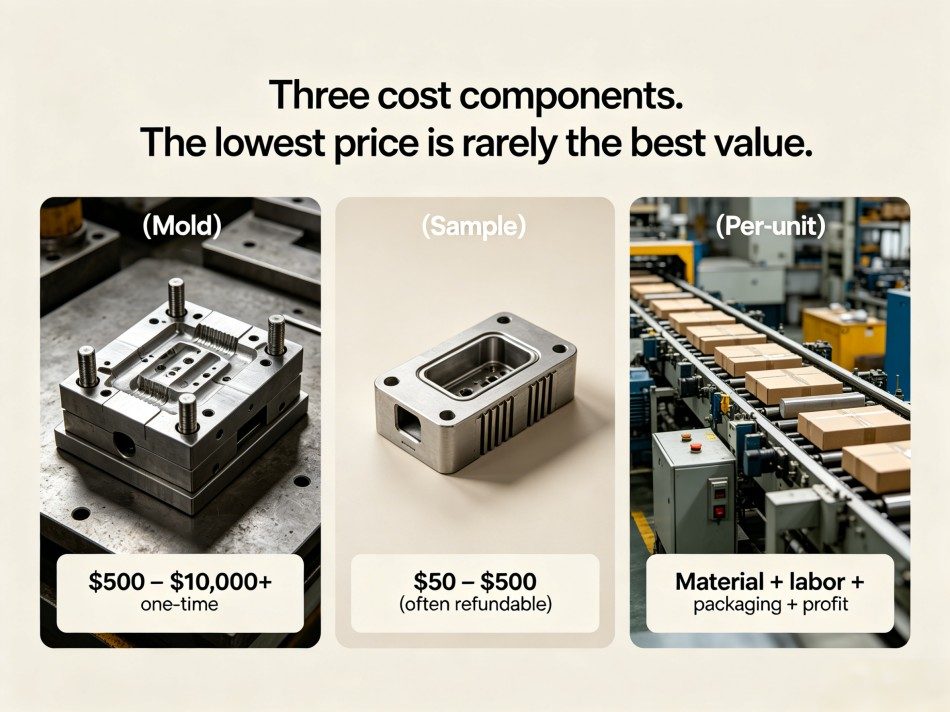
Be realistic. Silicone products have three cost components:
Price drivers:
Material: Virgin food-grade silicone costs more than industrial-grade or recycled.
Complexity: Multi-color, multi-hardness, or over-molding (silicone + plastic) costs more.
Surface finish: Matte, glossy, textured – each requires different mold treatment.
Packaging: OPP bag vs. color box vs. custom packaging – significant difference.
A useful rule of thumb from B2B sourcing experts: The lowest price is rarely the best value. A manufacturer that charges 20% more but delivers consistent quality, on-time shipments, and proper certifications saves you money on returns, customer complaints, and brand damage. Adopt a total cost of ownership (TCO) approach that includes unit price, shipping, defect rates, and after-sales support .
Initial Screening – Finding Potential Suppliers
Once you know what you need, it’s time to find who can make it.
Use Online Directories & Search Engines
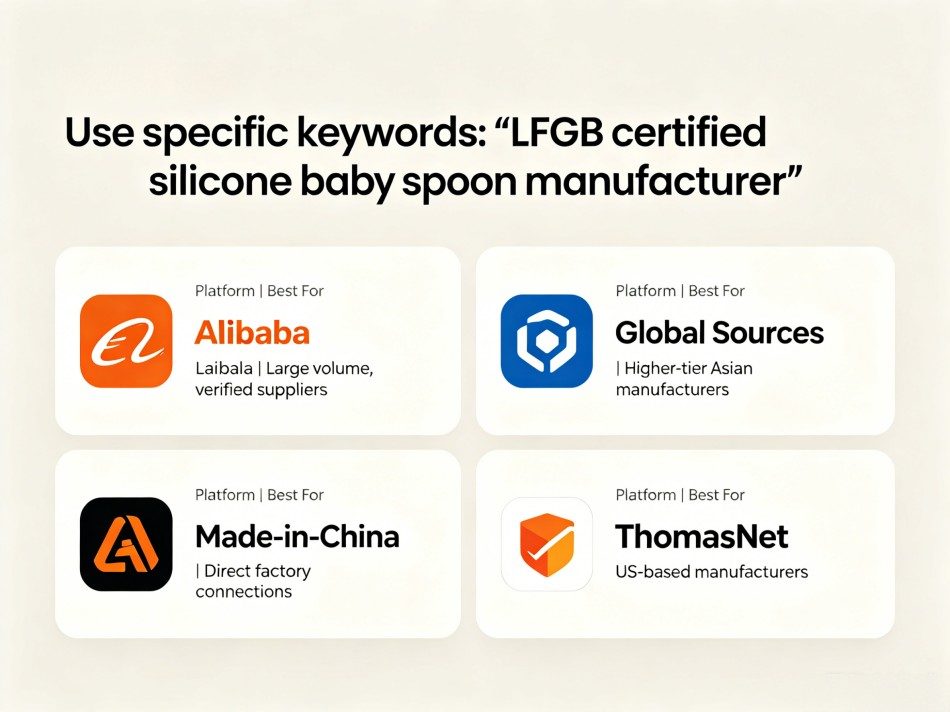
Reputable platforms for finding silicone manufacturers:
Search tips:
Use specific keywords: “LFGB certified silicone baby spoon manufacturer” not just “silicone spoon factory”
Look for manufacturers that specialize in your product category (baby, kitchen, medical)
Check how long they have been on the platform – 5+ years is a good sign
Evaluate operational metrics: on time delivery rate (top performers achieve 99–100%), customer reorder rate (high indicates satisfaction), and response time (under 24 hours is good)
Attend Trade Shows & Conferences
Nothing replaces face-to-face interaction. At trade shows, you can:
Touch and feel product quality
Assess the professionalism of sales staff
Compare multiple suppliers in one day
Build personal relationships that matter later
Major silicone-related trade shows:
Show | Location | Focus |
Canton Fair | Guangzhou, China | General merchandise, many silicone suppliers |
Ambiente | Frankfurt, Germany | High-end housewares, kitchen products |
Kind + Jugend | Cologne, Germany | Baby products (teethers, feeding) |
Global Pet Expo | Orlando, USA | Pet toys and accessories |
Household & Gift Shows | Various | Kitchenware and home products |
Ask for Recommendations
Sometimes the best supplier is one that’s already proven. Ask:
Industry peers – Not competitors, but non competing brands in adjacent categories
Industry associations – Baby products associations, kitchenware trade groups
Certification bodies – SGS, TÜV, Intertek – they test many factories and can recommend compliant ones
Freight forwarders – They see which factories ship reliably
Red flag: A manufacturer that has no references or refuses to share previous clients (even anonymized).
Credential Verification – Separating Real Factories from Traders
Many companies claim to be manufacturers but are actually traders. Here’s how to verify.
Basic Certifications for Your Target Market
Each market has mandatory standards. A capable manufacturer will hold the relevant certifications – not just claim to “comply.”
Additional market-specific requirements:
South America (MERCOSUR): New Resolution GMC/Res.No.34/2025 (effective June 16, 2026) establishes a separate regulatory framework for silicone, requiring positive lists and specific migration limits for volatiles (<0.5%), extractables (<0.5%), and primary aromatic amines (≤0.01mg/kg)
Medical applications: ISO 10993 (biocompatibility) and USP Class VI are required – these are not “certificates for a material” but testing concepts for the finished medical device
What to ask for:
Certificate number and issuing body (e.g., SGS, TÜV, Intertek, BSI)
Product range covered – Some certificates cover only specific products
Expiration date – Certificates expire; current certification matters
Critical Warning: Many factories post “FDA compliant” on their website. Ask for the actual test report. Cross-check FDA registration numbers at fda.gov/medicaldevices using the official device registration database . A legitimate ISO 10993 report will specify the exact material formulation tested, the testing laboratory, and the test dates .
Product-Specific Certificates & Safety Test Reports
Beyond basic certifications, your product may require specialized testing:
Ask for:
Full test reports (not just certificates)
Testing laboratory name (SGS, TÜV, Intertek, BV are reputable)
Test date – older than 2 years may need updating
Batch-specific traceability linking test reports to production lots
Platform-Specific Requirements
If you plan to sell on Amazon, additional requirements apply:
Requirement | Details |
General Certificate of Conformity (GCC) | Required for children’s products sold in the US |
Children’s Product Certificate (CPC) | Required for baby/toddler products |
Amazon’s specific testing | Amazon may require testing from their approved lab list |
Product liability insurance | Some marketplaces require proof |
Ask your manufacturer: “Can you provide CPC/GCC for Amazon listing?” A factory that understands Amazon requirements will save you months of compliance headaches.
Customization Capability (Team, Options, Experience)
Most B2B buyers need customization – their logo, their colors, their packaging. Not all manufacturers can deliver.
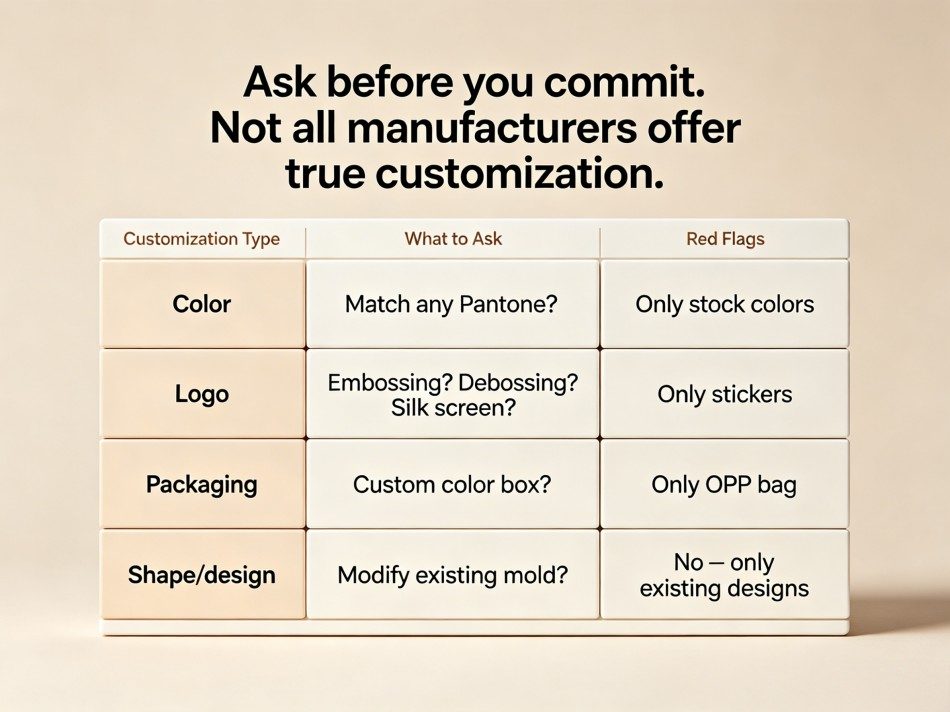
Customization Type | What to Ask | Red Flags |
Color | “Can you match any Pantone color in silicone?” | “Only stock colors available” |
Logo | “Embossing? Debossing? Silk screen? Heat transfer?” | “Only stickers or labels” |
Packaging | “Custom color box? Hang tags? Inserts?” | “Only standard OPP bag” |
Shape/design | “Can you modify existing mold or create new?” | “No – only existing designs” |
Assess their team:
Do they have in-house R&D/engineering? (Not outsourcing mold design)
How many patents do they hold? (Shows innovation capability)
What is their minimum order quantity for customization? (Lower is better for testing)
Example – Good answer: “We have 15 in-house R&D engineers. We offer color customization (any Pantone) with MOQ 5,000 pcs. Logo embossing/debossing available from 3,000 pcs.”
In-Depth Communication & Sampling
Once a manufacturer passes initial screening, it’s time to test them with real work.
Communicate Sample Requirements
Send a clear, written sample request. Include:
Product name and reference image/drawing
Target dimensions (length, width, height, weight if known)
Target material (food-grade silicone, shore hardness if known)
Color requirement (Pantone number or reference)
Logo requirement (embossed/debossed, location, size)
Packaging requirement (for sample, and for mass production)
Certification requirement (test reports needed)
What a good manufacturer will ask you:
“What is your target market?” (to recommend certifications)
“What is your expected annual volume?” (to suggest mold type)
“Do you have a deadline for first sample?” (to set expectations)
What a poor manufacturer will do: Say “no problem” to everything, deliver a sample that misses half your requirements, and disappear when you ask for revisions.
Pay Mold & Sample Fees
Mold fees are normal. A custom shape requires a steel mold. Typical mold costs:
Complexity | Estimated Cost | Notes |
Simple (flat, one-piece) | 500–500–1,500 | 1-2 cavities |
Medium (3D shape) | 1,500–1,500–4,000 | 2-4 cavities |
Complex (multi-part, undercuts) | 4,000–4,000–10,000+ | 4+ cavities |
Sample fees are also normal. Even if a mold exists, producing a sample takes time and material. Typical sample fees:
Protect yourself: Get a written agreement specifying what is refundable and under what conditions.
Evaluate the Sample – Don’t Just Look, Test
When the sample arrives, don’t just admire it. Put it through real world tests.
Visual inspection:
Color matches Pantone reference? (Check under natural and indoor light)
Logo is clear, properly positioned, permanent? (Rub it – does it smudge?)
No flash (excess silicone) on edges? No sink marks or voids?
Surface finish matches specification (matte/glossy/textured)?
Physical testing:
Dimensional check: Measure against drawing. ±0.5mm is typical; more than ±1mm may indicate mold issues.
Hardness check: Shore A durometer – confirm matches specification.
Bite/tear test: For teethers or dog toys – can it withstand chewing?
Heat test: For kitchen products – does it warp at 200°C?
Cold test: For teething products – does it become too hard when refrigerated?
For medical or high-reliability applications, request testing from multiple lots:
Test consistency across at least two different production batches
Verify tensile strength, elongation, compression set
Conduct sterilization compatibility testing (autoclave, EtO, gamma) for medical devices
Documentation check:
Test reports provided? Match sample batch number?
Certificates valid and current?
Practical fit test (for baby products):
Can a baby (or a hand mimicking a baby) actually grip it?
Does the spoon/fork head fit comfortably in a small mouth?
Are there sharp edges or pinch points?
What to do next:
Sample Result | Action |
Perfect | Proceed to mass production planning |
Minor issues (color slightly off, small flash) | Request revision sample – clarify what needs fixing |
Major issues (wrong material, wrong hardness, safety risks) | Consider other manufacturers – or require new sample at supplier’s cost |
Factory Audit – Seeing Is Believing
Samples can be perfect. That doesn’t mean mass production will be. A factory audit is your best insurance – whether on-site or remote.
Production Facilities & Technology
Walk the production floor. What do you see?
What to Look For | Why It Matters |
Modern injection molding machines | Better precision, faster cycle times |
Well-maintained equipment | Reduces defects and downtime |
Dedicated production lines | Your product isn’t competing for space |
In-house mold shop | Faster revisions, better quality control |
Clean, organized layout | Reduces cross-contamination and errors |
Ask about:
Daily production capacity (e.g., “2,400 pcs per 20 hours”)
Number of production lines
Years in operation
Most advanced machine capability (tonnage, precision)
Cleanliness & Organization
Silicone attracts dust. Dust in the product = rejected by your customers.
What to Look For | Red Flags |
Clean floors, work surfaces | Dust, debris, food remnants |
Separate raw material storage | Raw silicone stored next to chemicals |
Proper ventilation | Strong chemical smells |
Controlled access to production area | Anyone can walk in off the street |
Cleanroom for baby/medical products | No cleanroom but making baby teethers? |
Ask about: Cleanroom standards (ISO Class 7 or Class 8 is the minimum expectation for medical products) . For baby products, a million-level cleanroom (Class 1,000,000) is typical.
Company Culture & Workforce
The best machines mean nothing if the people running them don’t care.
What to Observe | What It Indicates |
Workers wear proper PPE (gloves, masks) | Safety and quality focus |
Workers seem engaged, not rushed or stressed | Low turnover, trained staff |
Supervisors are present and attentive | Active quality management |
No one on phones while operating machines | Professionalism |
Ask about:
Number of employees
Years of average employee tenure
Training programs for new workers
Quality inspection team size and processes (top manufacturers have 6+ inspection checkpoints)
Safety Facilities & Training
Safety is not just about ethics – it’s about consistency. Unsafe factories have higher turnover, more accidents, and often lower quality.
What to Look For | What It Indicates |
Fire extinguishers, emergency exits | Regulatory compliance |
First aid kits, eyewash stations | Basic safety infrastructure |
Safety signs (in local language and English) | Training for all workers |
Workers can explain emergency procedures | Training actually happens |
No blocked aisles or stacked boxes near exits | Organization and planning |
Ask for: Safety training records, accident reports (low accident rates are good; zero reported accidents may mean poor reporting).
Remote Audit Options
If an on-site visit is not feasible, request:
A live video factory tour with your specific questions addressed in real time
Third-party audit by SGS, Bureau Veritas, or Intertek
Recent audit reports from existing customers (with confidential information redacted)
Finalizing the Partnership
Once a manufacturer passes your audit, it’s time to formalize the relationship.
Quality Agreement
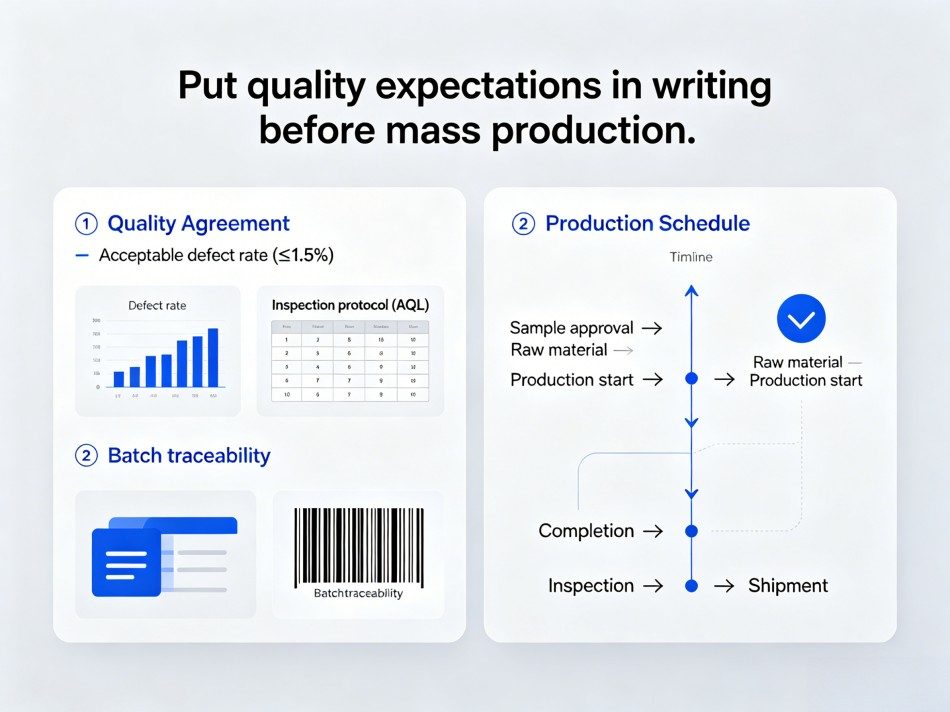
Put quality expectations in writing. Include:
Acceptable defect rate (e.g., ≤1.5%)
Inspection protocol (AQL sampling standard – typically 1.0 for major defects, 1.5–4.0 for minor, depending on defect classification)
Responsibility for non-conforming goods (replacement, refund, rework at whose cost)
Packaging standards (carton weight, labeling, palletization)
Batch traceability requirements – lot-level traceability from raw material to finished product, with batch records retention
Production & Delivery Schedule
Agree on realistic timelines:
Milestone | Agreed Date |
Sample approval | |
Raw material order | |
Production start | |
Production completion | |
Final inspection | |
Shipment date | |
Estimated arrival |
For reference: Sample preparation typically takes 7–14 days; bulk production lead time 15–25 days after deposit; sea freight adds 25–35 days .
Payment Terms
Standard payment terms for custom manufacturing:
Term | Typical | Risk Level |
30% deposit, 70% before shipment | Most common | Medium – you pay before receiving |
30% deposit, 70% after inspection | Better for buyer | Lower risk |
50% deposit, 50% before shipment | Common for new relationships | Medium |
100% before shipment | Acceptable for small orders (<$5,000) | Higher risk |
Letter of Credit (L/C) | Large orders, established relationships | Lowest risk for both |
Recommendation for new partnerships: 30% deposit, balance after third party inspection (SGS, TÜV) at factory – before shipment.
Communication Protocol
Miscommunication is the 1 source of manufacturing errors. Establish:
Single point of contact on each side
Language preference (English, Chinese – with translator if needed)
Response time expectation (e.g., 24 hours for urgent, 48 hours for general)
Documentation (use written confirmations – not just WeChat/WhatsApp voice messages)
Change control protocol: Establish a process for notifying customers of material or process changes. The supplier should provide advance notice before changing raw material suppliers or modifying production processes .
Why Choose KEAN – A Self-Introduction
[This section is a template. Replace KEAN-specific details with your own.]
At [KEAN Silicone] , we are more than a silicone products manufacturer – we are a design driven development partner for B2B brands worldwide.
Who We Are
Metric | Data |
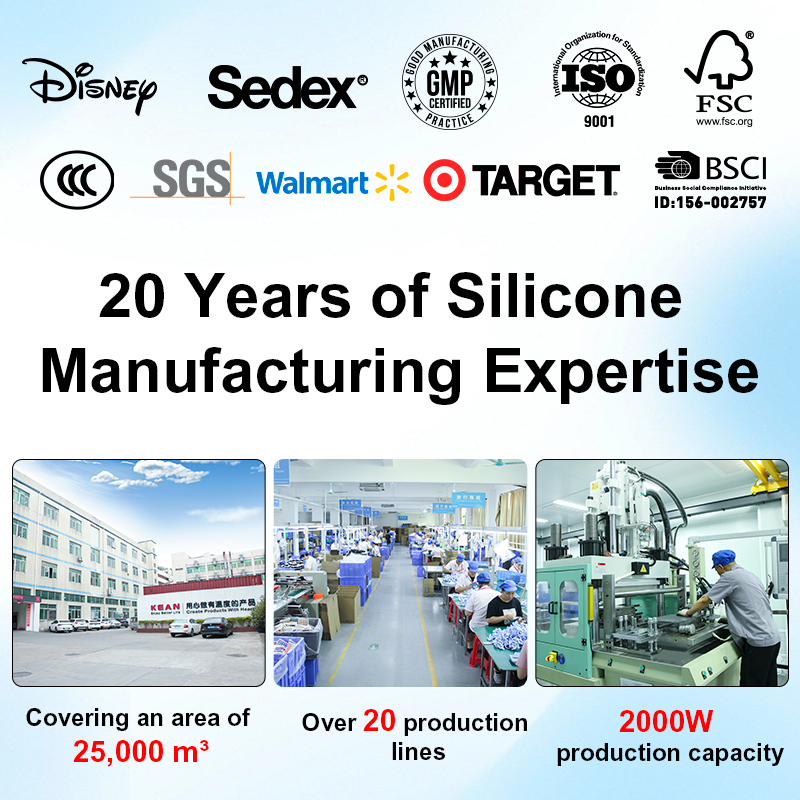
Founded | 2006 |
Facility size | 25,000 m² |
Cleanroom | Class 1,000,000) |
Production lines | 20+ dedicated lines |
Daily capacity | 2,400 pcs for spoon set |
R&D team | 15 engineers, in-house |
Patents held | 376+, including utility and design patents |
Quality inspectors | 19 full-time QC |
Brands served | 20+ top EU/US baby & kitchen brands |
Ontime delivery rate | 100% |
Our Certifications
We hold certifications for all major markets:
Certification | Applicable Market |
FDA 21 CFR 177.2600 | USA food contact materials |
LFGB | Germany / European food contact |
EN71 / CE | European toy safety |
GB 4806.11, GB 4806.7 | China food-grade silicone |
ISO 9001 | International quality management |
BSCI, Sedex, GMP | Social compliance and manufacturing standards |
REACH, RoHS | EU chemical compliance |
Our Customization Capabilities
Customization Type | Options | MOQ |
Color | Any Pantone color, mixed directly into silicone (no paint) | 1000 pcs per color |
Logo | Embossing, debossing, silk screen, heat transfer | 1000 pcs |
Packaging | Custom color box, hang tags, insert cards, polybags | 2000 pcs |
Mold/design | New product development, existing mold modification | Negotiable |
Material hardness | 20–80 Shore A | No additional MOQ |
Our Quality Assurance Process
Every product goes through six inspection points:
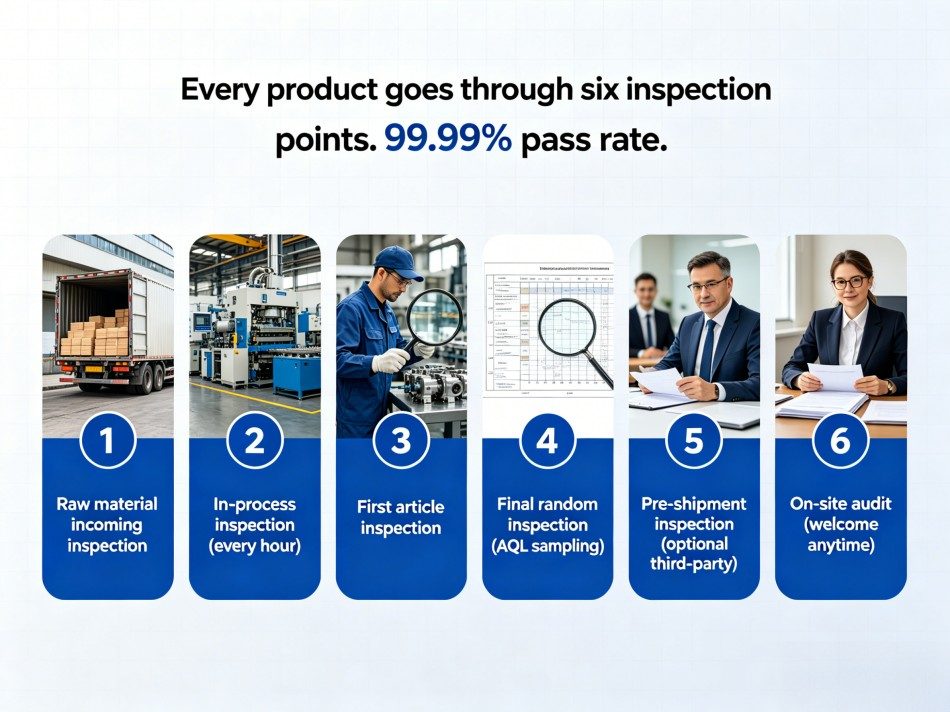
Raw material incoming inspection – Certificates verified, batch tested
In-process inspection – Every hour, dimensional and visual checks
First article inspection – Before production release
Final random inspection – AQL sampling before packaging (AQL levels based on defect classification)
Pre-shipment inspection – Optional third-party (SGS, TÜV, Intertek)
On-site audit – We welcome customer audits anytime
Our promise: 99.99% pass rate. Non-conforming products are replaced or refunded.
Our Product Categories
We specialize in:
Baby & toddler – Teethers, feeding spoons/forks, sippy cups, pacifiers, training utensils
Pet – Chew toys, lick mats, treat-dispensing toys, bowls
Kitchen & home – Spatulas, baking mats, food storage bags, ice cube trays
Travel & outdoor – Refillable bottles, collapsible containers
Industrial – Seals, gaskets, custom-molded parts
Why Our Clients Stay With Us
“We’ve sourced from [Your Company Name] for three years. The quality is consistent, the team is responsive, and they actually understand our market’s certification requirements. No surprises.”
— [Client name, title, brand (with permission)]
Our advantage:
In-house everything – Mold design, tooling, production, assembly, packaging – no subcontracting
Vertically integrated operations – From raw silicone compounding to finished product
Patent protection – We design original products; your branded version inherits legal protection
Order combining – Mix different products (baby + pet + kitchen) in one shipment to save freight
Low MOQ to test – Start with 1,000 pcs neutral packaging, scale up as you grow
Fast sampling – Stock samples: 5–7 days; custom color samples: 7–10 days
How to Start with Us
Step | Action |
1. Inquiry | Send product idea, target market, estimated volume |
2. Sample | We produce sample (stock or custom) for your approval |
3. Quote | Detailed quote including mold, sample, and per-unit cost |
4. Order | Deposit, production scheduling |
5. Production | Real-time updates, photos, video |
6. Inspection | Your choice: our QC or third-party (SGS, TÜV, Intertek) |
7. Shipment | Combined orders, best freight options |
Contact Information
Ready to add KEAN Silicone to your partner line?
Request a sample, download spec sheet, or contact our wholesale team today.
Contact Wholesale Team →Conclusion: The Right Partner Makes All the Difference
Choosing a silicone products manufacturer is not just about finding the lowest price. It is about finding a partner who:
Understands your target market’s certification requirements – from FDA and LFGB to the new MERCOSUR Resolution for South American markets
Has the technical capability to execute your design, including in-house R&D and vertically integrated operations
Communicates clearly and meets deadlines – with documented on-time delivery rates
Stands behind their quality with real guarantees, including batch traceability and AQL-based inspection protocols
Use this guide as your checklist. Take the time to define your needs, screen thoroughly, verify credentials, test samples across multiple lots, audit facilities, and formalize agreements.
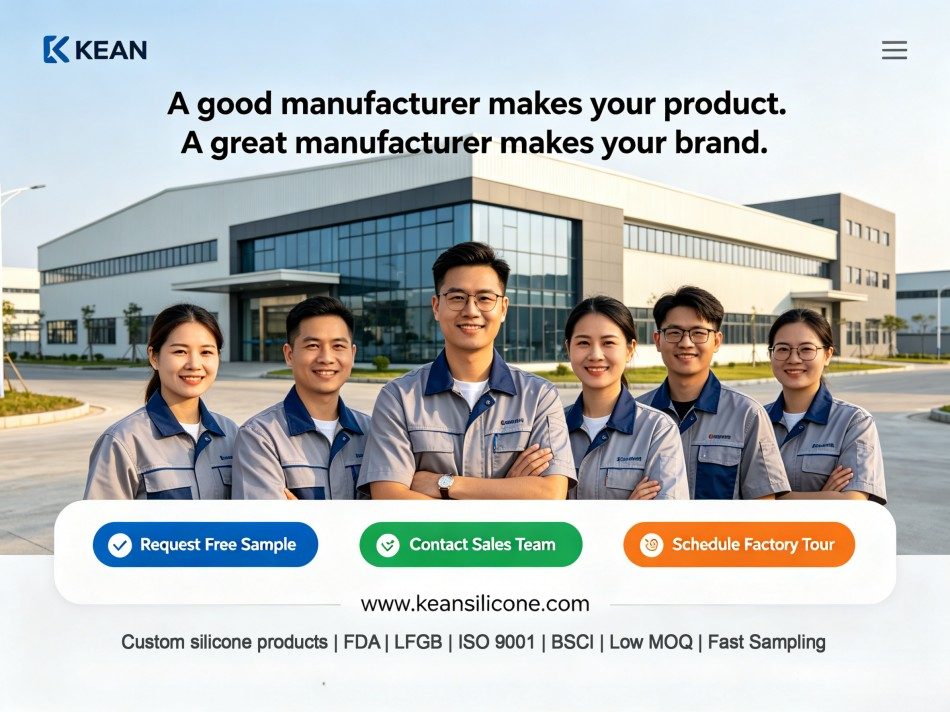
A good manufacturer makes your product. A great manufacturer makes your brand.
Manufacturer Evaluation Scorecard
Criteria | Weight | Score (1-5) |
Certifications match target market | 20% | |
Sample quality (test across multiple lots) | 20% | |
Communication responsiveness | 15% | |
Customization capability | 15% | |
Factory cleanliness & organization | 10% | |
Production capacity & vertical integration | 10% | |
Price competitiveness (TCO approach) | 5% | |
Payment terms flexibility | 5% | |
Total | 100% |
Action: Below 70% – proceed with caution. Below 60% – look elsewhere.


